Sirikorn Amaritwarin, Ph.D.
Program of philosophy and ethics, Graduate School,
Suan Sunandha Rajabhat University, Thailand
Abstract
This paper advances a philosophical and dialogical framework for understanding family as the foundational site of peace, particularly in the context of generational relationships. Drawing on the dialogical philosophy of David Bohm and Martin Buber, alongside Chinese philosophical traditions including Confucianism, Daoism, and Mohism, the study reconceptualizes family peace as a dynamic, relational process rather than a static condition. Generational conflict is reframed as a form of philosophical tension arising from differences in ontological orientations, epistemological frameworks, and ethical expectations. Through this lens, dialogue emerges as a transformative practice that enables the integration of these tensions into relational coherence. The paper develops a multi-layered model of dialogical practice—encompassing inner awareness, interpersonal engagement, and collective meaning-making—and situates it within a broader ecology of peace. The findings suggest that cultivating dialogical capacities within families can contribute not only to intergenerational harmony but also to wider social cohesion. By integrating Western and Eastern philosophical perspectives, this study offers a cross-cultural paradigm for peacebuilding rooted in everyday relational life.
Keywords: Dialogical philosophy; Family peace; Generational conflict; Bohmian dialogue
Introduction: Family as the Root of Peace
Peace is often conceptualized at the level of nations, institutions, and global systems. However, such macro-level understandings risk overlooking the primary site where human relationships are first formed and continuously shaped—the family. Within this intimate sphere, individuals encounter difference, negotiate identity, and develop patterns of communication that often persist throughout their lives. Consequently, the family can be understood not merely as a social unit but as a foundational microcosm of peace or conflict.
From a dialogical perspective, the quality of peace in society is deeply rooted in the quality of relationships within families. Martin Buber (1970) argues that human existence is fundamentally relational, structured through encounters that are either authentic (I–Thou) or instrumental (I–It). In family contexts, these modes manifest in everyday interactions: when members truly listen and respond to one another as whole persons, a space of mutual recognition emerges; when they reduce one another to roles, expectations, or stereotypes, relational distance and misunderstanding arise.
Similarly, David Bohm (1996) emphasizes that dialogue is not merely an exchange of information but a shared process of meaning-making. Within families, this process is particularly significant because generational differences—shaped by distinct historical, cultural, and technological contexts—often lead to divergent worldviews. Without dialogical engagement, these differences can harden into conflict, silence, or emotional fragmentation. However, when approached through dialogue, they become opportunities for collective learning and transformation.
Chinese philosophical traditions further deepen this understanding by situating family harmony at the core of social order. Confucian thought, for instance, posits that the cultivation of the self (xiushen), the regulation of the family (qijia), and the governance of the state (zhiguo) are intrinsically linked stages of moral development (Ebrey, 2010). The family is thus not only a private domain but also a moral and political foundation, where virtues such as ren (humaneness), li (ritual propriety), and xiao (filial relationality) are cultivated through lived interaction.
Importantly, these Confucian values are inherently dialogical rather than authoritarian when interpreted in their philosophical depth. While traditional readings of xiao (filial piety) emphasize obedience, contemporary scholarship highlights its reciprocal dimension—a dynamic relationship of care, respect, and moral responsiveness between generations (Yao, 2000). This reinterpretation aligns closely with Buber’s notion of mutuality and Bohm’s emphasis on participatory understanding.
In addition, the Yin–Yang cosmology offers a powerful metaphor for understanding generational relationships. Rather than framing differences between elders and youth as oppositional, Yin–Yang conceptualizes them as complementary and interdependent forces, each containing the seed of the other (Mou, 2009). Elders embody experience, continuity, and reflection, while younger generations represent change, creativity, and future orientation. Peace emerges not through dominance or uniformity but through the dynamic balancing of these forces, sustained by ongoing “dialogue” at both symbolic and practical levels.
Daoist philosophy further contributes by emphasizing wu wei (non-coercive action) and alignment with the natural flow of life. Applied to family relationships, this suggests that peace cannot be imposed through rigid control or forced agreement. Instead, it arises through attentive presence, patience, and the willingness to allow understanding to unfold organically (Laozi, 2008). Such an approach resonates strongly with Bohmian dialogue, where meaning is not predetermined but emerges through collective participation.
In contemporary contexts, the urgency of cultivating family-based peace is intensified by rapid social change. Digital technology, globalization, and shifting cultural norms have widened generational gaps, often disrupting traditional channels of communication. Younger generations may prioritize autonomy and self-expression, while older generations may emphasize stability and continuity. These differences, if left unaddressed, can lead to misalignment of expectations, emotional disconnection, and intergenerational tension.
Therefore, rethinking peace through the lens of the family requires a shift from control to communication, from hierarchy to relationship, and from static norms to dynamic dialogue. Dialogue becomes not merely a method but an ethical practice and a way of being, enabling family members to encounter one another with openness, humility, and respect.
In this sense, family peace is not the absence of conflict but the presence of ongoing, meaningful dialogue that transforms difference into understanding. It is within this dialogical space that individuals learn to listen, to empathize, and to co-create shared meaning—capacities that ultimately extend beyond the family to shape broader social harmony.
Dialogue as Relational Ontology
1. Dialogue Beyond Communication: Ontological and Epistemological Foundations
Dialogue, in its philosophical depth, must be distinguished from ordinary conversation or debate. While communication often aims at information exchange, persuasion, or problem-solving, dialogue—as articulated by Martin Buber and David Bohm—constitutes a fundamentally different mode of human engagement. It is not merely a technique but an ontological condition of being-in-relation and an epistemological process of co-creating meaning (Bohm, 1996; Buber, 1970).
From an ontological perspective, Buber posits that human existence unfolds through relational modalities: I–Thou and I–It. The I–Thou relation is characterized by immediacy, presence, and mutual recognition, whereas the I–It relation reduces the other to an object of use, classification, or control (Buber, 1970). In family contexts, this distinction is critical. When family members interact primarily through roles—such as “authority figure,” “obedient child,” or “provider”—they risk falling into I–It patterns that inhibit authentic connection. By contrast, dialogical engagement reconstitutes the family as a space of living relationships, where each member is encountered as a subject with intrinsic value.
Epistemologically, Bohm extends this relational ontology by proposing that thought itself is a collective and participatory process. Dialogue enables participants to become aware of the tacit assumptions, cultural conditioning, and fragmented thinking that shape their perceptions (Bohm, 1996). Rather than defending fixed positions, individuals engage in a shared inquiry where meaning emerges dynamically. This is particularly significant in intergenerational settings, where divergent life experiences often produce incompatible interpretive frameworks. Dialogue thus becomes a medium for bridging epistemic divides and cultivating what may be termed “relational knowing.”
2. Suspension, Listening, and the Ethics of Participation
A central principle in Bohmian dialogue is the suspension of assumptions, which does not imply their elimination but their conscious holding in awareness. This suspension creates a reflective space in which participants can observe their own thought processes without immediate reaction (Bohm, 1996). In family dynamics, this practice is transformative. It interrupts habitual patterns of blame, defensiveness, and projection, allowing members to engage one another with greater openness.
Closely related is the practice of deep listening, which extends beyond auditory reception to include attentiveness to emotional tone, intention, and unspoken meanings. Deep listening aligns with Buber’s notion of presence, where one “turns toward” the other in their entirety (Buber, 1970). Within families, such listening fosters psychological safety and enables the expression of vulnerability—an essential condition for trust.
These practices also carry an ethical dimension. Dialogue requires participants to adopt an attitude of non-domination and mutual respect, recognizing that no single perspective can claim absolute authority. This resonates strongly with Confucian ethics, particularly the concept of ren (humaneness), which emphasizes empathetic understanding and relational sensitivity (Cua, 2003). Thus, dialogue can be understood as an ethical practice of participation, where each voice is both expressed and transformed through interaction.
3. Chinese Philosophical Parallels: Relational Ontology and Harmony
Chinese philosophical traditions provide a rich conceptual framework that complements and deepens dialogical ontology. Unlike many Western traditions that prioritize individual substance, Chinese thought emphasizes relational processes and dynamic balance.
The Yin–Yang cosmology exemplifies this orientation. Rather than positing static oppositions, Yin and Yang are understood as mutually arising and interdependent forces, continuously transforming into one another (Mou, 2009). This dynamic can be interpreted as a form of “cosmic dialogue,” where meaning and order emerge through interaction. Applied to family relationships, generational differences are not obstacles to be resolved but constitutive elements of relational harmony.
Similarly, Confucian philosophy conceptualizes the self not as an isolated entity but as a node within a network of relationships. Identity is formed and refined through interaction, particularly within the family (Ebrey, 2010). The practice of li (ritual propriety) can be seen as a structured form of dialogue, guiding behavior in ways that sustain harmony while allowing for contextual responsiveness. Importantly, li is not rigid formalism but a living practice of attunement, requiring sensitivity to the needs and emotions of others.
Daoist philosophy further enriches this perspective by emphasizing the fluidity and spontaneity of relational life. The concept of wu wei (non-coercive action) suggests that effective interaction arises not from forceful assertion but from alignment with the natural flow of circumstances (Laozi, 2008). In dialogical terms, this implies a mode of engagement that is responsive rather than controlling, allowing meaning to emerge organically.
4. Dialogue as Transformative Praxis in Family Contexts
When understood as relational ontology, dialogue becomes a transformative praxis within families. It reshapes not only communication patterns but also the underlying structures of perception, identity, and power.
First, dialogue reconfigures power relations. Traditional family hierarchies often privilege authority and obedience, potentially silencing certain voices. Dialogical engagement, however, introduces a principle of participatory equality, where each member’s perspective is valued. This does not negate the role of guidance or experience but situates it within a framework of mutual respect.
Second, dialogue facilitates identity transformation. Through sustained interaction, individuals come to see themselves not as fixed entities but as evolving participants in a shared relational field. This aligns with both Bohm’s notion of thought as process and the Confucian emphasis on self-cultivation as an ongoing endeavor.
Third, dialogue enables conflict transformation. Rather than viewing conflict as a problem to be eliminated, dialogical approaches treat it as a source of insight into underlying assumptions and unmet needs. In this sense, conflict becomes a productive tension, analogous to the Yin–Yang dynamic, capable of generating new forms of understanding.
5. Toward a Dialogical Model of Generational Peace
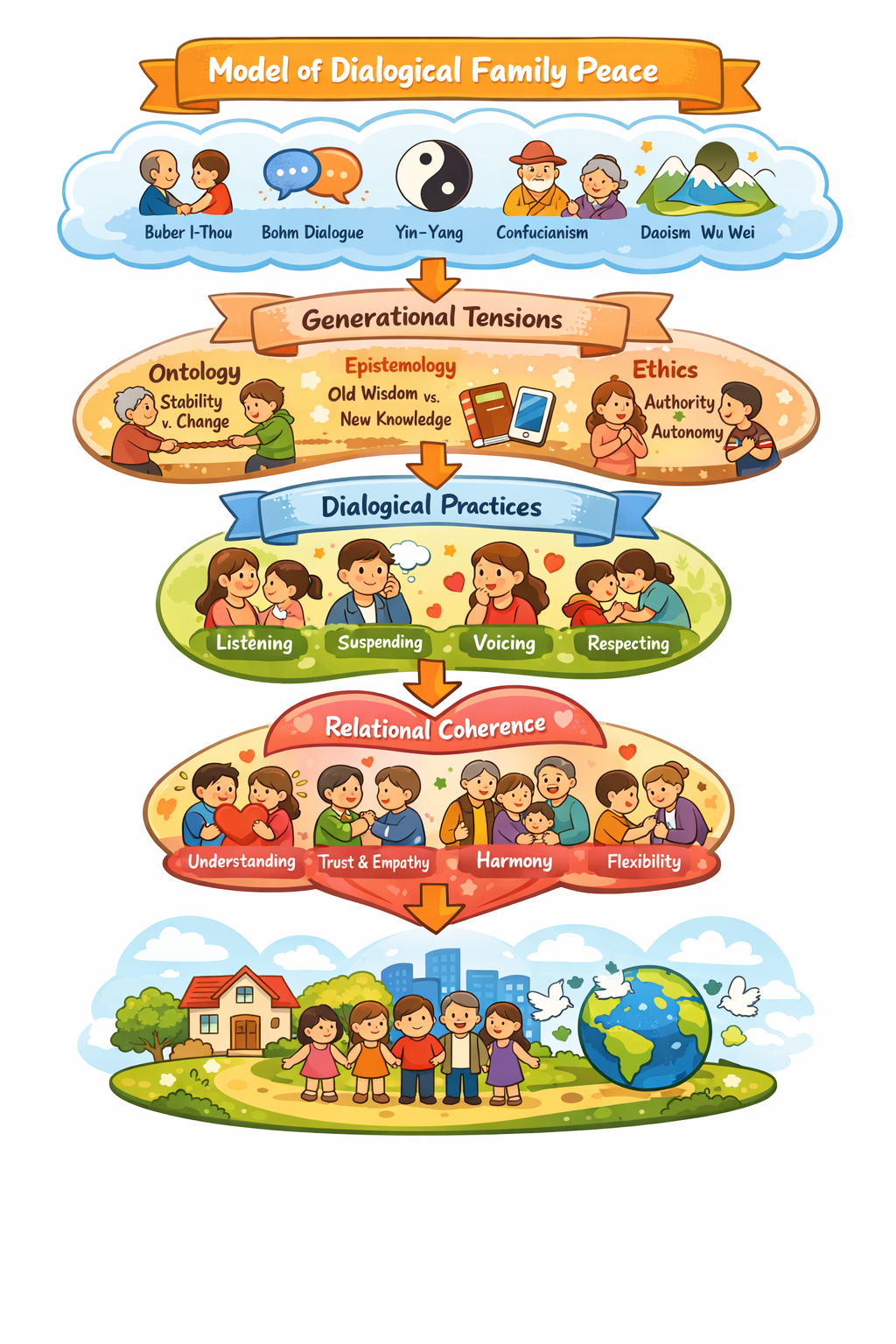
Integrating these perspectives, a dialogical model of family peace can be conceptualized as comprising three interrelated dimensions:
- Ontological Dimension – Recognition of the other as a subject (I–Thou), grounded in relational being (Buber, 1970).
- Epistemological Dimension – Co-creation of meaning through shared inquiry and suspension of assumptions (Bohm, 1996).
- Ethical-Cultural Dimension – Cultivation of harmony, empathy, and balance, informed by Chinese philosophical traditions (Cua, 2003; Mou, 2009).
Together, these dimensions form a holistic framework in which dialogue is not an isolated practice but a way of inhabiting relationships across generations.
By situating dialogue within a relational ontology, generational peace is not achieved through uniformity or control but through ongoing, participatory processes of understanding. Dialogue, in this sense, becomes both the means and the manifestation of peaceful family life.
Chinese Philosophical Foundations of Generational Harmony
1. Relational Cosmology: Yin–Yang and the Ontology of Complementarity
At the heart of Chinese philosophy lies a relational cosmology that conceives reality not as a collection of discrete substances but as a dynamic interplay of forces. The Yin–Yang framework provides a foundational model for understanding this ontology. Rather than representing fixed opposites, Yin and Yang are mutually constitutive, interdependent, and continuously transforming (Mou, 2009).
This cosmological principle offers a profound lens for interpreting intergenerational relationships within families. Generational differences—often framed in modern discourse as sources of conflict—can instead be understood as complementary modalities of existence:
- Elders embody continuity, reflection, and accumulated wisdom (Yin)
- Younger members represent change, creativity, and future orientation (Yang)
From this perspective, tension between generations is not inherently problematic but is a necessary condition for balance and vitality. Harmony (he, 和) does not imply uniformity but the dynamic coordination of difference. This resonates strongly with dialogical philosophy, where meaning emerges through interaction rather than consensus.
The extension of Yin–Yang into the Five Elements (Wu Xing) further enriches this relational model. The cycles of generation (sheng) and control (ke) illustrate how different forces both support and regulate one another, preventing excess and maintaining systemic balance (Mou, 2009). Applied to family systems, this suggests that generational influence is cyclical and reciprocal, and conflict can function as a regulative mechanism, restoring equilibrium
Thus, Chinese cosmology provides not only a metaphysical foundation but also a systemic model of dialogical interaction.
2. Confucianism: Ethical Relationality and Intergenerational Dialogue
Confucian philosophy offers one of the most comprehensive frameworks for understanding family as the core site of moral and social order. Central to this tradition are the concepts of ren (humaneness), li (ritual propriety), and xiao (filial relationality), which together articulate an ethics of relational attunement and responsibility (Cua, 2003).
Importantly, these concepts are not static norms but practices enacted through interaction. The family becomes a living space where ethical meaning is continuously negotiated and embodied. The Confucian ideal of xiao is often misinterpreted as hierarchical obedience; however, a more nuanced reading reveals it as a reciprocal and dialogical relationship. Parents are expected to act with benevolence and moral integrity, while children respond with respect and care, creating a mutually reinforcing ethical bond (Yao, 2000).
The Analects illustrate this dialogical dimension vividly. Confucius does not present doctrine in abstract form but engages in situated conversations with his disciples, adapting his responses to their specific contexts and capacities. This pedagogical style reflects a proto-dialogical method, where knowledge emerges through relational engagement rather than unilateral transmission (Cua, 2003).
Furthermore, Confucianism situates family harmony within a broader ethical-political continuum:
“Cultivate the self, regulate the family, govern the state, bring peace to the world”
(xiushen, qijia, zhiguo, ping tianxia) (Ebrey, 2010).
In this sequence, the family is not merely a private domain but a moral nexus through which social harmony is realized. Dialogical practices within families thus have implications that extend beyond the घरेलestic sphere to the fabric of society itself.
3. Daoism: Non-Coercive Harmony and the Art of Letting Be
While Confucianism emphasizes ethical structure and relational roles, Daoism introduces a complementary perspective grounded in spontaneity, naturalness, and non-coercion. The Dao (Way) is conceived as the underlying process of reality, which cannot be fully captured through language or rational analysis (Laozi, 2008).
The Daoist principle of wu wei (non-forcing) is particularly relevant for family dynamics. It suggests that effective action arises not from control or imposition but from attunement to the natural unfolding of situations. In intergenerational relationships, this translates into 1) avoiding rigid enforcement of authority; 2) allowing space for individual development; and 3) trusting the organic emergence of understanding.
This orientation aligns closely with Bohmian dialogue, where participants refrain from imposing conclusions and instead allow meaning to emerge through shared participation (Bohm, 1996).
Zhuangzi further develops this perspective by emphasizing the relativity of perspectives and the limitations of fixed judgments. His parables encourage a form of cognitive flexibility that is essential for dialogue, particularly in contexts of generational difference. By recognizing the partiality of one’s own viewpoint, individuals become more open to alternative perspectives, fostering epistemic humility and relational openness.
Thus, Daoism contributes a crucial dimension to generational harmony: the capacity to let go of control and embrace the fluidity of relational life.
4. Mohism: Impartial Care and the Ethics of Inclusion
Mohism offers a distinctive ethical framework centered on jian ai (impartial or universal care), which advocates for equal concern for all individuals regardless of social status or relational proximity (Mou, 2009). Although often contrasted with Confucianism’s emphasis on graded love, Mohist thought provides valuable insights for contemporary family dynamics.
In modern contexts, where hierarchical authority is increasingly questioned, Mohist principles support a more egalitarian form of dialogue within families. This includes:
- Valuing the voices of younger members
- Reducing authoritarian communication patterns
- Promoting fairness and mutual consideration
Moreover, Mohism’s opposition to aggressive conflict and emphasis on practical benefit align with dialogical aims of conflict reduction and cooperative problem-solving. By foregrounding inclusivity and shared welfare, Mohism reinforces the ethical foundation for participatory and non-exclusionary dialogue.
5. Synthesis: Toward a Chinese Dialogical Model of Family Harmony
When synthesized, these Chinese philosophical traditions reveal a multi-dimensional framework of generational harmony:
- Ontological Dimension (Yin–Yang, Wu Xing): Reality as dynamic, relational, and balanced
- Ethical Dimension (Confucianism): Harmony through cultivated relationships and moral responsibility
- Processual Dimension (Daoism): Non-coercive interaction and emergent understanding
- Inclusive Dimension (Mohism): Equality, impartial care, and shared participation
This integrated framework converges with dialogical philosophy in its emphasis on relational being over isolated individuality, process over static structure, and mutual transformation over unilateral control.
Thus, Chinese philosophy not only parallels but enriches dialogical theory, providing culturally grounded resources for cultivating family and generational peace.
By situating generational relationships within a relational cosmology, ethical practice, and non-coercive process, Chinese philosophical traditions offer a robust foundation for understanding family harmony as a dynamic, dialogical achievement. These insights deepen the theoretical basis for dialogue as a lived practice, capable of transforming generational difference into sustainable relational balance.
Generational Conflict as Philosophical Tension
1. Reframing Conflict: From Dysfunction to Philosophical Tension
Generational conflict within families is often interpreted in psychological or sociological terms—as miscommunication, developmental divergence, or value disagreement. While these perspectives are valuable, they may overlook a deeper dimension: conflict as an expression of underlying philosophical tensions embedded in human existence.
From a dialogical standpoint, conflict is not merely a breakdown of communication but a manifestation of differing horizons of meaning (Bohm, 1996). Each generation is shaped by distinct historical conditions, cultural narratives, and epistemic frameworks. These differences give rise to contrasting interpretations of key existential questions:
- What constitutes a good life?
- What is the role of the individual in society?
- How should authority and freedom be balanced?
Thus, generational conflict can be understood as a collision of lived philosophies, rather than simply incompatible preferences.
2. Tradition and Transformation: A Yin–Yang Dialectic
One of the most fundamental tensions in intergenerational relationships is that between tradition and change. Older generations often embody continuity, stability, and preservation of inherited values, while younger generations tend to emphasize innovation, autonomy, and adaptation to new realities.
Within Chinese philosophy, this tension can be interpreted through the Yin–Yang dynamic, where opposing forces are not mutually exclusive but interdependent and generative (Mou, 2009). Tradition (Yin) provides grounding and coherence, while transformation (Yang) introduces vitality and renewal. Conflict arises when either force becomes dominant: 1) excessive tradition is rigidity, resistance to change, and excessive transformation make fragmentation, loss of identity.
Dialogical engagement allows these forces to enter into constructive interplay, enabling families to maintain continuity while embracing necessary change. In this sense, generational conflict becomes a site of creative synthesis rather than division.
3. Authority and Autonomy: Confucian Ethics Revisited
Another central tension concerns the relationship between authority and autonomy. Confucian family structures traditionally emphasize hierarchical roles, where elders guide and younger members follow. However, modern contexts increasingly prioritize individual freedom and self-expression.
This tension is often mischaracterized as a simple opposition between “traditional obedience” and “modern independence.” A more nuanced reading of Confucian philosophy reveals that authority is ideally grounded in moral virtue and relational responsibility, not coercion (Cua, 2003). The concept of xiao (filial relationality) implies a reciprocal relationship, where elders must act with benevolence and wisdom, and younger members respond with respect and openness.
When this reciprocity breaks down—e.g., when authority becomes authoritarian or autonomy becomes dismissive—conflict intensifies. Dialogue offers a means of re-negotiating roles and expectations, transforming hierarchical tension into relational balance.
4. Epistemic Fragmentation and the Digital Divide
In contemporary families, generational conflict is increasingly shaped by epistemic fragmentation, particularly due to technological change. Digital environments have created distinct “worlds of experience”: Older generations may rely on tradition, lived experience, and linear narratives, and younger generations navigate fluid, networked, and rapidly evolving information systems.
This divergence produces not only different opinions but fundamentally different ways of knowing. Bohm (1996) describes such fragmentation as a condition where thought becomes disconnected from its own processes, leading to misunderstanding and defensive communication.
From a Daoist perspective, this can be seen as a loss of alignment with the flow of relational understanding. When individuals become rigidly attached to their own perspectives, they lose the capacity for wu wei—responsive, non-coercive engagement (Laozi, 2008).
Dialogical practice addresses this by encouraging awareness of one’s own assumptions, creating space for multiple epistemologies, enabling the emergence of shared meaning across differences.
5. Emotional Undercurrents and the Ethics of Recognition
Beyond philosophical and epistemic differences, generational conflict is deeply shaped by emotional dynamics, including unmet expectations, unexpressed needs, and historical grievances. These emotional undercurrents often remain implicit, surfacing indirectly through criticism, withdrawal, or conflict escalation.
Buber’s concept of I–Thou highlights the importance of recognition and presence in addressing such dynamics (Buber, 1970). When individuals feel unseen or reduced to roles, they are more likely to respond defensively. Conversely, when they are encountered as whole persons, emotional barriers begin to dissolve.
Confucian ren (humaneness) similarly emphasizes empathetic attunement, requiring individuals to perceive and respond to the emotional states of others (Cua, 2003). This ethical sensitivity is essential for transforming conflict into relational understanding.
6. Conflict as Generative Potential: Toward Transformative Dialogue
Rather than viewing generational conflict as a problem to be eliminated, a dialogical-philosophical approach reframes it as a source of generative potential. Conflict reveals hidden assumptions, divergent values, and unarticulated needs.
When engaged dialogically, these elements can lead to deeper self-awareness, expanded perspectives, and stronger relational bonds.
This aligns with the Yin–Yang principle, where tension is not destructive but constitutive of balance. It also reflects Bohm’s view that dialogue can transform fragmented thought into coherent collective understanding (Bohm, 1996).
7. Toward a Philosophical Model of Generational Conflict
Synthesizing the above, generational conflict can be conceptualized across three interrelated dimensions:
- Ontological Tension – Differences in modes of being (tradition vs change; stability vs fluidity)
- Epistemological Tension – Differences in ways of knowing (experience vs digital knowledge; linear vs networked thinking)
- Ethical-Relational Tension – Differences in expectations of roles, authority, and care
Dialogue functions as the mediating process that allows these tensions to be articulated rather than suppressed, explored rather than judged, and integrated rather than polarized.
Generational conflict, when understood as philosophical tension, reveals the depth and complexity of family relationships. Rather than signaling failure, it points to the presence of diverse perspectives that, when engaged through dialogue, can become sources of mutual transformation and enduring harmony. In this way, conflict is not the opposite of peace but a pathway toward it, when navigated through dialogical awareness.
Dialogical Practices for Family Peace
1. From Theory to Praxis: Dialogue as a Cultivated Practice
While philosophical frameworks—such as Bohmian dialogue, Buber’s I–Thou relation, and Chinese relational ethics—offer conceptual foundations for understanding family harmony, their transformative potential lies in practice. Dialogue, in this sense, is not merely conversation but a disciplined, ethical, and relational practice that must be cultivated over time (Bohm, 1996; Buber, 1970).
In family contexts, dialogical practice involves intentional presence rather than habitual reaction, mutual recognition rather than role-based interaction, and shared inquiry rather than persuasive argument.
Thus, dialogue becomes a mode of being-with-others, aligning with Confucian ren (humaneness) and Daoist wu wei (non-coercive action), where harmony emerges through attuned participation rather than control.
2. Core Dialogical Capacities: Listening, Suspending, Voicing, and Respecting
Drawing from Bohm (1996), effective dialogue is grounded in four interrelated capacities:
(1) Deep Listening (Listening as Ethical Presence); Listening in dialogue is not passive reception but active, empathetic engagement. It requires suspending internal judgment, attending to both verbal and emotional content, and recognizing the other as a subject, not an object. This resonates with Buber’s I–Thou relation, where the other is encountered in their full presence, not reduced to a function or category (Buber, 1970).
(2) Suspension (Holding Assumptions Lightly); Participants are encouraged to “suspend” their assumptions, meaning not to suppress them but to hold them in awareness without immediate defense. This creates a reflective space where hidden biases become visible, and new meanings can emerge. This practice parallels Daoist epistemic humility, acknowledging the limits of fixed knowledge (Laozi, 2008).
(3) Authentic Voicing (Speaking from Lived Experience); Dialogue requires participants to speak honestly and reflectively, expressing personal experiences, underlying values, and emotional realities. In Confucian terms, this reflects sincerity (cheng), a key virtue in ethical communication (Cua, 2003).
(4) Respect (Sustaining Relational Space); Respect is not mere politeness but the active maintenance of relational dignity, even amidst disagreement. It ensures that dialogue remains non-coercive, non-hierarchical in expression, and open to transformation. Together, these capacities form the micro-foundations of dialogical practice.
3. Structured Practices for Family Dialogue
To translate these capacities into lived experience, families can adopt structured dialogical practices that create safe and generative spaces for interaction.
(1) The Family Dialogue Circle; Inspired by Bohmian dialogue, the family sits in a circle without hierarchical positioning. Key features include no interruption or immediate rebuttal, equal opportunity to speak, and focus on understanding rather than resolving. This format reduces power asymmetry and fosters collective meaning-making.
(2) Reflective Turn-Taking; Each participant speaks in turn, followed by others reflecting back what they heard before responding. This ensures accurate understanding, emotional validation, and reduced reactive escalation.
(3) Generational Storytelling; Family members share life experiences across generations; elders transmit wisdom and historical memory, and younger members articulate contemporary challenges. This practice bridges the temporal gap between generations, aligning with Confucian continuity and Daoist flow.
(4) Silent Co-Presence and Mindfulness; Periods of shared silence or mindful breathing can regulate emotional intensity, cultivate awareness of internal states, and enhance receptivity to others. This reflects Daoist wu wei and Buddhist mindfulness traditions, emphasizing non-reactive awareness.
4. Dialogical Ethics: Power, Vulnerability, and Inclusion
Effective family dialogue must address underlying power dynamics and ensure inclusivity. Without this, dialogue risks reproducing existing hierarchies.
(1) Power Sensitivity; Families must recognize age-based authority, gender roles, and socio-cultural expectations. Dialogical practice seeks not to eliminate these structures but to render them transparent and negotiable.
(2) Vulnerability as Strength; Dialogue requires participants to express uncertainty, emotion, and personal struggle. This vulnerability: Humanizes interaction, builds trust, and enables deeper connection. Buber’s I–Thou relation emerges most fully in such moments of authentic exposure (Buber, 1970).
(3) Inclusion of Marginal Voices; Younger members, often marginalized in traditional structures, must be actively included. This aligns with Mohist jian ai (impartial care), promote equal consideration, shared participation, and ethical inclusivity (Mou, 2009)
5. Dialogical Transformation: From Fragmentation to Coherence
The ultimate aim of dialogical practice is not agreement but transformation of relational consciousness. Bohm (1996) describes this as a movement from fragmentation to coherence, where individuals become aware of their own thought processes, collective meaning begins to emerge, and conflict is integrated rather than suppressed
In family contexts, this transformation manifests as increased empathy and mutual understanding, greater flexibility in roles and expectations, and strengthened emotional bonds.
From a Chinese philosophical perspective, this corresponds to the realization of he (harmony), not as uniformity but as dynamic balance.
6. Toward a Model of Dialogical Family Practice
Integrating the above, dialogical practice for family peace can be conceptualized as a three-layered model:
(1) Inner Practice (Self-Awareness) address the mindfulness, reflection on assumptions, and emotional regulation.
(2) Interpersonal Practice (Relational Engagement) address deep listening, authentic expression, and mutual respect.
(3) Collective Practice (Shared Space) address the dialogue circles, storytelling, and co-creation of meaning.
These layers interact dynamically, forming a living system of relational cultivation.
Dialogical practices transform the family from a site of habitual interaction into a space of conscious relational cultivation. By integrating philosophical insight with practical methods, families can navigate generational differences not as obstacles but as opportunities for shared growth and enduring peace. In this way, dialogue becomes not only a method of communication but a way of life—one that embodies harmony through ongoing participation, reflection, and care.
Discussion and Implications
1. Reframing Family Peace: From Private Harmony to Relational Praxis
This study has argued that family peace is not merely the absence of conflict but a dynamic, dialogically sustained condition of relational coherence. By integrating Bohmian dialogue, Buber’s relational ontology, and Chinese philosophical traditions, family interaction can be reconceptualized as a site of ongoing philosophical practice.
The implications of this reframing are significant. First, it challenges the conventional separation between the “private” domain of the family and the “public” domain of social order. In line with the Confucian sequence—xiushen, qijia, zhiguo, ping tianxia—family becomes the micro-foundation of societal harmony (Ebrey, 2010). Dialogical practices cultivated within families thus contribute to broader patterns of social trust, ethical responsibility, and conflict transformation.
Second, this reframing positions dialogue not as a communication technique but as a mode of relational being, requiring sustained cultivation rather than episodic intervention.
2. Theoretical Contributions: Toward an Integrative Dialogical Framework
This research contributes to the literature by advancing an integrative framework that bridges Western dialogical philosophy and Eastern relational thought. Three key theoretical contributions emerge:
(1) Dialogue as Ontological Process; Drawing from both Bohm and Yin–Yang cosmology, dialogue is conceptualized as a process of becoming, rather than a tool for information exchange. This shifts the focus from outcomes (agreement, resolution) to processual transformation.
(2) Relational Ethics Beyond Individualism; By incorporating Confucian ren and Mohist jian ai, the study expands dialogical ethics beyond individual autonomy to include relational responsibility and inclusivity. This is particularly relevant in non-Western contexts, where personhood is often understood relationally.
(3) Non-Coercive Praxis and Emergence; Daoist wu wei enriches dialogical theory by emphasizing non-forcing and emergence, offering an alternative to interventionist or control-oriented models of conflict resolution. Together, these contributions form a cross-cultural dialogical paradigm capable of addressing the complexities of contemporary family life.
3. Practical Implications: Applications in Family, Education, and Community
The findings have direct implications across multiple domains:
(1) Family Systems and Parenting Practices; Families can adopt dialogical practices to reduce intergenerational misunderstanding, foster emotional intelligence and empathy, and create inclusive spaces for all voices. Parenting shifts from directive control to facilitated co-learning, where both parents and children participate in mutual development.
(2) Educational Contexts; Schools can integrate dialogical principles into curricula by encouraging reflective discussion, promoting intergenerational learning projects, and cultivating critical and empathetic thinking. This aligns with Inner Development Goals (IDGs), particularly in the domains of Relating, Thinking, and Being, which emphasize self-awareness and collaborative capacity.
(3) Community and Social Cohesion; At the community level, dialogical family practices can strengthen social resilience, reduce polarization, and foster cultures of listening and mutual respect. The family thus becomes a nodal point in a wider ecology of peacebuilding.
4. Generational Implications: Bridging Temporal Worlds
One of the most pressing challenges in contemporary societies is the widening gap between generations, exacerbated by rapid technological and cultural change. This study suggests that dialogical practice can function as a bridge across temporal horizons.
Rather than attempting to eliminate differences, dialogue enables recognition of generational uniqueness, integration of past wisdom with future innovation, and co-creation of shared meaning. In this sense, generational diversity becomes a resource rather than a liability, contributing to the adaptive capacity of families and societies.
5. Toward a Dialogical Ecology of Peace
Building on the above, this study proposes the concept of a dialogical ecology of peace, where harmony emerges through interconnected layers of relational practice:
- Intrapersonal: self-awareness and reflective capacity
- Interpersonal: dialogical engagement within families
- Societal: collective norms of communication and coexistence
These layers are mutually reinforcing. Transformation at the family level contributes to broader societal change, while supportive social structures enable deeper family dialogue.
This ecological perspective aligns with both Bohm’s vision of collective coherence and Chinese cosmological notions of interconnected harmony.
Conclusion
This study advances the argument that family peace is a foundational and generative form of global peace. Family peace is not a static condition but a dynamic achievement, realized through ongoing dialogical practice. By engaging generational conflict as philosophical tension and integrating diverse traditions of thought, this paper is cultivating relational awareness through dialogue, families can transform fragmentation into coherence.
The integration of Western and Chinese philosophical traditions demonstrates that dialogue is not merely a communicative act but a civilizational resource—a way of living that sustains harmony across difference, time, and context. In this sense, the family becomes not only a social unit but a philosophical space, where peace is cultivated through relational awareness, ethical engagement, and shared meaning-making.
References
Bohm, D. (1996). On dialogue. Routledge.
Buber, M. (1970). I and thou (W. Kaufmann, Trans.). Scribner. (Original work published 1923)
Cua, A. S. (2003). Ethics. In A. S. Cua (Ed.), Encyclopedia of Chinese philosophy (pp. 249–254). Routledge.
Ebrey, P. B. (2010). The Cambridge illustrated history of China (2nd ed.). Cambridge University Press.
Laozi. (2008). Dao de jing (D. C. Lau, Trans.). Penguin Classics.
Mou, B. (2009). Chinese philosophy A–Z. Edinburgh University Press.
Yao, X. (2000). An introduction to Confucianism. Cambridge University Press.
 ปรัชญาสวนสุนันทา
Leave a comment