Phramaha Suriya Sumeto (Doungtili), Harimtepathip, M., Bunchua, K. (2018). The Tenfold Virtue of the King : An Analytical Study. In Proceeding of National Research Presentation Graduate School Conference 2018, Suan Sunandha Rajabhat University 2018 (pp. 39-42). Bangkok: Suan Sunandha Rajabhat University.
Abstract
This research was a philosophical study which aimed to analyze the tenfold virtue of the king in order to answer whether the tenfold virtue can be interpreted as an ethical principle of the moderate postmodernism. The findings of the research found that there are people who argued that the tenfold virtue cannot be interpreted as an ethical principle of the moderate postmodernism because the tenfold virtue is often viewed as being divided into separate unrelated principles and each of these principles serve as the indicators of good behavior of the kings. The research proposes a different argument by pointing out that the opponent’s view which treats the tenfold virtue as consisting of different principles or Dhamma is not right. In fact, the tenfold virtue cannot be viewed as consisting of different unrelated principles. In the point of view of the researcher, the reason that the tenfold virtue is often seen as being divided into different principles is to analyze the details of each principle of the virtue, not to separate it into different principle. Therefore, the researcher argues that the tenfold virtue can be interpreted as ethical principles in the moderate postmodernism because each of the ten principles or Dhamma of the tenfold virtue is connected to each other therefore they can be seen as one principle. This means that whenever these ten principles are well balanced and combined in the behavior of a person, that person is known as having the tenfold virtue. Viewing ethics as being holistic, not being separated, is the way used to interpret the ten virtue as an ethical principle according to the moderate postmodernism.
Keywords: Tenfold Virtues of the King, Analytical Study
Introduction
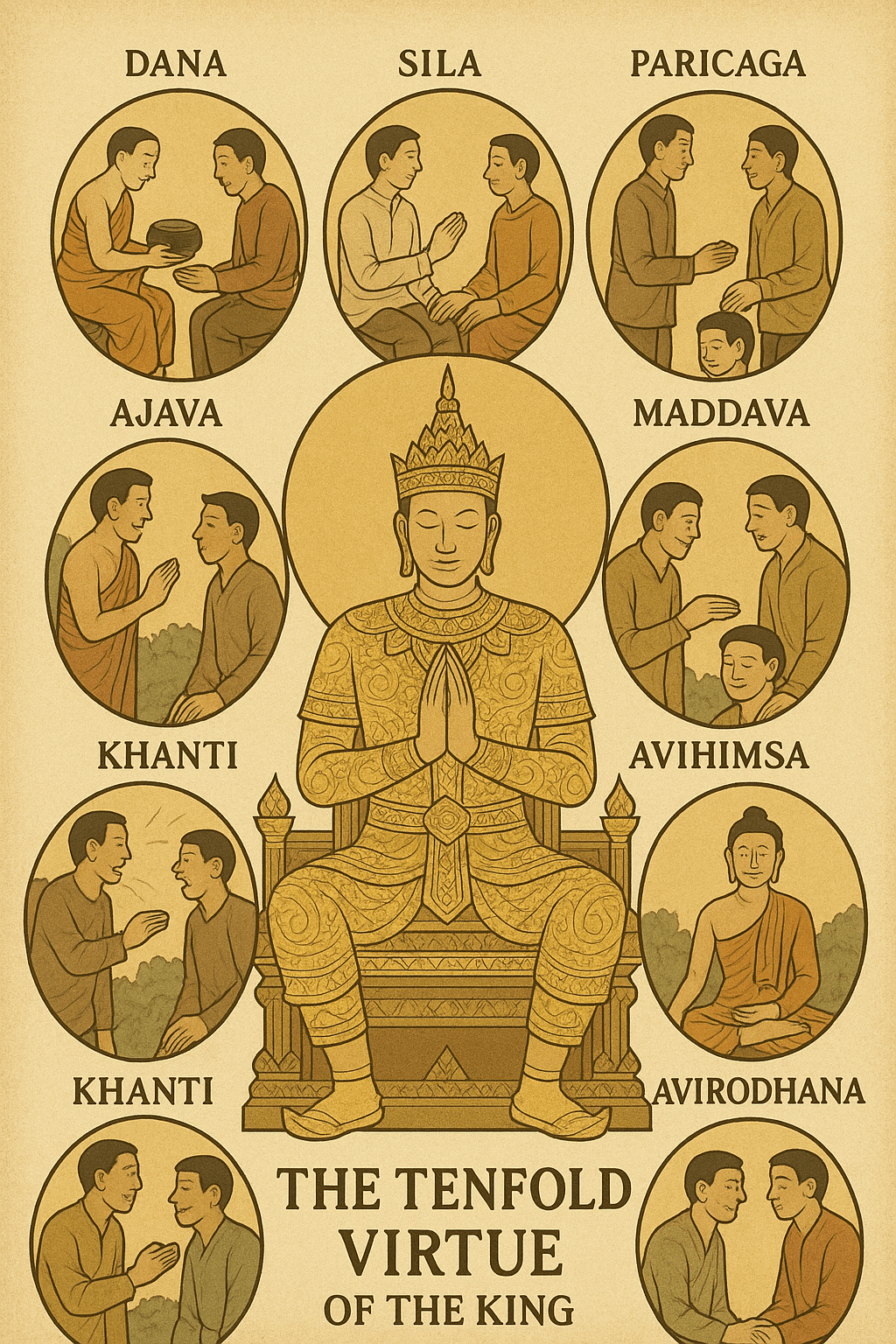
The tenfold virtue is the principles or Dhamma for the leaders and the rulers of any states. It consists of 10 principles which are Dana, Sila, Paricaga, Ajava, Maddava, Tapa, Akkodha, Avihimsa, Khanti, and Avirodhana (The Royal Society, 1992) If the tenfold virtue is viewed in the point of view of modernism, it will only serve as the indicators of good conduct. This means that it can be studied by using statistics such as percentage, mean, standard deviation, t-test, F-test or One-way ANOVA. In other words, with this point of view, the tenfold virtue can be evaluated and assessed with quantitative research approach which is consistent with the positivist paradigm. (Setho, 2010). However, the researcher has a different view by arguing that the tenfold virtue cannot be used as the indicators that can be assessed and evaluated in terms of statistics. The right way to study and interpret the tenfold virtue is to interpret it as an ethical principle of the moderate postmodernism. This view seems to bring about an argument from those who has the view of modernism. Therefore, this research was conducted to prove and provide a confirmation that the tenfold virtue can absolutely be interpreted as an ethical principle of the moderate postmodernism.
Objective of the study
This research aimed to analyze the tenfold virtue of the king.
The scope of the research
This research is conducted by following the philosophical research approach by studying from Phra Sutta Pitaka and other documents and research related to the tenfold virtue, modernism, and moderate postmodernism.
Literature Review
1.The tenfold virtue is Dhamma or the ten guiding principles for a king or a ruler. The ruler of any state has to practice these principles strictly and use them as personal habits. These principles are not only for the king, but also serve as the principles for other rulers such as the government of the country or the leader of the organization. These ten Guiding Principles for a King comprise dana, sila, paricaga, ajava, maddava, tapa, akkodha, avihimsa, khanti and avirodhana.
2.Modernism is a philosophy that argues that the reality is single and that reality is a scientific reality. This philosophy believes that only scientific method can be used to discover reality. People who believe in modernism believe in the scientific process and the use of statistics in bringing about true knowledge. The example of the studies following modernism is the study of Isaac Newton, known as the Cartesian project, which is considered to be the pioneer in reductionism (Omnès, 2002).
3.Moderate postmodernism is a philosophy that argues that reality is multiple and individual truth cannot access the whole reality because each person knows only one part of the reality. Therefore, the principle of moderate postmodernism focuses on not being attached to one thing or “reread all, reject non” (Harimtepathip, 2015).
Research methodology
This research was conducted by following the process below:
- Studying from related documents such as Phra Sutta Pitaka and research related to the tenfold virtue, modernism, and moderate postmodernism.
- Analyzing the information from the documents and organize it.
- Synthesizing the organized information by using the philosophical research approaches including dialectic and discursive.
Research findings
The tenfold virtue of the king consists of ten principles or Dhamma which are as follows:
- Dana or giving which means giving things that are necessary to other persons who deserve to receive them.
- Sila or morality which means maintaining good behaviors, physically and verbally abstaining from doing what should not be done.
- Paricaga or giving up which means donating or making selfless sacrifice for the greater good such as giving up personal benefits for the interest of the public.
- Ajava or straightness which refers to behaving honestly toward one’s self, one’s duties, and others and being honest in carrying out one’s work and duty.
- Maddava or gentleness which refers to being gentle, polite with the absence of arrogance and conceit. This means that one should speak gently and to act gently, not show roughness and rudeness.
- Tapa or perseverance which means diligence in performing the duties and
restraining the mind from indulging in sensual pleasure. - Akkodha or non-anger which means not showing anger, being compassionate based on good wishes, knowing how to accept and forgive others.
- Avihimsa or not causing injury which refers to not causing troubles for others, including all living things and adhering to peace and tranquility for all.
- Khanti or endurance or patience which means the capacity to endure hardship and to persevere against all emotions and abrasive words, being clam in body and speech.
- Avirodhana or not going wrong which refers to not doing what is known to be wrong and being steadfast in righteousness.
Modernism or modern Philosophy focuses on reductionism or studying the reality from separate parts by using a scientific approach. This is consistent with David Bohm (2000, p. 178) who proposes that small parts or components of the reality can be separated and the study from these separated components are the basis to gain the whole meaning of the reality. This philosophy explains that the holistic view of the reality is a result of the interaction and relationship of separated components. Moderate postmodernism or moderate Postmodern Philosophy focuses on studying
the reality from a holistic view without looking at separate parts of it. This philosophy argues that the main principle of holism is an awareness that holism is the basis for creating knowledge in the present time and we should emphasize the meaning and value of holism.
Discussion of findings
1.The opponents argue that the tenfold virtue cannot be interpreted as an ethical philosophy of the moderate postmodernism because the tenfold virtue consists of clear separate components to be studied. Specifically, it consists of ten principles which has different meaning. These ten principles do not present the same thing therefore the study of the tenfold virtue requires the study on separate principles to avoid confusion. These ten principles should be used as the indicators for good human behavior. In other words, they should be used to evaluate and assess human behavior to check how that person behaves well at each principle. The result of the behavior at each separate principle can be combined to provide the whole meaning or the whole picture of that person’s behavior.
2.The research argues the opponents’ view by pointing out that the ten principles in the tenfold virtue cannot be looked separately because they are connected to and support each other. The opponents view the ten principles as being fragmented but the researcher views them as being reduced. Fragmentation has different meaning from reduction in that the first views each component separately as an individual component which is not a part of the original item and each component is not connected with each other whereas the latter looks each component as being connect to each other. Reduction is the right way to look at the tenfold virtue. Therefore, the researcher argues that the tenfold virtue can be interpreted as ethical principles in the moderate postmodernism because each of the ten principles or Dhamma of the tenfold virtue is connected to each other therefore they can be seen as one principle
References
Bohm, D. (2000). Wholeness and the Implicate Order. London : Routledge.
Harimtepathip, M. (2015). The Moderate Postmodernism. Accessed https://philosophysuansunandha.com/2015/07/08/moderate-postmodernism/
Omnès, R. (2002). Quantum Philosophy : Understanding and Interpreting Contemporary Science. Oxford : Princeton University Press.
Setho, N. (2010). The Management Style of the Executive Body of the Local Government Organization Based on the Tenfold Virtue: A Case of Suvarnabhumi District, Roi Et Province. Unpublished Dissertation. Nakhon Pathom: The Graduate School, Mahamakut Buddhist University.
The Royal Society. (1992). Rajaniti- Dharmniti. Bangkok: The Royal Society.
 ปรัชญาสวนสุนันทา
Leave a comment