Ravich Takaew, Ph.D.
Abstract
In much of Western philosophy since the Enlightenment, ethical judgment (what is good) and aesthetic judgment (what is beautiful) have been treated as distinct domains, governed by separate criteria. However, in traditional Thai philosophy, these categories also are divided. Moreover, there is the another kind that goodness and beauty are deeply intertwined, reflecting a holistic worldview in which ethical and aesthetic values mutually reinforce each other. Thai thought exemplifies an “ethical aesthetics” as Dee Ngam (ดีงาม) in which moral virtue is expressed through beauty, and beauty is recognized through moral conduct.
Introduction
Modern Western philosophy often divides the domains of ethics and aesthetics. Philosophers such as Immanuel Kant treated moral goodness as a matter of reason and duty, while aesthetic beauty was grounded in disinterested pleasure and subjective judgment. Such a bifurcation of values reflects a modern paradigm of thought and analytical tendency to fragment human experience into isolated categories.
In contrast, Thai philosophy particularly in its classical, folkloric, and Buddhist-infused forms has three kind of those related. Morals, Aethetics and unified moral and aesthetic as a vision of human flourishing, the last kind present in which that the good is often experienced as the beautiful, and vice versa. This Thai unique ethical-aesthetic framework is interested to deserves philosophical recognition in its own right.
The Western division between the good and the beautiful
In ancient Greece, philosophers like Plato and Aristotle saw links between the good, the truth, and the beautiful. Plato, for instance, described beauty as a visible form of the good, something that leads the soul upward. Aristotle associated beauty with the telos, or proper function, of a being.
Yet by the time of Enlightenment, the domains had been sharply separated. Kant, in his Critique of Judgment, argued that beauty arises from subjective feelings of harmony without concept or purpose, while morality arises from rational adherence to the categorical imperative (duty to be done). Utilitarians such as Bentham further abstracted ethics into calculations of utility, distancing ethics from any notion of aesthetic form or beauty.
In the view of Western philosophers, goodness and beauty are the result of the search for truth in order to prove how reliable human knowledge is. After searching for a while, it was found that human knowledge, whether true or false, is sometimes not as important as applying it to daily life. Therefore, there was an understanding of the value of knowledge and it was found that there were two things that made knowledge valuable: goodness and beauty.
The Eastern geralize the good and beauty alied to the religion
The criteria for judging goodness, badness, beauty, and ugliness of Eastern philosophers have regarded that practice of religion and philosophy as the same theme that is, it is a way of life that must be carried out according to the goals of life in each belief. Such as the criteria for judging beauty and ugliness according to the concept of Buddhism, the theory of taste (Rasa) according to the concept of Brahman-Hinduism, therefore, sets the measures of goodness and beauty as the same thing that uses different perspectives, seeing goodness as a matter of action, and beauty as a matter of results that occur at the time of action, because beauty changes according to the level of emotion or the intensity of the taste that the recipient has experienced, with different levels of pleasure according to the tastes in the current world.
Therefore, the criteria for judging value in the Eastern world are criteria that respond to the state of mind more than physical responses, and the criteria for judging that are popularly used are often the same as religion, including holding it as a goal of life that everyone should practice.
The Thai ethical-aesthetic integration
Nowadays, Thai philosophical rooted in Theravāda Buddhism, indigenous animism, and cultural codes. they do not treat the good and the beautiful as wholly distinct. The belief in Buddhism is that good and bad, both beautiful and ugly, are “dharma” that must go together. In other words, the two things cannot be without one or the other.
The Thai word Dee (ดี), meaning good, and ngam (งาม), meaning beautiful, are often used in their contexts such as tam dee (ทำดี- do good), ngam baina (งามใบหน้า-beautiful face).
The thai word “DeeNgam” (ดีงาม-ethical aesthetics) is a another definition of behavior to fulfill spiritual values and to search for true happiness according to the Buddhist principle, which is to escape from the law of the cycle of rebirth. Goodness is the behavior that humans express to the world through body, speech and mind that does not cause suffering to themselves and others. Therefore, it is considered “goodness” and is considered the “beauty” of behavior that is expressed to the world as well.
DeeNgam is common used in the context of Thai culture to communicate the intention to create awareness of what is right and what should be done. When aware, one should act according to the specified framework. The behavior mentioned above can be called good and beauty according to the goal of the context of Thai culture that adheres to the concept of Buddhism, and to honor the actions that indicate the value of good and beautiful actions for the conduct of oneself in body, speech and mind, which deserve to be honored, which is the ethical value of Thai society.
Thai ethical aesthetics: A holistic paradigm
The Thai cultural context accepts that goodness and beauty are the same thing because it is believed that both goodness and beauty lead to the development of a quality of life, making the mind happy, which is the same goal. In other words, the belief in goodness and beauty arises because it is for the development of a quality of life of human beings.
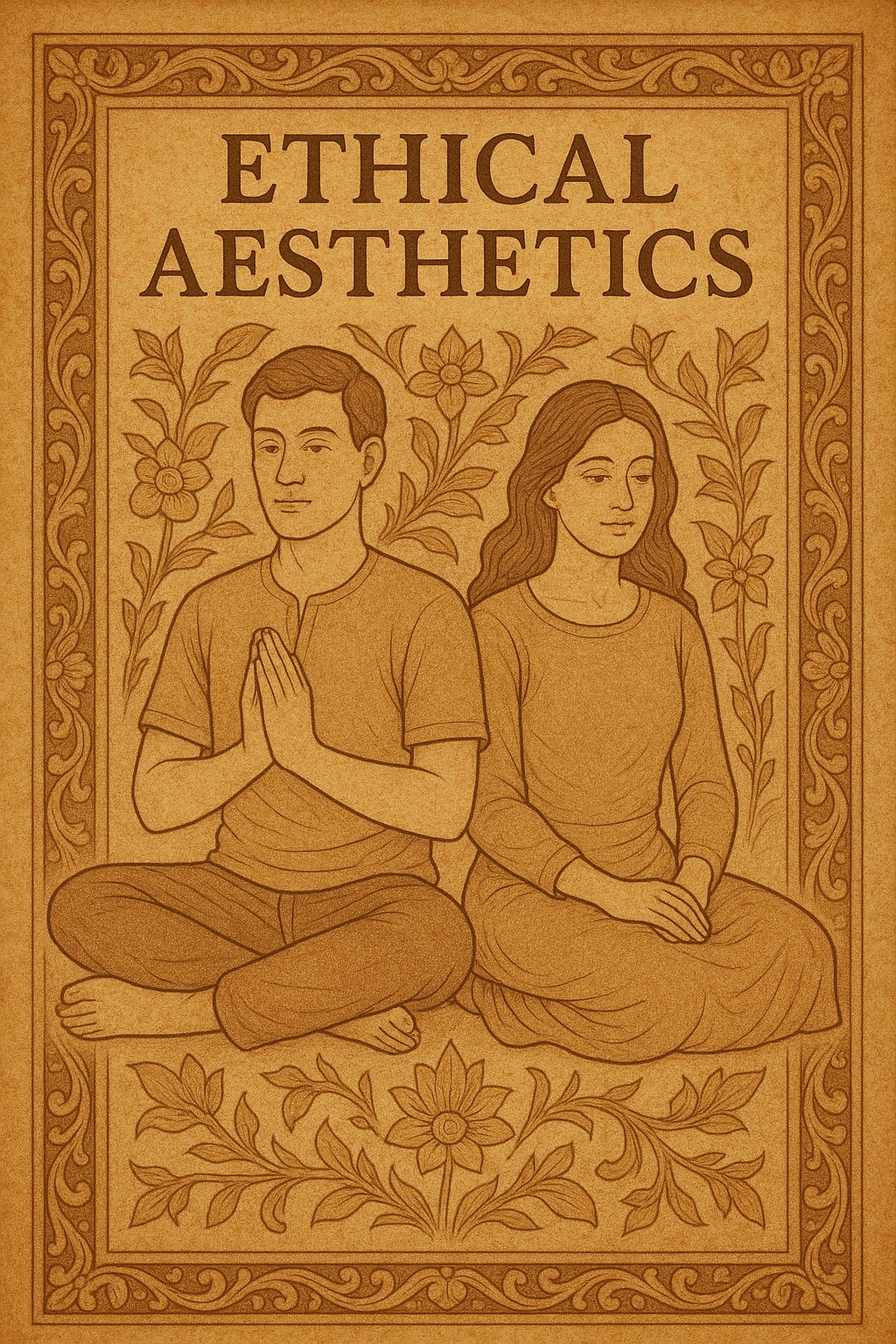
The Thai worldview supports the above which can be called ethical aesthetics, a conception in which ethical life is not ascetic or abstract but graceful, composed, and beautiful. This is evident in traditional Thai manner, speech, etiquette, dance, literature, architecture, and even social relations. A virtuous act is expected to be performed beautifully; a beautiful act must also be virtuous.
Unlike the Western subjectivist view of aesthetics, Thai philosophy does not reduce beauty to personal taste. Beauty is ethical in form, rhythm, and intention. The body, the voice, the gesture, the space, all are mediums through which virtue manifests aesthetically.
However, Thai culture does not distinguish in detail whether the word “DeeNgam” is subjective or objective, because there is a belief that subjectivity and objectivity must coexist. Without subjectivity and objectivity, there will be nothing. This can be compared with the form (รูป) and name (นาม) in Buddhist belief, whichboth support each other and cannot be separated absolutely.
Conclusion
While modern paradigm especially Western thought tends to separate ethics from aesthetics, Thai philosophy affirms their unity. Goodness is not only right but radiant. Beauty is not merely attractive but aligned with virtue. DeeNgam in the context of Thai culture has a different idea from the idea of Western philosophers, Thai philosophy believe that goodness and beauty are the same theme. Therefore, the words “Dee” and “Ngam” are combined to form the word “DeeNgam” to confirm the value that the person who is praised is a person of value to society.
This ethical-aesthetic integration challenges the inherited Western dichotomy and offers a different philosophical lens for considering how we live and judge human actions.
Recognizing this convergence opens the way to rethinking ethical theory beyond rules and consequences, and to exploring beauty not as superficial form, but as the very shape of virtue itself.
Keywords: Thai philosophy; Ethics; Aesthetics
Referred: Takaew, R. & Bunchua, K. (2015). The meaning of the word “DeeNgam” in the context of Thai culture. Journal of Graduate Studies, Suan Sunandha Rajabhat University, 8(1), 258-272.
 ปรัชญาสวนสุนันทา
Leave a comment