Anek Suwanbundit, Ph.D.
Program of philosophy and ethics, Graduate School,
Suan Sunandha Rajabhat University, Thailand
E-mail: asuwanr@hotmail.com
Abstract
This article develops the EOCR (Emergence–Order–Controlity–Result) thinking system into a comprehensive epistemological framework grounded in ontology. It argues that knowledge should not be conceived as a static representation of reality but as a dynamic, iterative process through which reality is disclosed, structured, evaluated, and validated. By synthesizing insights from phenomenology, transcendental epistemology, process philosophy, pragmatism, and critical theory, EOCR is formulated as a meta-epistemological model that bridges the gap between Being and Knowing. The study employs philosophical reconstruction and comparative analysis to position EOCR within contemporary epistemological discourse. It introduces the concept of “knowledge blocks” as structured units of validated understanding and conceptualizes knowledge formation as a recursive feedback system. The findings suggest that EOCR provides a robust theoretical architecture for understanding reality as both disclosed and co-constructed through human cognition. The paper concludes by outlining implications for epistemology, ethics, education, and complex systems research.
Keywords: EOCR, epistemology, ontology, phenomenology, knowledge systems, process philosophy, meta-epistemology
- Introduction
The problem of knowledge—how human beings come to know reality—remains one of the most enduring questions in philosophy. Classical epistemological traditions have approached this problem from divergent perspectives. Empiricism emphasizes sensory experience as the foundation of knowledge (Locke, 1690/1975), rationalism foregrounds the role of reason (Descartes, 1641/1996), and phenomenology prioritizes lived experience (Husserl, 1970). Despite their differences, these approaches share a common limitation: they tend to isolate specific dimensions of knowing without offering a fully integrated account of knowledge as a dynamic process.
Contemporary philosophical discourse increasingly recognizes the need for integrative frameworks that account for the complexity of knowledge formation in a rapidly changing world (Floridi, 2011). In this context, the EOCR (Emergence–Order–Controlity–Result) thinking system offers a promising foundation for developing a comprehensive epistemological model (Suwanbundit, 2016).
Originally conceived as a cognitive framework, EOCR can be reconceptualized as an onto-epistemic system that captures the full cycle of knowledge formation. This paper argues that EOCR provides a unified model in which knowledge emerges through iterative engagement with reality, encompassing perception, cognition, evaluation, and validation.
The central thesis is:
EOCR constitutes a process-oriented onto-epistemic framework in which knowledge arises through recursive cycles of interaction between Being and the structures of human understanding.
- Literature Review
2.1 Classical Epistemology
Empiricism and rationalism represent two foundational approaches to epistemology. Locke (1975) argued that knowledge derives from experience, whereas Descartes (1996) emphasized innate ideas and rational certainty. Kant (1998) sought to reconcile these traditions by proposing that knowledge arises from the interaction between sensory input and the a priori structures of the mind.
However, Kant’s framework remains largely static, focusing on the conditions of possibility for knowledge rather than its dynamic evolution.
2.2 Phenomenology and the Primacy of Experience
Phenomenology, particularly in the work of Husserl (1970), reorients epistemology toward lived experience. Husserl introduces the concept of intentionality, emphasizing that consciousness is always directed toward objects.
Heidegger (1962) extends this perspective by situating knowledge within the broader context of Being. For Heidegger, truth is not correspondence but unconcealment (aletheia).
While phenomenology provides a rich account of the emergence of experience, it does not fully address the processes by which experience becomes structured knowledge and validated truth.
2.3 Pragmatism and Validation
Pragmatist philosophers such as Dewey (1938) and James (1907) emphasize the practical consequences of knowledge. Truth is understood not as correspondence but as what “works” in practice.
This perspective highlights the importance of validation but does not fully integrate earlier stages of knowledge formation.
2.4 Critical Theory and Knowledge–Power Relations
Foucault (1980) argues that knowledge is inseparable from power, emphasizing the role of discourse in shaping what is considered true. This insight is crucial for understanding the evaluative dimension of knowledge.
2.5 Process Philosophy
Whitehead (1978) conceptualizes reality as a process of becoming rather than a collection of static entities. This perspective aligns with EOCR’s emphasis on dynamic systems.
2.6 Research Gap
Despite these contributions, existing theories do not provide a unified, process-oriented account that integrates: emergence of experience, structural cognition, normative evaluation, and practical validation. EOCR addresses this gap.
- Methodology
3.1 Research Design
This study employs a conceptual philosophical methodology, combining:
- Philosophical Reconstruction
- EOCR is reformulated as an epistemological framework.
- Comparative Analysis
- EOCR is compared with major epistemological traditions.
- Systemic Modeling
- EOCR is analyzed as a dynamic feedback system.
3.2 Analytical Framework
The analysis proceeds through four stages:
- Conceptual clarification of EOCR components
- Epistemological interpretation
- System integration
- Theoretical evaluation
3.3 Validity and Rigor
Rigor is ensured through:
- Logical consistency
- Theoretical coherence
- Alignment with established philosophical literature
3.4 Limitations
This study is theoretical and does not include empirical validation. Future research may operationalize EOCR in applied contexts.
- EOCR Epistemological Framework
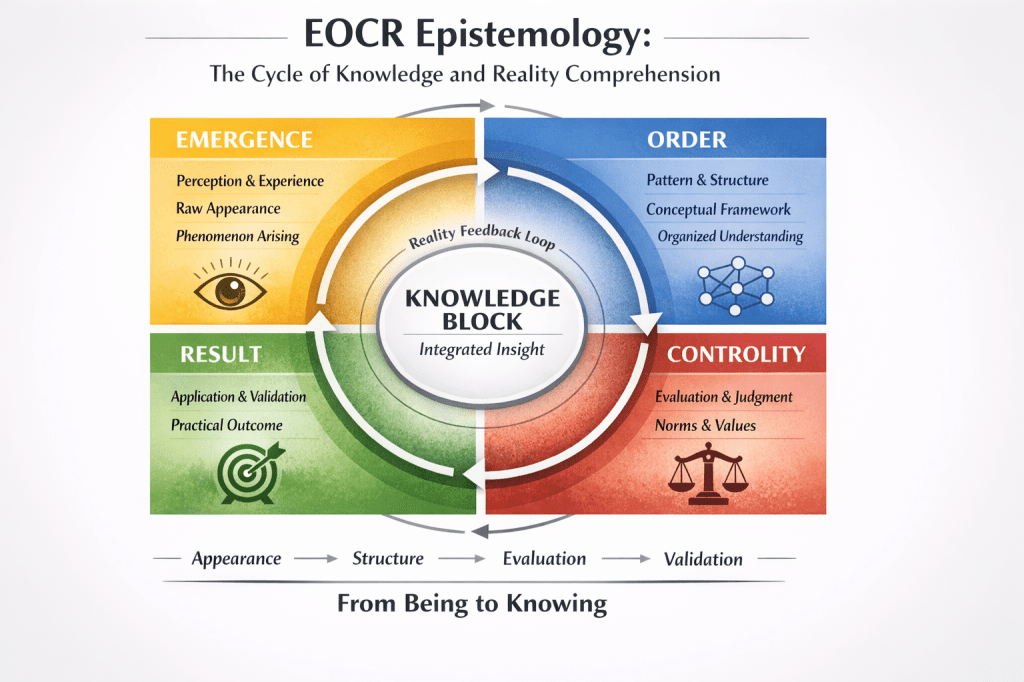
4.1 Emergence: Phenomenological Disclosure
Emergence represents the initial appearance of phenomena. It corresponds to pre-conceptual awareness and immediate experience. At this stage: Knowledge is non-structured, and perception precedes interpretation. Emergence aligns with phenomenology but extends it by situating it within a broader epistemic cycle.
4.2 Order: Structural Cognition
Order involves organizing experience into meaningful structures. This includes: Categorization, pattern recognition, and system formation. This stage reflects Kant’s insight that knowledge is structured by the mind.
4.3 Controlity: Normative Evaluation
Controlity introduces evaluation and judgment. It involves: Determining truth and falsity, assigning value, and guiding action. This stage integrates epistemology with ethics and power.
4.4 Result: Validation and Feedback
Result represents the testing of knowledge in practice. Validation occurs through: Pragmatic success, experiential confirmation, and systemic coherence. Feedback loops refine knowledge.
- Knowledge Block Formation
A knowledge block is the outcome of a complete EOCR cycle.
5.1 Structure
Emergence → Experience
Order → Structure
Controlity → Evaluation
Result → Validation
5.2 Function
Knowledge blocks serve as: Units of understanding, foundations for reasoning, and components of knowledge systems.
- Discussion
6.1 EOCR as Meta-Epistemology
EOCR integrates multiple traditions into a unified framework. It functions as a meta-epistemology by providing a higher-order structure that encompasses diverse approaches.
6.2 The Role of the Knower
EOCR reconceptualizes the knower as: Observer, constructor, evaluator, and agent. This transforms epistemology into a participatory process.
6.3 Ethical Implications
Knowledge entails responsibility. Errors in evaluation lead to harmful consequences, highlighting the ethical dimension of epistemology.
6.4 Application to Complex Systems
EOCR is particularly relevant in contexts characterized by: Uncertainty, interdependence. and rapid change
6.5 Toward an Onto-Epistemic Paradigm
EOCR suggests a shift from static to process-oriented epistemology, emphasizing the unity of Being and Knowing.
- Conclusion
EOCR epistemology provides a comprehensive framework for understanding knowledge as a dynamic, iterative process. It demonstrates that; 1) knowledge emerges through interaction, 2) understanding is structured, 3) Truth is evaluated and 4) Reality is validated through experience. Ultimately, human beings do not merely know reality—they participate in its unfolding.
References
Descartes, R. (1996). Meditations on first philosophy. Cambridge University Press. (Original work published 1641)
Dewey, J. (1938). Logic: The theory of inquiry. Holt.
Floridi, L. (2011). The philosophy of information. Oxford University Press.
Foucault, M. (1980). Power/knowledge. Pantheon.
Heidegger, M. (1962). Being and time. Harper & Row.
Husserl, E. (1970). The crisis of European sciences. Northwestern University Press.
James, W. (1907). Pragmatism. Longmans.
Kant, I. (1998). Critique of pure reason. Cambridge University Press.
Locke, J. (1975). An essay concerning human understanding. Oxford University Press.
Popper, K. (2002). The logic of scientific discovery. Routledge.
Suwanbundit, A. (2016). EOCR knowledge block. [lecture], Bangkok, Suan Sunandha Rajabhat University.
Whitehead, A. N. (1978). Process and reality. Free Press.
 ปรัชญาสวนสุนันทา
Leave a comment