Anek Suwanbundit, Ph.D.
Program of philosophy and ethics, Graduate School,
Suan Sunandha Rajabhat University, Thailand
E-mail: asuwanr@hotmail.com
Abstract
This article develops the EOCR (Emergence–Order–Controlity–Result) thinking system into a comprehensive epistemological framework grounded in ontology. It argues that knowledge should not be conceived as a static representation of reality but as a dynamic, iterative process through which reality is disclosed, structured, evaluated, and validated. By synthesizing insights from phenomenology, transcendental epistemology, process philosophy, pragmatism, and critical theory, EOCR is formulated as a meta-epistemological model that bridges the gap between Being and Knowing. The study employs philosophical reconstruction and comparative analysis to position EOCR within contemporary epistemological discourse. It introduces the concept of “knowledge blocks” as structured units of validated understanding and conceptualizes knowledge formation as a recursive feedback system. The findings suggest that EOCR provides a robust theoretical architecture for understanding reality as both disclosed and co-constructed through human cognition. The paper concludes by outlining implications for epistemology, ethics, education, and complex systems research.
Keywords: EOCR, epistemology, ontology, phenomenology, knowledge systems, process philosophy, meta-epistemology
- Introduction
The problem of knowledge—how human beings come to know reality—remains one of the most enduring questions in philosophy. Classical epistemological traditions have approached this problem from divergent perspectives. Empiricism emphasizes sensory experience as the foundation of knowledge (Locke, 1690/1975), rationalism foregrounds the role of reason (Descartes, 1641/1996), and phenomenology prioritizes lived experience (Husserl, 1970). Despite their differences, these approaches share a common limitation: they tend to isolate specific dimensions of knowing without offering a fully integrated account of knowledge as a dynamic process.
Contemporary philosophical discourse increasingly recognizes the need for integrative frameworks that account for the complexity of knowledge formation in a rapidly changing world (Floridi, 2011). In this context, the EOCR (Emergence–Order–Controlity–Result) thinking system offers a promising foundation for developing a comprehensive epistemological model (Suwanbundit, 2016; 2020; 2021).
Originally conceived as a cognitive framework, EOCR can be reconceptualized as an onto-epistemic system that captures the full cycle of knowledge formation. This paper argues that EOCR provides a unified model in which knowledge emerges through iterative engagement with reality, encompassing perception, cognition, evaluation, and validation.
The central thesis is:
EOCR constitutes a process-oriented onto-epistemic framework in which knowledge arises through recursive cycles of interaction between Being and the structures of human understanding.
- Literature Review
2.1 Classical Epistemology
The problem of knowledge has traditionally been framed through the tension between empiricism and rationalism, two foundational paradigms that continue to shape contemporary epistemological discourse.
Empiricism, most prominently articulated by John Locke, posits that the mind begins as a tabula rasa, and that all knowledge is derived from sensory experience (Locke, 1690/1975). Subsequent empiricists such as Berkeley and Hume further radicalized this position by emphasizing the primacy of perception and questioning the existence of necessary causal relations (Hume, 1748/2007). From this perspective, knowledge is fundamentally contingent, probabilistic, and grounded in observation.
In contrast, rationalism—exemplified by René Descartes, Baruch Spinoza, and Gottfried Wilhelm Leibniz—argues that reason provides the foundation for certain knowledge (Descartes, 1641/1996). Descartes’ methodological doubt and cogito ergo sum establish a model in which certainty arises from self-evident truths rather than empirical input. Rationalist epistemology thus privileges necessity, universality, and deductive structure.
Immanuel Kant’s critical philosophy represents a pivotal synthesis of these traditions. In the Critique of Pure Reason, Kant (1998) argues that knowledge arises through the interaction between sensory intuitions (Anschauungen) and the a priori categories of understanding. This “Copernican revolution” shifts epistemology from a passive reception model to an active structuring process. However, Kant’s framework remains largely transcendental-static, focusing on the conditions of possibility for knowledge rather than its dynamic formation and transformation over time.
From the perspective of EOCR epistemology, classical epistemology provides essential insights into the Order dimension (structuring of knowledge), yet remains insufficient in accounting for:
- The emergent genesis of experience prior to categorization
- The normative evaluation of knowledge beyond formal justification
- The recursive validation of knowledge in lived contexts
2.2 Phenomenology and the Primacy of Experience
Phenomenology represents a decisive shift from abstract epistemological speculation toward the analysis of lived experience. Edmund Husserl’s project of returning “to the things themselves” (Husserl, 1970) emphasizes that knowledge originates in intentional consciousness, wherein all acts of knowing are directed toward objects.
Husserl introduces the method of epoché (phenomenological reduction), suspending presuppositions in order to examine the structures of experience as they appear. This approach foregrounds the Emergence stage in EOCR, where phenomena are disclosed prior to conceptual structuring.
Martin Heidegger extends phenomenology into ontology by reconceptualizing human existence as Dasein, a being that is always already “being-in-the-world” (Heidegger, 1962). Knowledge, in this view, is not a detached representation but an existential engagement with Being. Truth is redefined as aletheia—the process of unconcealment.
Maurice Merleau-Ponty (2012) further deepens this analysis by emphasizing embodiment, arguing that perception is not a passive reception but an active, bodily engagement with the world.
Despite its strengths, phenomenology faces two limitations:
- It prioritizes description over systematization, leaving unclear how experiences become structured knowledge systems.
- It lacks a fully articulated account of evaluation and validation, particularly in intersubjective contexts.
EOCR extends phenomenology by embedding the Emergence dimension within a broader epistemic cycle that includes structuring (Order), evaluation (Controlity), and validation (Result).
2.3 Pragmatism and Validation
Pragmatism introduces a functional and action-oriented approach to epistemology. William James (1907) defines truth as “what works,” emphasizing that beliefs are validated through their practical consequences. John Dewey (1938) further develops this perspective by framing knowledge as an instrument for problem-solving within dynamic environments.
Pragmatism shifts epistemology toward:
- Process over static truth
- Action over representation
- Consequences over correspondence
Charles Sanders Peirce (1931–1958) adds a semiotic dimension, proposing that knowledge evolves through a process of inquiry involving hypothesis, experimentation, and community verification.
From the EOCR perspective, pragmatism corresponds closely to the Result stage, where knowledge is validated through outcomes and feedback loops. However, pragmatism alone does not fully account for:
- The ontological grounding of experience (Emergence)
- The structural formation of concepts (Order)
- The normative evaluation of knowledge claims (Controlity)
Thus, EOCR incorporates pragmatism as a necessary but not sufficient component of epistemology.
2.4 Critical Theory and Knowledge–Power Relations
Critical theory, particularly in the work of Michel Foucault, challenges the neutrality of knowledge by exposing its entanglement with power structures. Foucault (1980) argues that what counts as knowledge is shaped by discursive formations and institutional practices. Knowledge is not merely discovered but produced within regimes of power.
This perspective introduces several key insights:
- Knowledge is historically contingent
- Truth is socially constructed
- Power shapes epistemic legitimacy
Jürgen Habermas (1984) offers a complementary view, emphasizing communicative rationality and the possibility of consensus through discourse. He distinguishes between different “knowledge interests,” including technical, practical, and emancipatory.
From the EOCR standpoint, critical theory is essential for understanding the Controlity stage, where knowledge is evaluated, regulated, and legitimized. It highlights that evaluation is never purely objective but is influenced by social norms, institutional structures, and ethical considerations.
However, critical theory often focuses on critique rather than constructive system-building. EOCR addresses this limitation by integrating normativity into a broader epistemic process.
2.5 Process Philosophy
Process philosophy provides a metaphysical foundation for understanding reality as dynamic and evolving. Alfred North Whitehead (1978) argues that reality consists of “actual occasions” rather than static substances. Each occasion arises through a process of becoming, integrating past influences into present experience.
This perspective aligns closely with EOCR’s emphasis on:
- Emergence as genesis
- Order as pattern formation
- Result as continuous transformation
Henri Bergson (1911/2001) similarly emphasizes duration (durée) as the qualitative flow of time, resisting reduction to discrete units.
Process philosophy challenges traditional epistemology by suggesting that:
- Knowledge must be understood as temporal and evolving
- Reality cannot be fully captured by static representations
EOCR extends process philosophy by incorporating epistemic stages that account for cognition, evaluation, and validation.
2.6 Constructivism and Systems Thinking
Constructivist epistemology, as developed by Jean Piaget (1970) and Ernst von Glasersfeld (1995), posits that knowledge is actively constructed by the knower rather than passively received. This perspective emphasizes cognitive development, adaptive structures, and interaction with the environment.
Systems thinking, particularly in the work of Niklas Luhmann (1995), conceptualizes knowledge as part of self-referential systems that reproduce themselves through communication.
These approaches resonate strongly with EOCR’s notion of knowledge blocks, where knowledge emerges as structured units within a dynamic system.
However, constructivism raises the challenge of relativism: if knowledge is constructed, how can it be validated? EOCR addresses this by incorporating Controlity (evaluation) and Result (validation).
2.7 Research Gap
Despite these contributions, existing theories do not provide a unified, process-oriented account that integrates: emergence of experience, structural cognition, normative evaluation, and practical validation. EOCR addresses this gap.
| Tradition | Strength | EOCR Dimension |
|---|---|---|
| Empiricism | Sensory grounding | Emergence |
| Rationalism/Kant | Structural cognition | Order |
| Phenomenology | Lived experience | Emergence |
| Pragmatism | Practical validation | Result |
| Critical Theory | Normativity/power | Controlity |
| Process Philosophy | Dynamic becoming | All stages |
| Constructivism | Knowledge construction | Order + Controlity |
2.8 Toward EOCR Epistemology
EOCR emerges as a meta-integrative framework that synthesizes these traditions into a coherent system:
- Emergence captures phenomenological disclosure and empirical grounding
- Order reflects rational structuring and constructivist cognition
- Controlity integrates ethical, social, and power-based evaluation
- Result embodies pragmatic validation and systemic feedback
This integration enables EOCR to function not merely as a theory of knowledge but as a process-oriented onto-epistemology, bridging the gap between Being and Knowing.
- Methodology
3.1 Research Design
This study employs a conceptual philosophical methodology, combining:
- Philosophical Reconstruction
- EOCR is reformulated as an epistemological framework.
- Comparative Analysis
- EOCR is compared with major epistemological traditions.
- Systemic Modeling
- EOCR is analyzed as a dynamic feedback system.
3.2 Analytical Framework
The analysis proceeds through four stages:
- Conceptual clarification of EOCR components
- Epistemological interpretation
- System integration
- Theoretical evaluation
3.3 Validity and Rigor
Rigor is ensured through:
- Logical consistency
- Theoretical coherence
- Alignment with established philosophical literature
3.4 Limitations
This study is theoretical and does not include empirical validation. Future research may operationalize EOCR in applied contexts.
- EOCR Epistemological Framework
Conceptual Foundation: EOCR as an Onto-Epistemic System
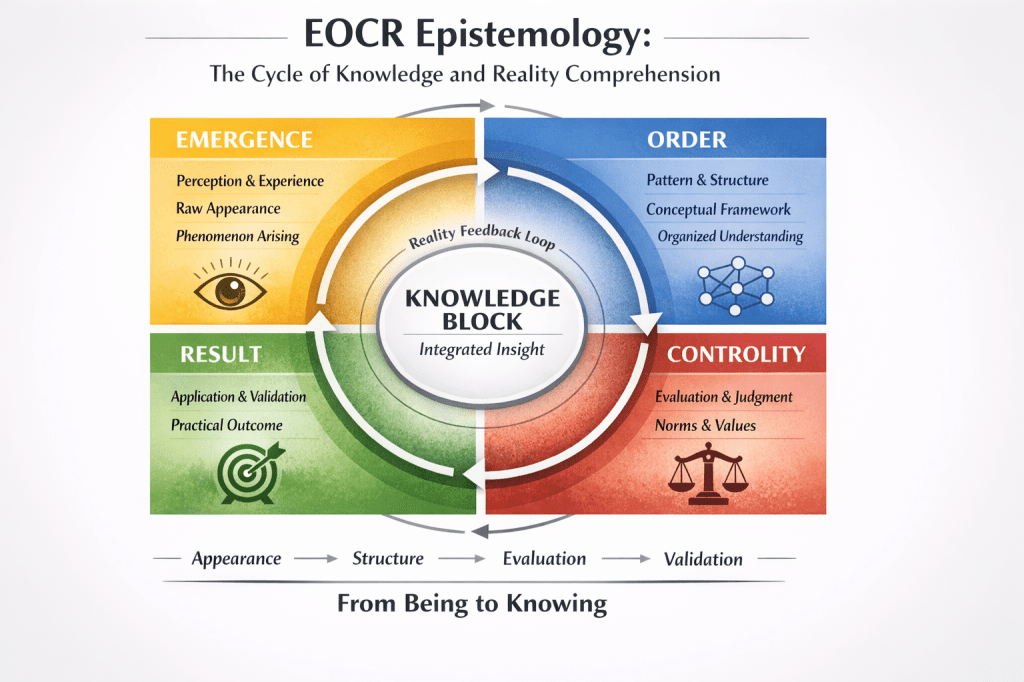
The EOCR epistemological framework—comprising Emergence (E), Order (O), Controlity (C), and Result (R)—is best understood not merely as a sequential cognitive model, but as a recursive onto-epistemic system that integrates the genesis of Being with the formation, evaluation, and validation of knowledge.
Unlike classical epistemological models that isolate cognition from ontology, EOCR posits that knowing is always already grounded in modes of Being. In this sense, EOCR resonates with Heidegger’s (1962) claim that understanding is an existential structure of Dasein, while extending it into a systematic and operationalizable epistemology.
Formally, EOCR can be defined as:
EOCR = f(E, O, C, R)
where knowledge emerges through recursive transitions across four interdependent dimensions of experience, structure, evaluation, and consequence.
Each dimension is not a discrete stage but a mode of epistemic articulation, and the movement among them is non-linear, iterative, and reflexive (Suwanbundit, 2016).
4.1 Emergence: Phenomenological Disclosure
Emergence refers to the pre-conceptual arising of phenomena, where reality is disclosed prior to formal structuring. It corresponds to what Husserl (1970) calls intentional givenness and what Heidegger (1962) describes as unconcealment (aletheia).
In EOCR, Emergence is not merely sensory input but a field of ontological potentiality, where Being manifests as experience. It includes: Raw perception, Affective tone (mood, attunement), Pre-reflective awareness, and Contextual situatedness.
Thus, Emergence is both empirical and existential, bridging empiricism and phenomenology.
EOCR distinguishes between two modes of emergence: 1) Genesis: Phenomena arise through identifiable causes or agents. Example: Moral goodness arising from intentional action. Aligns with Aristotelian causality (Aristotle, Metaphysics) and 2) Debut: Phenomena appear without explicit causal attribution. Example: Spontaneous perception or intuition. Resonates with phenomenological immediacy. This distinction allows EOCR to address a longstanding philosophical tension between: Causal realism and Phenomenological immediacy.
Emergence serves as the ground of intelligibility. Without it, no knowledge can arise. However, it remains: Indeterminate, Pre-structured, Open to multiple interpretations. Thus, EOCR emphasizes that all knowledge begins in ambiguity, requiring further articulation through Order.
4.2 Order: Structural Cognition
Order involves organizing experience into meaningful structures. This includes categorization, pattern recognition, and system formation. This stage reflects Kant’s (1998) categories of understanding and Piaget’s (1970) cognitive schemas.
EOCR conceptualizes Order through two interrelated dimensions: 1) Law (Nomological Structure) Regularities, rules, or principles governing phenomena. Example: Moral norms, scientific laws. And 2) Relation (Relational Structure) Interconnections among entities. Example: Social interactions, causal chains. Order thus transforms phenomenal multiplicity into intelligible systems.
Order enables: Stability of meaning, communicability of knowledge, and predictive capacity. However, Order also introduces limitations: Over-structuring may obscure novelty and categories may impose artificial boundaries. EOCR therefore treats Order as necessary but provisional, always subject to revision through further cycles.
4.3 Controlity: Normative Evaluation
Controlity is the most distinctive dimension of EOCR, referring to the evaluation and regulation of knowledge in terms of: Value (good/bad, better/worse), responsibility, authority, and ethical implications. It integrates insights from Foucault’s (1980) power/knowledge, Habermas’s (1984) communicative rationality, and Aristotelian virtue ethics.
EOCR identifies four key elements: 1) Order – Evaluation presupposes structure, 2) Power –
Knowledge generates influence and authority, example: Expertise, moral authority, 3) Duty -Knowledge entails obligations, example: Ethical responsibility in action, and 4) responsibility – Accountability for consequences includes unintended effects.
Controlity ensures that knowledge is not merely true but meaningful, ethically grounded, and socially accountable. It transforms epistemology into a normative enterprise, bridging the gap between knowledge and action.
EOCR proposes that evaluation operates on a continuous scale, not binary categories. For example: Degrees of goodness rather than absolute good/evil, degrees of validity rather than true/false. This aligns with Fuzzy logic (Zadeh, 1965), Pragmatic fallibilism (Peirce, 1931–1958).
4.4 Result: Validation and Feedback
Result refers to the outcomes of knowledge in practice, including intentional outcomes, functional utility, and emergent consequences. It corresponds to pragmatist theories of truth (James, 1907; Dewey, 1938).
EOCR conceptualizes Result through three components: 1) Intention – Purpose or motivation behind action, 2) Utility – Practical effectiveness, 3) Outcome – Actual consequences (intended and unintended).
Result serves as the validation mechanism of knowledge. It answers the question “Does this knowledge work in reality?” However, EOCR emphasizes that validation is context-dependent, temporally dynamic, and open to revision.
Results feed back into Emergence, generating new experiences and restarting the cycle. This creates a self-correcting epistemic system.
- Knowledge Block Formation
Within the EOCR epistemological framework, knowledge is not an instantaneous product but a stabilized outcome of recursive epistemic activity. The concept of a knowledge block refers to a relatively stable, structured, and actionable unit of understanding that emerges through repeated cycles of Emergence–Order–Controlity–Result (EOCR).
A knowledge block may be formally defined as “A context-sensitive, recursively validated configuration of meaning that integrates experiential disclosure, conceptual structuring, normative evaluation, and pragmatic validation.”
This notion resonates with Thomas Kuhn’s concept of paradigms as stabilized frameworks of understanding (Kuhn, 1962), as well as Michael Polanyi’s idea of tacit knowledge, where knowing is embodied and practice-oriented (Polanyi, 1966). However, EOCR advances these theories by specifying the internal generative mechanism through which such epistemic units are formed.
EOCR operates as a recursive loop, not a linear sequence: E → O → C → R → E …
Key characteristics are non-linearity, iteration, and reflexivity. This aligns with systems theory (Luhmann, 1995), and Cybernetics (Wiener, 1948). A knowledge block is the outcome of a complete EOCR cycle. Knowledge blocks mature through iterative EOCR cycles, where each cycle; Refines conceptual clarity, adjusts normative evaluation, and tests practical applicability. Over time, knowledge blocks become more stable, more transferable, and more resilient to error.
Characteristics are context-sensitive, action-guiding, and open to refinement. These blocks form the basis of expertise, wisdom, and institutional knowledge.
5.1 Structure
| EOCR Dimension | Function within Knowledge Block |
|---|---|
| Emergence | Experiential grounding |
| Order | Conceptual structure |
| Controlity | Normative legitimacy |
| Result | Practical validation |
This structure ensures that knowledge is grounded, coherent, responsible, and effective. Despite their stability, knowledge blocks remain fallible (Peirce, 1931–1958), context-dependent, and historically situated. They may collapse under contradiction, transform under new evidence, and be replaced by more robust structures (Kuhn, 1962).
5.2 Function
At higher levels of refinement, knowledge blocks contribute to wisdom, understood as context-sensitive judgment, ethical awareness, and practical insight. This aligns with Aristotelian phronesis (practical wisdom) (Aristotle, 2009). Knowledge blocks serve as units of understanding, foundations for reasoning, and components of knowledge systems.
EOCR allows entry at any point (E, O, C, or R), depending on context; Scientists may begin with Order, practitioners with Result, and ethicists with Controlity. However, completeness requires full traversal of the system, ensuring epistemic robustness.
- Discussion
6.1 EOCR as Meta-Epistemology
EOCR integrates multiple traditions into a unified framework. It functions as a meta-epistemology by providing a higher-order structure that encompasses diverse approaches. EOCR transcends traditional epistemology by integrating ontology and epistemology, bridging descriptive and normative dimensions, and unifying multiple philosophical traditions. It thus functions as a meta-epistemology, capable of analyzing knowledge systems, guiding decision-making, and supporting interdisciplinary inquiry.
6.2 The Role of the Knower
EOCR reconceptualizes the knower as: Observer, constructor, evaluator, and agent. This transforms epistemology into a participatory process.
6.3 Ethical Implications
One of the most significant implications of EOCR is its reintroduction of ethics into epistemology. Modern epistemology has often attempted to remain value-neutral; however, EOCR argues that “All knowledge is implicitly normative, as it influences action and consequences.” Knowledge entails responsibility. Errors in evaluation lead to harmful consequences, highlighting the ethical dimension of epistemology.
Through Controlity, EOCR evaluates knowledge not only in terms of truth but also ethical validity, social impact, and responsibility. This aligns with virtue epistemology (Sosa, 2007), and Aristotelian ethics (Aristotle, 2009). However, EOCR extends these traditions by embedding ethics within the structural formation of knowledge itself.
6.4 Application to Complex Systems
EOCR aligns closely with systems theory and complexity thinking, particularly in its emphasis on recursion, feedback loops, and non-linearity. It is particularly relevant in contexts characterized by uncertainty, interdependence. and rapid change. EOCR contributes to this tradition by offering a micro-epistemic model of how knowledge evolves within complex systems. It demonstrates that knowledge is not merely stored but continuously reconstructed, and epistemic stability emerges from dynamic equilibrium.
6.5 Toward an Onto-Epistemic Paradigm
A central contribution of EOCR lies in its integration of ontology and epistemology. Classical philosophy often treats these as distinct domains: ontology concerns what exists, while epistemology concerns how we know (Quine, 1969). EOCR suggests a shift from static to process-oriented epistemology, emphasizing the unity of Being and Knowing.
This position resonates with Martin Heidegger’s fundamental ontology, in which understanding is constitutive of Dasein (Heidegger, 1962). It also parallels onto-epistemology in contemporary philosophy (Barad, 2007), where knowing and being are mutually entangled.
However, EOCR extends these insights by providing a structured operational model. Whereas Heidegger offers an existential analytic and Barad a relational ontology, EOCR specifies how ontological disclosure becomes structured knowledge and actionable understanding.
- Conclusion
EOCR epistemology provides a comprehensive framework for understanding knowledge as a dynamic, iterative process. It demonstrates that; 1) knowledge emerges through interaction, 2) understanding is structured, 3) Truth is evaluated and 4) Reality is validated through experience. Ultimately, human beings do not merely know reality—they participate in its unfolding.
The analysis suggests several key strengths that EOCR synthesizes multiple traditions into a unified framework. It captures the dynamic nature of knowledge formation. It incorporates ethical and social evaluation. And It links knowledge directly to action and outcomes.
Despite its strengths, EOCR faces several challenges such as the framework may be difficult to operationalize empirically and the recursive structure may appear circular without clear criteria for validation. future research is needed in developing measurable indicators for each EOCR dimension, linking EOCR with cognitive science and AI, and applying EOCR in fields such as education, healthcare, and policy.
References
Aristotle. (1998). Metaphysics (H. Tredennick & G. C. Armstrong, Trans.). Harvard University Press.
Aristotle. (2009). Nicomachean ethics (W. D. Ross, Trans.). Oxford University Press.
Barad, K. (2007). Meeting the universe halfway. Duke University Press.
Bhaskar, R. (1975). A realist theory of science. Routledge.
Descartes, R. (1996). Meditations on first philosophy. Cambridge University Press. (Original work published 1641)
Dewey, J. (1938). Logic: The theory of inquiry. Holt.
Floridi, L. (2011). The philosophy of information. Oxford University Press.
Foucault, M. (1980). Power/knowledge. Pantheon.
Gettier, E. (1963). Is justified true belief knowledge? Analysis, 23(6), 121–123.
Goldman, A. (1979). What is justified belief? In G. Pappas (Ed.), Justification and knowledge (pp. 1–23). Reidel.
Habermas, J. (1984). The theory of communicative action, Vol. 1. Beacon Press.
Heidegger, M. (1962). Being and time. Harper & Row.
Husserl, E. (1970). The crisis of European sciences. Northwestern University Press.
James, W. (1907). Pragmatism. Longmans.
Jonas, H. (1984). The imperative of responsibility. University of Chicago Press.
Kant, I. (1998). Critique of pure reason. Cambridge University Press.
Kuhn, T. S. (1962). The structure of scientific revolutions. University of Chicago Press.
Ladyman, J. (2002). Understanding philosophy of science. Routledge.
Locke, J. (1975). An essay concerning human understanding. Oxford University Press.
Luhmann, N. (1995). Social systems. Stanford University Press.
Marion, J.-L. (2002). Being given: Toward a phenomenology of givenness. Stanford University Press.
Merleau-Ponty, M. (2012). Phenomenology of perception. Routledge.
Morin, E. (2008). On complexity. Hampton Press.
Peirce, C. S. (1931–1958). Collected papers of Charles Sanders Peirce (Vols. 1–8). Harvard University Press.
Piaget, J. (1970). Genetic epistemology. Columbia University Press.
Polanyi, M. (1966). The tacit dimension. University of Chicago Press.
Popper, K. (2002). The logic of scientific discovery. Routledge.
Quine, W. V. O. (1969). Ontological relativity and other essays. Columbia University Press.
Ratcliffe, M. (2008). Feelings of being. Oxford University Press.
Rescher, N. (1996). Process metaphysics. SUNY Press.
Sosa, E. (2007). A virtue epistemology. Oxford University Press.
Suwanbundit, A. (2016). EOCR knowledge block. [lecture], Bangkok, Suan Sunandha Rajabhat University.
Suwanbundit, A. (2023). Afterthought, Bangkok, Pispes.
Suwanbundit, A. (2024). Knowledge and peace, Bangkok, Pispes.
von Glasersfeld, E. (1995). Radical constructivism. Falmer Press.
Wiener, N. (1948). Cybernetics. MIT Press.
Whitehead, A. N. (1978). Process and reality. Free Press.
Zadeh, L. A. (1965). Fuzzy sets. Information and Control, 8(3), 338–353.
Zahavi, D. (2005). Subjectivity and selfhood. MIT Press.
 ปรัชญาสวนสุนันทา
Leave a comment