Anek Suwanbundit, Ph.D.
Program of Philosophy and Ethics, Graduate School, Suan Sunandha Rajabhat University, Thailand
Abstract
In the aftermath of Postmodernism, educational theory has undergone a profound epistemological and existential transformation. While postmodern critique successfully deconstructed grand narratives and destabilized claims to objective truth, it also contributed to a crisis of meaning, identity fragmentation, and psychological distress among contemporary learners. This article develops a comprehensive philosophical and educational framework that integrates re-enchantment theory, contemplative practices, and paradigm analysis to address this crisis. Drawing upon Metaphysics, philosophy of mind, and philosophy of spirit, the study proposes a model of Dynamic Re-enchanted Consciousness in Education (DRCE). Through an interdisciplinary literature review and conceptual analysis grounded in Western and Eastern traditions, the article argues that education must move beyond knowledge transmission toward meaning-making, shared understanding, and spiritual cultivation. The study further outlines methodological pathways and empirical implications for implementing re-enchanted, contemplative educational practices that enhance resilience, ethical awareness, and existential coherence among learners.
Keywords: Re-enchantment; contemplative education; shared meaning; paradigm shift; postmodernism; spiritual pedagogy
Introduction
The contemporary educational landscape is shaped by a paradox: unprecedented access to knowledge coexists with an unprecedented crisis of meaning. Students today are more informed than ever before, yet increasingly report feelings of disconnection, anxiety, and existential uncertainty. This paradox reflects a deeper philosophical transformation rooted in the intellectual legacy of Postmodernism.
Postmodernism challenged foundational assumptions about truth, objectivity, and universality. While this critique dismantled oppressive epistemologies and opened space for plurality, it also eroded shared frameworks of meaning. The result is what many scholars describe as epistemic fragmentation—a condition in which individuals possess knowledge but lack orientation.
In response, a growing body of scholarship in education, philosophy, and contemplative studies calls for a re-enchantment of learning—a reintegration of rational inquiry with existential meaning, ethical depth, and spiritual awareness. This movement seeks not to return to premodern dogma but to cultivate a new form of understanding grounded in relationality, presence, and shared meaning.
Literature Review
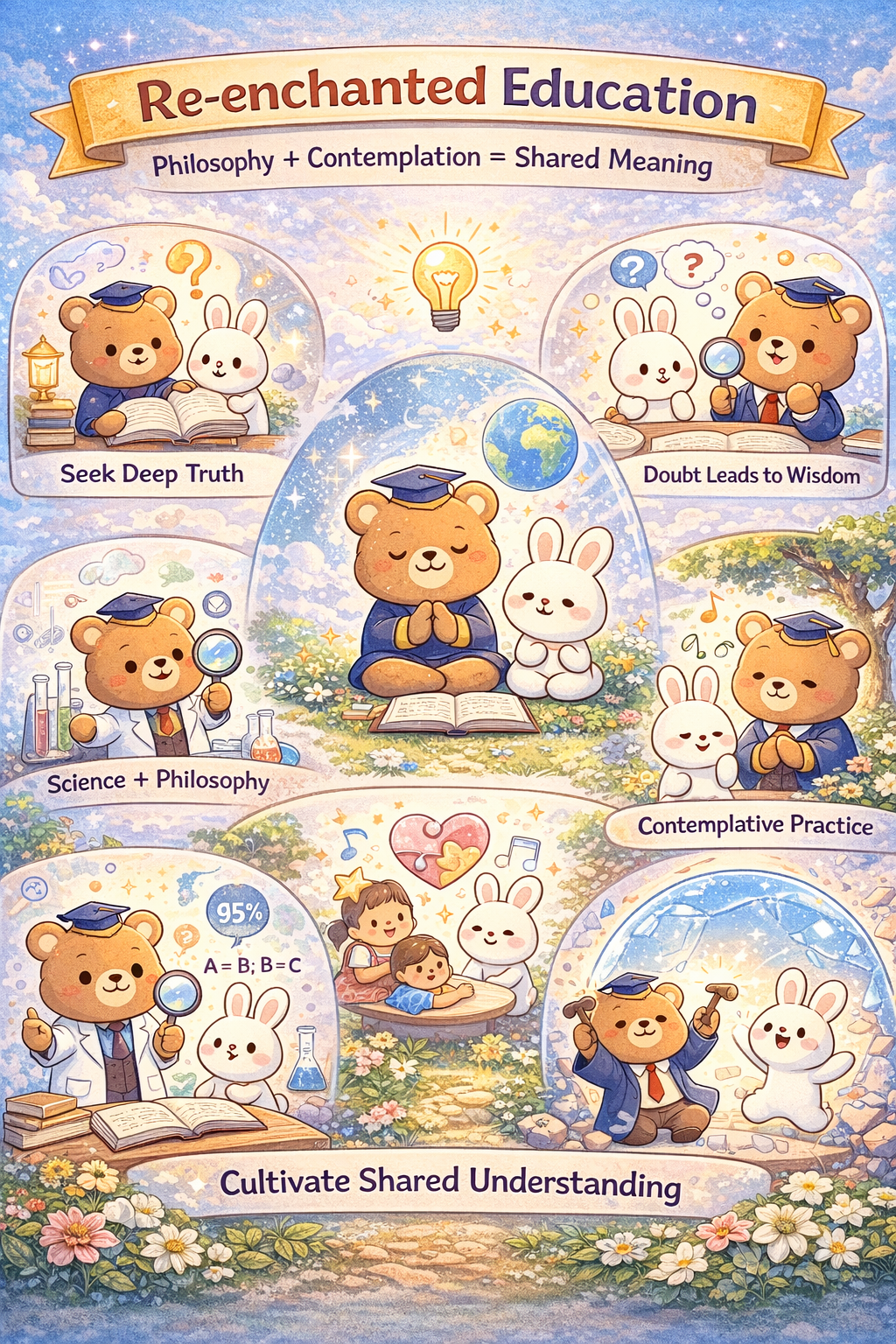
Philosophy, traditionally understood as the “love of wisdom,” begins with a fundamental question: What is it? This question extends beyond empirical description into the realm of Metaphysics—the inquiry into the nature of reality itself.
Unlike scientific disciplines, which focus on prediction and control, philosophy seeks explanation—an understanding of why things are as they are. This distinction is crucial in educational contexts that science answers how while philosophy asks why.
This epistemological distinction forms the basis of a deeper educational paradigm—one that moves beyond technical competence toward existential understanding.
Modern education often privileges scientific epistemology, grounded in probability, experimentation, and statistical validation. However, this framework is inherently limited because of scientific truth is provisional. It operates within probabilistic certainty and cannot address questions of meaning, value, or purpose.
In contrast, logical and philosophical reasoning seeks coherence and necessity. While science may assert that a treatment works in 95% of cases, philosophy asks whether it ought to be used.
The failure to integrate these perspectives has led to what may be called epistemological reductionism—the belief that all knowledge must conform to scientific standards.
Contrary to modern educational systems that discourage error, philosophy recognizes doubt as the beginning of wisdom. As Socrates famously suggested, awareness of one’s ignorance is the first step toward knowledge.
Doubt functions as a disruption of certainty, a catalyst for inquiry, and a pathway to deeper understanding.
In 21st century education, however, systems of evaluation often suppress doubt in favor of correctness, thereby limiting intellectual and existential growth.
Modern education excels at cultivating intelligence but often neglects wisdom. This imbalance contributes to a technologically advanced yet existentially impoverished society.
Every individual operates within a conceptual framework—a “glass dome” shaped by culture, experience, and belief. This metaphor reflects the influence of Thomas Kuhn and his theory of paradigms.
Education, therefore, must reveal the existence of these frameworks, encourage critical reflection and facilitate paradigm transformation.
Breaking the “glass dome” is not merely intellectual but existential—it involves confronting one’s assumptions about reality.
1. Postmodernism and the Deconstruction of Meaning
Postmodernism, as articulated by Jean-François Lyotard, is characterized by “incredulity toward metanarratives.” This skepticism undermined universal claims to truth, leading to a plurality of perspectives but also to relativism.
Michel Foucault further emphasized the relationship between knowledge and power, arguing that truth is constructed within discursive regimes. While these insights revealed hidden structures of domination, they also destabilized the possibility of shared meaning.
Jacques Derrida introduced deconstruction, highlighting the inherent instability of language and meaning. Together, these thinkers contributed to a philosophical climate in which certainty became suspect and meaning became contingent.
2. The Emergence of Re-enchantment
In response to postmodern fragmentation, scholars such as Charles Taylor have explored the concept of re-enchantment. In A Secular Age, Taylor argues that modernity’s “disenchantment” removed the sense of transcendence and meaning from everyday life.
Re-enchantment does not imply a return to superstition but a recovery of depth, wonder, and participation in reality. It aligns with educational movements that emphasize holistic development, including emotional, ethical, and spiritual dimensions.
3. Contemplative Education
Contemplative education, influenced by scholars such as Arthur Zajonc and Parker Palmer, integrates practices such as mindfulness, reflection, and deep listening into pedagogy.
These approaches are rooted in both Western philosophical traditions (e.g., Stoicism) and Eastern contemplative traditions (e.g., Buddhism). They aim to cultivate attention, awareness, and inner stability—qualities essential for meaning-making.
4. Philosophy of Mind and Spirit
Philosophy of mind traditionally focuses on cognition, perception, and consciousness. However, contemporary discourse increasingly incorporates philosophy of spirit, which explores the existential and transcendent dimensions of human experience.
Western traditions often emphasize rationality and dualism, while Eastern traditions emphasize non-duality and experiential awareness. Integrating these perspectives enables a more comprehensive understanding of consciousness as dynamic and relational.
Result
1. Reconstructing Meaning
Postmodernism dismantled grand narratives but offered no stable alternative. Thinkers such as Jean-François Lyotard emphasized the collapse of universal truth, leading to relativism, fragmentation, and loss of shared meaning.
While this critique was necessary, its consequences include a generation disconnected from purpose and identity. Education must help them breaking the glass dome (recognize and transcend these limitations). This process involves the critical reflection, exposure to diverse perspectives, and dialogical engagement.
Re-enchantment seeks to restore wonder, meaning, and spiritual depth. Unlike premodern belief systems, re-enchantment does not rely on dogma but on participatory meaning-making. It aligns with contemplative traditions and emerging educational philosophies that emphasize presence, awareness, and interconnectedness.
Collaborative learning environments enable students to co-create understanding. Shared meaning enhances the belonging, empathy, and social cohesion.
2. Mind and Spirit Cultivation
Contemplative education practices—rooted in traditions eastern and western both offer a pathway toward reintegration.
These practices cultivate the attention, awareness, and inner stability. These practices support the development of wisdom, not just intelligence.
They correspond to what may be described as Dynamic Re-enchanted Consciousness in Education (DRCE) framework, which integrates three dimensions:
2.1 Ontological Dimension: Understanding of self as dynamic, non-fixed, and emphasis on relational being
2.2 Epistemological Dimension: Integration of scientific and philosophical knowledge, and recognition of multiple truth frameworks.
2.3 Ethical–Spiritual Dimension: Cultivation of meaning, purpose, and interconnectedness
Development of shared values and responsibility
This framework is influenced by paradigm theory (Thomas Kuhn), contemplative traditions, and re-enchantment theory.
3. Learning Ecosystem and Education Transformation
The emerging paradigm may be described as Re-enchanted Education, characterized by the integration of reason and spirit, emphasis on meaning over information, cultivation of wisdom over intelligence, community-based learning, and contemplative practice. This paradigm responds directly to the existential challenges of postmodern society.
And one of the most significant developments in contemporary educational theory is the emphasis on Shared Meaning—the co-construction of understanding within communities.
Shared meaning propose to reduces alienation, builds belonging, and enhances psychological resilience. It represents a shift from individual knowledge acquisition to collective meaning-making.
Implications
1. Youth Mental Health
The absence of meaning has been linked to rising mental health issues. Re-enchanted education offers the existential grounding, emotional resilience, and sense of purpose. By reconnecting learners with meaning, education can function as a protective factor against depression and alienation.
2. Education Paradigm Shift
Curriculum design has to integrate philosophical inquiry across disciplines and include contemplative practices in daily learning.
Pedagogical Strategies have to vary from dialogue-based learning, reflective writing to
experiential learning.
Assessment has to shift from accuracy to evaluate depth of understanding and include self-reflection and ethical reasoning.
Educational Policy should shift from standardized testing toward holistic development models.
Conclusion
The dominance of scientific rationality has led to an instrumental view of knowledge. Education is often reduced to skill acquisition and performance metrics, neglecting existential questions.
This reductionism contributes to loss of purpose, emotional disconnection and increased mental health issues in youth students.
The transition from modern certainty to postmodern fragmentation has created a profound challenge for education. However, it also presents an opportunity to reimagine learning as a process of meaning-making, self-discovery, and collective understanding.
Re-enchantment offers a pathway forward—one that integrates reason with spirit, knowledge with wisdom, and individuality with community.
Education, in this paradigm, becomes not merely a means of acquiring information but a journey toward becoming fully human.
References
Bunchua, K. (2003). Postmodern Philosophy. Doung Kamol Book.
Hadot, P. (1995). Philosophy as a way of life. Blackwell.
Kuhn, T. S. (1962). The structure of scientific revolutions. University of Chicago Press.
Lyotard, J.-F. (1984). The postmodern condition. University of Minnesota Press.
Foucault, M. (1972). The archaeology of knowledge. Pantheon.
Derrida, J. (1976). Of grammatology. Johns Hopkins University Press.
Taylor, C. (2007). A secular age. Harvard University Press.
Palmer, P. J. (1998). The courage to teach. Jossey-Bass.
Zajonc, A. (2013). Contemplative pedagogy. Wiley.
Noddings, N. (2013). Caring: A relational approach to ethics and moral education. University of California Press.


Leave a Reply