Sirikorn Amaritwarin, Ph.D.
Program of philosophy and ethics, Graduate School,
Suan Sunandha Rajabhat University, Thailand
Abstract
In the late information age, unprecedented connectivity coexists with profound social fragmentation and isolation. This paradox raises philosophical questions about how genuine human relationships and understanding can be restored. This paper examines dialogue – especially as conceived by Martin Buber and David Bohm – as a philosophical and practical response. Drawing on phenomenology and critical theory, we argue that authentic dialogue fosters I–Thou relations and shared meaning, reduces conflict through mutual understanding, and cultivates the creative, cooperative ethos prized by moderate postmodernism. Dialogue requires suspending ego-driven judgments (the phenomenological epoché) to encounter others “as Thou”. In so doing, dialogue aligns with moderate postmodern ideals: transcending absolutism and nihilism, valuing unity-in-diversity, and reconstructing knowledge through participatory inquiry. As such, Bohmian and Buberian dialogue can be seen as practical tools for global peace and human flourishing, turning the “digital paradox” into an opportunity for genuine connection.
Keywords: Dialogue, Martin Buber, David Bohm, phenomenology, moderate postmodernism, I–Thou, conflict resolution, phenomenological bracketing, shared meaning.
Introduction
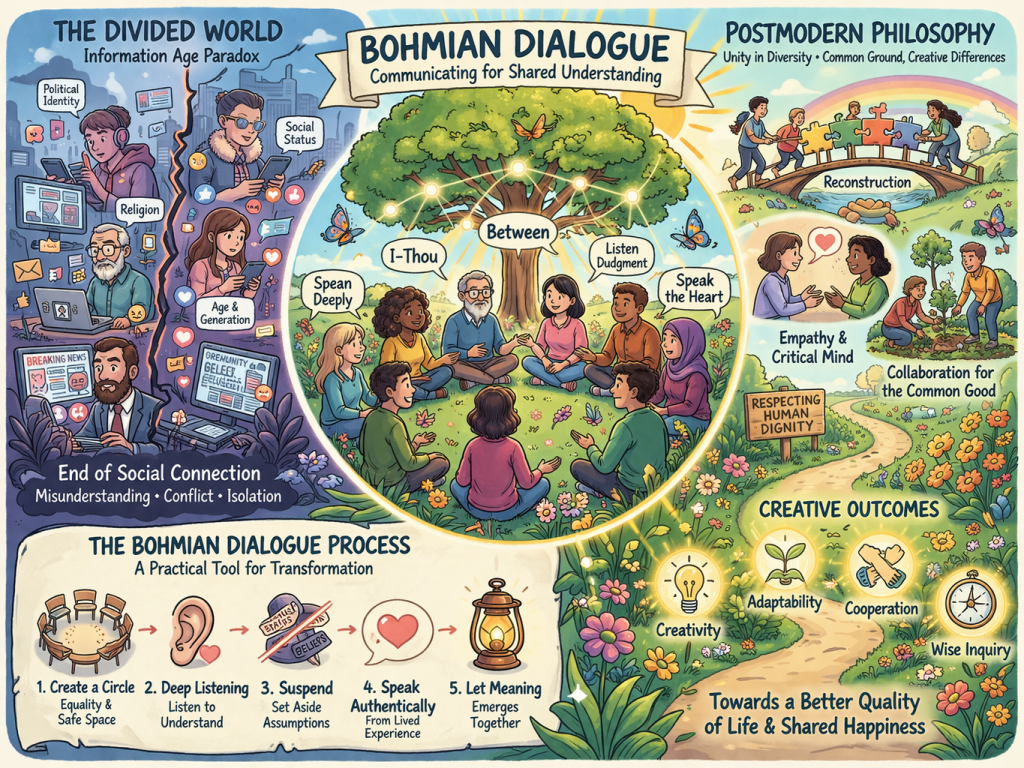
Contemporary information societies boast unprecedented technological interconnection, yet many observers lament a simultaneous rise in isolation and social fragmentation. People may be “connected” via social media and networks, but genuine interpersonal bonds often weaken. Roles, status, religion, and ideology can become masks that shut out authentic encounter (Bohm, 1996). Meetings and debates frequently end in rigid conclusions that participants later exploit for personal or partisan gain, perpetuating misunderstanding and conflict. In this milieu, how can philosophy address the breakdown of social relations?
This study explores dialogue as both a philosophical paradigm and a practical method. We ask: Can “dialogue” – particularly the Bohmian/Buberian conception of open, reflective conversation – serve as a tool of moderate postmodern philosophy to overcome division and promote peace? Our working hypothesis is affirmative: dialogue epitomizes the postmodern emphasis on creative, shared inquiry and unity-in-diversity (Friedman, 1960; Husserl, 1913/1970). To investigate, we use a discursive, text-analytic method: reviewing classic works (Buber’s I and Thou, Bohm’s On Dialogue, Husserl’s phenomenology) and contemporary sources, plus insights from expert roundtables. We analyze how dialogue (a) rests on a deep philosophy of relational being, (b) functions as a process tool in education, politics, and peacebuilding, (c) employs a phenomenological suspension of bias, and (d) fosters mutual understanding and creative cooperation. Finally, we connect these findings to moderate postmodern thought, which values open-ended inquiry, pluralism, and reconstruction of meaning(Clayton, 2006; Husserl, 1913/1970).
Philosophy of Dialogue: Buber and Bohm
Martin Buber’s I–Thou: Dialogue has a philosophical pedigree. Martin Buber’s classic I and Thou (1923) distinguishes two modes of relation: I–It (objective, utilitarian) and I–Thou (reciprocal, present) (Isaacs, 1999; Turkle, 2011). In I–It relations, one treats others as discrete objects (“things”), whereas in I–Thou relations one encounters others (even things or God) in full presence. Buber emphasizes that the “world is twofold…according to the two basic words [I–Thou and I–It]”(Isaacs, 1999). The “I” that speaks “Thou” engages with its whole being, creating a shared field – the “sphere of between” – where relation itself becomes real (Bohm, 1996)
Buber writes: “But when two individuals ‘happen’ to each other, then there is an essential remainder…that remainder is the basic reality, the ‘sphere of between’ (das Zwischenmenschliche)”(Bohm, 1996). This “dialogical” sphere requires both partners’ full participation: meaning is found in “neither one nor the other of the partners, nor in both taken together, but in their interchange” (Buber, 1970). In other words, genuine dialogue creates something new in between participants. Love, trust, or understanding emerge only in the relational meeting (I–Thou), not through cognitive manipulation. Buber’s notion of the Eternal Thou further extends this: the highest I–Thou relation is between man and God, modeling ultimate presence (Turkle, 2011).
Thus, as Buber posits, dialogue is more than technique – it is ontologically central. Philosophy itself for Buber is grounded in relational encounter, not abstract debate. Dialogue opens “a space between” individuals where the co-created reality of intersubjectivity comes alive (Bohm, 1996). This philosophical grounding implies that in the end dialogue is not primarily about reaching preset conclusions, but about being together authentically (Buber, 1970).
Bohm’s Collective Inquiry: Physicist David Bohm built on Buber’s insight and pioneered a formal “Dialogue” method for groups (colloquially Bohmian Dialogue). In On Dialogue (1996), Bohm and editor Lee Nichol describe dialogue as a free-flowing group conversation that explores thought processes themselves. Bohm emphasizes that dialogue is a “multi-faceted process” extending beyond ordinary discussion: it examines our feelings, assumptions, and the collective formation of meaning (Bohm, 1996). In a genuine Bohm dialogue, participants suspend judgment and status, listening deeply so that ideas can be reshaped.
Bohm famously contrasted dialogue with “discussion.” Drawing on Greek etymology, he notes “dialogos” means “through the word,” suggesting a stream of meaning flowing among people (Bohm, 1996). Unlike debate (latin discutere, to break apart), dialogue is creative. Bohm explains that in dialogue “everybody wins if anybody wins” (Bohm, 1996): there is no goal of persuasion or victory. He writes: “Whenever any mistake is discovered on the part of anybody, everybody gains… dialogue is a win-win.” (Bohm, 1996). This shift from adversarial to cooperative interaction is key.
Bohm (via Isaacs) also highlights that dialogue nurtures new, emergent understanding. William Isaacs (1999) notes, “A large part of [learning dialogue] has to do with… giving up the effort to make [others] understand us and [moving] to a greater understanding of ourselves and each other” (Bohm, 1996). He observes that “the most important parts of any conversation are those that neither party could have imagined before starting”(Bohm, 1996). As Bohm remarks, genuine dialogue produces a “flow of meaning” that was not in the starting point at all (Bohm, 1996). Concretely, one participant may respond to another’s words with a slightly different meaning, prompting all to see something new. Bohm describes how dialogue can “go back and forth, with the continual emergence of a new content that is common to both participants”. In short, dialogue is dialogical: participants co-create insights together (Bohm, 1996).
Phenomenological Stance in Dialogue
Philosophically, dialogue adopts a phenomenological attitude. Participants are asked to “bracket” their prejudices and assumptions (a practice akin to Husserl’s epoché) (Buber, 1970) in order to perceive others’ perspectives freshly. As Husserl put it, bracketing involves “refraining from judgment and biased opinions to wholly understand an experience”(Buber, 1970). Similarly, in dialogue one suspends personal agendas, roles, and preconceptions – symbolized in practice by “taking off the masks and hats” one normally wears. Only then can each person listen deeply without interrupting, and attend with a “neutral trust” to whatever emerges (Buber, 1970).
This phenomenological openness means each participant treats the conversation itself as the source of meaning, rather than relying solely on prior beliefs. Bohm explicitly frames dialogue as inquiry into thought: it “explores the way in which [thought]…is generated and sustained on a collective level” (Isaacs, 1999). Likewise, Buber’s idea of the dialogical foregrounds that experience of encounter, not the spectator attitude. By focusing on experience as it unfolds, dialogue honors each person’s embodied perspective (Amaritwarin & Suwanbundit, 2022). Indeed, moderate postmodernism emphasizes that all knowledge is perspectival, yet real. As Clayton notes, even “radically divergent perspectives may at some level apprehend the same element of reality” (Clayton, 2006). Dialogue provides the setting where such different perspectives can meet without being reduced to one “absolute” viewpoint (Clayton, 2006).
Dialogue, Conflict and Peace
A wealth of literature shows that dialogue can reduce conflict and build peace. When participants share their experiences openly and listen empathically, they gain mutual understanding that undercuts stereotypes and hostility. As Isaacs (1999) observes, dialogue “enables people to bring out differences and begin to make sense of them, fostering communication and understanding” (Bohm, 1996). By consciously reflecting on diversity in a safe space, dialogue lowers the tensions that breed conflict.
Bohm similarly points out that dialogue “lifts us out of polarization” by channeling the energy of differences into something creative (Bohm, 1996). He distinguishes dialogue from negotiation: the latter seeks agreement, whereas dialogue “seeks to open possibilities and see new options” (Bohm, 1996). In practice, communities worldwide have used dialogue sessions to address intractable disputes – from ethnic and religious strife to organizational gridlock. True dialogue dissolves problems at a deeper level: one’s “motive is not to achieve victory or consensus, but to create a context from which many new agreements might come” (Bohm, 1996). The ultimate result is a thicker fabric of relationships and shared meaning (the “glue” that holds societies together).
Moderate postmodern philosophy similarly affirms this dialogical approach to conflict. It rejects both authoritarian uniformity and “anything goes” relativism. Instead, it advocates finding common ground within genuine disagreement (Clayton, 2006). As Clayton notes, moderate postmodernists hold that error is corrigible through normal human dialogue; there are “better and worse” perspectives, but no infallible arbiter (Clayton, 2006). In such a view, dialogical inquiry is precisely the method by which plural groups negotiate meaning. Participants share their traditions and assumptions, yet remain open to being changed. In this way, dialogue incarnates the postmodern ideal of unity-in-diversity: it recognizes difference but also affirms that we are not “irreducibly far apart” as embodied beings (Clayton, 2006). Through ongoing dialogue and creative reframing, communities can reconstruct peaceful social orders that respect human dignity in all its variety.
Dialogue and Human Flourishing
Beyond conflict, dialogue nurtures personal growth and quality of life. In our media-saturated age, people often complain of “losing touch” with inner values and with each other (Turkle 2011). Dialogue counters this by demanding presence, empathy, and authenticity. When participants speak from the heart and listen fully, they exercise mindfulness and self-reflection. Many report that the aftermath of true dialogue produces a surge of creative insight and communal purpose. Bohm himself believed that the shared field created by dialogue liberates latent creativity and intelligence in groups (Bohm, 1996). This “shared meaning” acts like “cement” bonding people (Bohm, 1996), enabling cooperative action on long-term challenges (from environmental projects to social innovation).
From a philosophical perspective, dialogue also aligns with humanistic and Buddhist values. Reflecting on the experts’ suggestions, dialogue trains individuals to know themselves in each moment, noticing biases and emotional states as they arise – a form of self-inquiry akin to meditation (Buber, 1970). It diminishes the “egoic self” fixations that postmodern theorists critique, helping people become less attached to artificial personas. The postmodern moderate vision posits that true happiness (or “moral/spiritual progress”) arises when we assess external knowledge realistically and live by convictions rooted in empathy and cooperation. In dialogue, participants practice precisely this: they question assumptions (Bacon’s idols) and use critical openness (Husserl’s epoché) to approach a freer understanding (Buber, 1970). As a result, they may experience the “joy of conviction” – knowing truth by one’s own criteria – and pride in collaborative creativity (Clayton, 2006). In sum, dialogue can be seen as a praxis for flourishing: it cultivates virtues of respect, humility, and solidarity that define a just, joyful society.
Dialogue and Moderate Postmodernism
The convergence of dialogue and moderate postmodern philosophy is striking. Moderate postmodernism (as articulated by thinkers like John Clayton) rejects both rigid modern rationalism and nihilistic deconstruction (Clayton, 2006). It holds that while no view is absolutely true, we can correct errors through ordinary intersubjective means. Dialogue epitomizes this stance: it places us in “the muck and mire of real existence” with all ambiguity, where no one has absolute truth but none is utterly wrong (Clayton, 2006). Each participant brings a situated perspective, yet through dialogue they can transcend solipsism without resorting to authoritarian certainty.
Moreover, moderate postmodernists emphasize building a new cooperative understanding from diverse inputs. They “take to heart the postmodern freedom from the modern burden of explicating and justifying all basic assumptions” (Clayton, 2006), and recognize that differences need not entail division (Clayton, 2006). Dialogue provides a concrete method for exactly this process. It systematically invites multiple viewpoints, allows them to interact, and “stretch[es] to fuller truth” by synthesizing elements of each (Clayton, 2006). In short, dialogue is a participatory reconstruction of meaning, mirroring the postmodern project of reconstruction (rather than deconstruction alone)(Bohm, 1996; Clayton, 2006).
In particular, Bohm’s notion of inquiry with “a center, not sides” (Bohm, 1996) resonates with moderate postmodern values. The aim is not to crush dissenting voices but to channel their energy toward common insight. After a dialogue session, groups often report a new “field of consensus” emerging that no individual had planned. This outcome – the creative, unplanned byproduct – is precisely the “power of creativity” that the Thai research suggests is unleashed post-dialogue. Such creativity can then fuel adaptive collaboration, echoing the moderate postmodern emphasis on cooperation and adaptability (as a way to improve life quality).
Thus, our hypothesis is supported: dialogue is indeed a tool of the moderate postmodern paradigm. It operationalizes key postmodern principles – pluralism, contextual truth, unity-in-diversity, and critical reconstruction – within a communicative practice. It arms communities with “immunity” against fragmentation: when people learn to listen across differences and create shared meaning, they become resilient to polarization. Dialogue neither denies objective dimensions of reality nor submits to relativism; instead it acknowledges that all participants are fallible knower–beings and that truth emerges intersubjectively (Clayton, 2006). In practice, dialogue thus helps realize a “new social space” of egalitarian reflection, as envisioned by the Thai researchers, where cooperation and empathy can flourish.
Conclusion
In a world where technology simultaneously connects and isolates, the philosophy of dialogue offers a timely remedy. By fostering I–Thou encounters and creative co-thinking, dialogue rebuilds the “sphere of between” that Buber described and honors the embodied pluralism that postmodern thought affirms (Buber, 1970; Clayton, 2006). As a practical method, Bohmian dialogue enacts a phenomenological suspension of bias and generates new shared meaning, dissolving conflicts and unearthing solutions no side could foresee (Bohm, 1996). These outcomes – understanding, empathy, adaptability, and collective creativity – are precisely the foundations of peace and well-being.
We conclude that dialogue is not merely a communication technique but a philosophical praxis aligned with moderate postmodernism. It embodies a critical-creative mindset that values both commonality and difference. In the language of moderate postmodernists: it places us humbly in “real existence” where all views matter and errors can be self-corrected through mutual reflection (Buber, 1970; Clayton, 2006). In short, dialogue is a tool of moderate postmodern philosophy – an essential means for cultivating global peace, social harmony, and the human qualities of trust and creativity that durable happiness requires.
References
Amaritwarin, S., & Suwanbundit, A. (2022). Dialogue: Instrument of Moderate Postmodern Paradigm. Journal of Dhammasuksa Research. 5(1): 152-161.
Bohm, D. (1996). On Dialogue (L. Nichol, Ed.). London: Routledge.
Buber, M. (1970). I and Thou (W. Kaufmann, Trans.; original work published 1923). New York: Scribner.
Clayton, G. (2006). Discerning the spirits of modernity and postmodernity. Perspectives on Science and Christian Faith, 58(1), 15–37.
Friedman, M. S. (1960). Martin Buber: The Life of Dialogue. New York: Harper.
Husserl, E. (1913/1970). The Crisis of European Sciences and Transcendental Phenomenology (D. Carr, Trans.). Evanston, IL: Northwestern University Press.
Isaacs, W. (1999). Dialogue: The Art of Thinking Together. New York: Doubleday.
Turkle, S. (2011). Alone Together: Why We Expect More from Technology and Less from Each Other. New York: Basic Books.
 ปรัชญาสวนสุนันทา
Leave a comment