Ravich Takaew, Ph.D.
Program of Philosophy and Ethics, Graduate School,
Suan Sunandha Rajabhat University, Thailand
Abstract
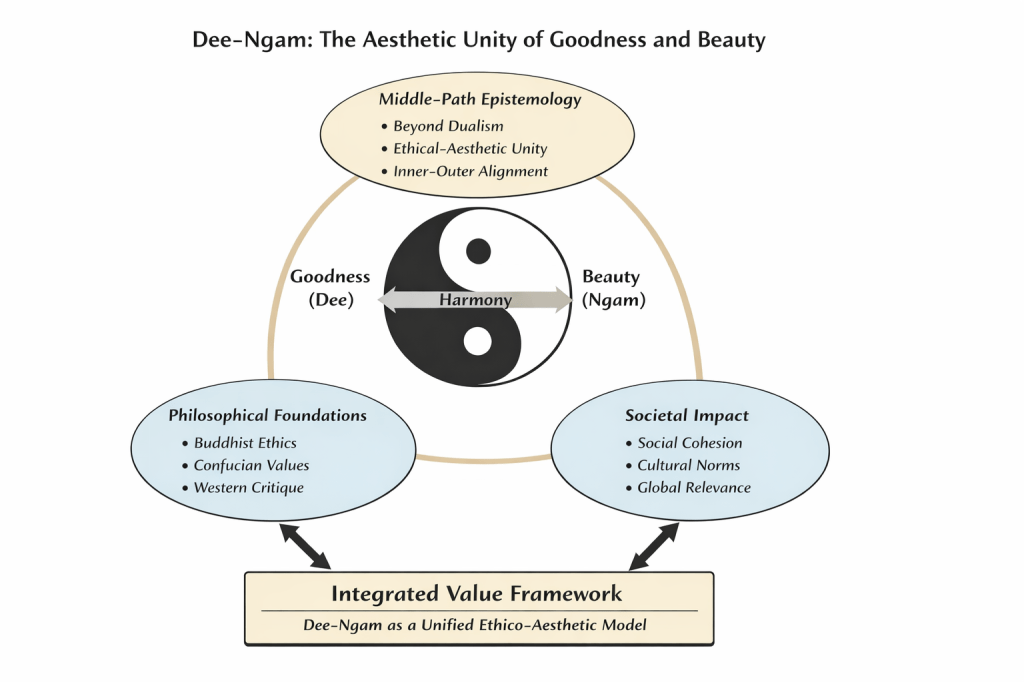
This article explores the philosophical-aesthetic concept of “Dee-Ngam” (ดีงาม) in Thai cultural context, arguing that goodness and beauty are not merely related but fundamentally unified within Thai cognitive and cultural structures. By synthesizing Eastern and Western philosophical traditions alongside sociological roles of sophists, philosophers, and philosophical academicians, the study demonstrates that Dee-Ngam functions not merely as a linguistic construct but as both an ethical criterion and an aesthetic ideal embedded in lived experience. The analysis employs hermeneutics, analytic philosophy, and cultural semiotics to argue that Thai civilization articulates a middle-path epistemology integrating objectivity and subjectivity. This unified concept contributes significantly to understanding how moral-aesthetic frameworks sustain social harmony and civilizational continuity.
Introduction
The relationship between goodness and beauty has long occupied a central yet deeply contested position within the history of philosophy. In classical Greek thought, particularly in the philosophy of Plato, the Good (to agathon) and the Beautiful (to kalon) are intimately connected within the metaphysical structure of the Forms, suggesting an ontological unity between ethical and aesthetic value (Plato, trans. 1997). However, this unity is progressively destabilized in modern philosophy. Most notably, Immanuel Kant’s critical project establishes a decisive distinction between moral judgment—grounded in practical reason—and aesthetic judgment—grounded in reflective judgment and subjective universality (Kant, 2000). This bifurcation becomes institutionalized within modern epistemology and metaphysics, reinforcing broader dualisms such as fact versus value, subject versus object, and being versus meaning (Putnam, 2002).
Yet, the postmodern turn in twentieth-century philosophy fundamentally challenges these inherited separations. Martin Heidegger’s reconfiguration of ontology displaces the primacy of substance and instead foregrounds Being-in-the-world (In-der-Welt-sein) as the basic condition of human existence, wherein meaning is disclosed through situated, relational engagement rather than abstract cognition (Heidegger, 1962). Building upon and radicalizing this insight, Jacques Derrida’s deconstructive approach reveals that binary oppositions—such as reason/emotion or ethics/aesthetics—are not stable foundations but rather effects of différance, a process of continual deferral and relational constitution of meaning (Derrida, 1978). Similarly, Michel Foucault demonstrates that what counts as truth or knowledge is inseparable from historically contingent discursive formations and power relations, thereby undermining the presumed neutrality of epistemological categories (Foucault, 1972). Together, these postmodern critiques call into question the very conditions under which ontological and evaluative distinctions are drawn.
Within this critical philosophical landscape, the Thai concept of Dee-Ngam (ดีงาม) emerges as a compelling and underexplored resource for rethinking the ontology of value. Conventionally translated as “good and beautiful,” Dee-Ngam appears, at first glance, to denote a conjunction of ethical and aesthetic qualities (Takaew, & Bunchua 2015). However, such a translation risks imposing a Western conceptual framework that presupposes the separability of these domains. This article argues that Dee-Ngam should instead be understood as a non-reductive unity, one that reflects a cultural logic in which goodness and beauty are not merely associated but intrinsically intertwined. In this sense, Dee-Ngam challenges the semantic and ontological assumptions embedded in modern dualistic thought.
From a philosophical standpoint, the significance of Dee-Ngam lies in its capacity to reconfigure the relationship between ontology and axiology. Rather than treating value as a secondary property attributed to an otherwise neutral reality, Dee-Ngam suggests that value is constitutive of being itself. This insight aligns with broader developments in relational and process-oriented philosophies. For instance, Alfred North Whitehead’s process metaphysics conceives reality as a network of interrelated events rather than static substances, thereby allowing value to emerge as an intrinsic feature of relational becoming (Whitehead, 1978). Similarly, in Buddhist philosophy, the doctrine of dependent origination (pratītyasamutpāda) posits that all phenomena arise interdependently, implying that meaning and value are co-emergent with relational existence (Garfield, 1995). These perspectives resonate strongly with the implicit ontology of Dee-Ngam, in which harmony, appropriateness, and balance function as criteria for both ethical and aesthetic evaluation.
At a deeper level, however, the theoretical articulation of Dee-Ngam necessitates engagement with meta-metaphysics—the philosophical inquiry into the nature, scope, and legitimacy of metaphysical claims themselves (Chalmers et al., 2009). Meta-metaphysics shifts the focus from questions about what exists to questions about how ontological frameworks are constructed, justified, and interpreted. In this context, Dee-Ngam can be conceptualized as a meta-metaphysical operator: a concept that not only participates in ontological description but also exposes the contingent structures underlying such descriptions. By collapsing the distinction between fact and value, Dee-Ngam reveals that the separation of ontology and axiology is not a necessary feature of reality but a historically situated philosophical choice.
This reconceptualization has significant implications for postmodern philosophy. While postmodern critiques have been effective in deconstructing foundational metaphysics, they are often criticized for leading to relativism or fragmentation (Habermas, 1987). Dee-Ngam, however, offers an alternative trajectory: a form of non-dual, relational coherence that does not rely on universal foundations yet avoids the dissolution of meaning into pure contingency. In this sense, it can be understood as articulating a “middle path” between metaphysical absolutism and epistemic nihilism—an approach that is both context-sensitive and normatively meaningful.
Accordingly, this article advances three central claims. First, that Dee-Ngam constitutes a relational ontology of value, wherein ethical and aesthetic dimensions are co-constitutive aspects of being. Second, that it functions as a meta-metaphysical critique of modern dualisms, particularly the fact–value distinction. Third, that it provides a postmodern yet non-relativistic framework for rethinking value in a global context marked by pluralism and fragmentation. By developing these claims, the study seeks not only to introduce Dee-Ngam into contemporary philosophical discourse but also to challenge the Eurocentric assumptions that continue to shape debates in ontology and value theory.
In doing so, the article contributes to an emerging body of comparative and cross-cultural philosophy that treats non-Western concepts not merely as objects of interpretation but as active interlocutors in the reconstruction of philosophical thought (Garfield & Van Norden, 2016). Ultimately, Dee-Ngam is presented here as more than a linguistic or cultural phenomenon; it is a philosophically generative concept that invites a rethinking of being, value, and their interrelation in the postmodern condition.
Ontology Revisited: From Substance to Relation
1. Classical Ontology and the Primacy of Substance
Classical ontology in the Western philosophical tradition has been predominantly structured around the notion of substance (ousia) as the fundamental unit of reality. In Aristotle’s metaphysics, substance is understood as that which exists in itself and underlies all predicates, serving as the bearer of properties and the ground of identity (Aristotle, trans. 1998). This substance-based ontology establishes a hierarchical framework in which essence precedes relation, and identity is prior to difference. Entities are thus conceived as self-contained, stable, and intelligible through their intrinsic characteristics.
This metaphysical orientation is further reinforced in early modern philosophy. René Descartes, for instance, distinguishes between res cogitans (thinking substance) and res extensa (extended substance), thereby inaugurating a dualistic ontology that separates mind and matter into distinct domains of being (Descartes, 1996). Such a framework not only privileges substance over relation but also introduces a rigid separation between subject and object, which becomes foundational for modern epistemology.
However, the primacy of substance entails significant limitations. First, it renders relationality secondary or derivative, thereby obscuring the ways in which entities are constituted through interaction and context. Second, it necessitates a sharp distinction between facts and values, as value is treated as an external attribution rather than an intrinsic dimension of being (Putnam, 2002). Third, it struggles to account for change, process, and emergence without reducing them to modifications of an underlying static essence. These limitations have prompted a series of philosophical reorientations aimed at reconceiving ontology beyond substance.
2. The Ontological Turn: Heidegger and Being-in-the-World
A decisive shift occurs in the work of Martin Heidegger, who challenges the substance-based framework by rearticulating ontology in terms of existential relationality. In Being and Time, Heidegger argues that the fundamental question of philosophy is not the categorization of entities but the meaning of Being itself (Heidegger, 1962). He introduces the concept of Dasein—the human mode of being—as inherently Being-in-the-world, a condition in which subject and object are not ontologically separate but co-constituted through practical engagement.
In this framework, entities are not first encountered as isolated substances but as meaningful within a referential totality (Bewandtnisganzheit). A tool, for example, is not understood as a neutral object with properties but as something “ready-to-hand” (zuhanden) within a network of purposes and relations (Heidegger, 1962). Ontology thus becomes fundamentally relational: being is disclosed through involvement, use, and context rather than abstract representation.
Heidegger’s notion of truth as aletheia—unconcealment—further reinforces this shift. Truth is no longer a correspondence between propositions and reality but a process of revealing that occurs within a horizon of understanding (Gadamer, 2004). This reconceptualization opens the possibility that value is not imposed upon being from an external standpoint but emerges from the very structures through which being is disclosed.
3. From Structuralism to Post-Structuralism: The Destabilization of Ontological Foundations
Building upon Heidegger’s critique, post-structuralist thinkers further destabilize the foundations of ontology by interrogating the conditions under which meaning and being are constituted. Jacques Derrida’s deconstruction reveals that metaphysical systems rely on binary oppositions—such as presence/absence, identity/difference, and essence/appearance—that are inherently unstable (Derrida, 1978). Through the concept of différance, Derrida demonstrates that meaning is always deferred and relationally constituted, thereby undermining the possibility of fixed ontological grounds.
Similarly, Michel Foucault’s genealogical approach shifts attention from universal structures of being to historically contingent discursive formations. In The Archaeology of Knowledge, Foucault argues that what counts as an object of knowledge is not given but produced through regimes of discourse and power (Foucault, 1972). Ontology, in this sense, is not a neutral description of reality but an effect of epistemic practices.
Jean-François Lyotard extends this critique by rejecting the legitimacy of grand narratives that claim to ground knowledge in universal principles. In The Postmodern Condition, he characterizes postmodernity as an “incredulity toward metanarratives,” emphasizing the plurality and heterogeneity of language games (Lyotard, 1984). This perspective further erodes the possibility of a unified ontological framework, replacing it with a multiplicity of localized, context-dependent realities.
4. Toward a Relational Ontology
In light of these critiques, contemporary philosophy increasingly moves toward a relational ontology, in which entities are understood not as self-subsisting substances but as nodes within dynamic networks of relations. This shift is evident in multiple traditions. In process philosophy, Alfred North Whitehead reconceives reality as a series of “actual occasions” whose identities are constituted through their relations to other occasions (Whitehead, 1978). Similarly, in Buddhist philosophy, the doctrine of dependent origination (pratītyasamutpāda) asserts that all phenomena arise interdependently, without intrinsic essence (svabhāva) (Garfield, 1995).
Relational ontology challenges the assumption that identity precedes relation. Instead, it posits that relations are ontologically primary, identity is emergent and contingent, and value is immanent within relational configurations.
This framework provides a fertile ground for reinterpreting concepts such as Dee-Ngam, which implicitly operate within a logic of relational harmony rather than substantive isolation.
5. Ontology, Value, and the Collapse of the Fact–Value Distinction
One of the most significant implications of the shift from substance to relation is the collapse of the fact–value distinction. In a substance-based ontology, facts are objective features of the world, while values are subjective or normative additions. However, if being itself is relational and context-dependent, then value cannot be cleanly separated from ontology.
Hilary Putnam argues that the fact–value dichotomy is untenable because descriptive and evaluative elements are deeply entangled in language and practice (Putnam, 2002). Similarly, Charles Taylor emphasizes that human understanding is always oriented by “strong evaluations” that shape our perception of reality (Taylor, 1989). These perspectives suggest that value is not an external layer imposed upon being but an integral aspect of how being is experienced and interpreted.
Within this context, Dee-Ngam can be seen as exemplifying an ontology in which ethical and aesthetic dimensions are inseparable from the structure of reality itself. It reflects a mode of being in which harmony, appropriateness, and relational balance are not merely evaluative criteria but ontological conditions.
6. Transition to Meta-Metaphysics
The movement toward relational ontology also necessitates a shift to meta-metaphysical reflection. If ontological categories are themselves products of relational and discursive processes, then the task of philosophy is not only to describe what exists but to examine the frameworks through which existence is conceptualized (Chalmers et al., 2009). This reflexive turn opens the possibility of rethinking ontology as an ongoing, interpretive practice rather than a fixed system of truths.
In this regard, Dee-Ngam can be understood as operating at both ontological and meta-metaphysical levels. It not only describes a mode of being characterized by ethical–aesthetic unity but also challenges the conceptual distinctions that make such a description appear paradoxical within modern philosophy. As such, it prepares the ground for a postmodern reconfiguration of ontology in which relation, value, and meaning are inseparably intertwined.
Dee-Ngam as Relational Ontology
1. From Linguistic Expression to Ontological Insight
The Thai term Dee-Ngam (ดีงาม), commonly translated as “good and beautiful,” initially appears to function as a descriptive or evaluative expression within everyday language. However, from a philosophical perspective, such a translation risks reducing the term to a mere conjunction of two distinct value categories—ethical goodness (dee) and aesthetic beauty (ngam). This interpretive move implicitly presupposes the modern Western distinction between ethics and aesthetics, thereby obscuring the deeper ontological implications embedded within the concept.
Rather than treating Dee-Ngam as a composite of separable properties, this article proposes that it be understood as a non-dual semantic unity that reflects a culturally embedded ontology of value. In this sense, Dee-Ngam operates not at the level of predication (i.e., attributing qualities to objects) but at the level of ontological disclosure, revealing a mode of being in which ethical and aesthetic dimensions are co-constitutive. This interpretation aligns with Heidegger’s notion that language is “the house of Being,” wherein meaning is not merely expressed but ontologically revealed (Heidegger, 1971).
From a hermeneutic standpoint, the task is therefore not to translate Dee-Ngam into pre-existing philosophical categories, but to allow it to challenge and reconfigure those categories. As Gadamer (2004) argues, understanding involves a “fusion of horizons” in which the interpreter’s conceptual framework is transformed through engagement with the other. Dee-Ngam, in this sense, becomes a site of philosophical innovation rather than a passive object of analysis.
2. Dee-Ngam and the Ontology of Harmony
At the core of Dee-Ngam lies an implicit ontology of relational harmony. Unlike substance-based frameworks that prioritize independence and self-identity, Dee-Ngam presupposes that value emerges through the alignment and balance of relations—between individuals, communities, environments, and moral intentions. An action is not “good” in isolation, nor “beautiful” merely in form; it is Dee-Ngam insofar as it manifests a harmonious integration of ethical intention and aesthetic expression.
This notion resonates strongly with relational ontologies found in both Eastern and Western philosophical traditions. In Confucian philosophy, for example, the concept of he (harmony) is central to ethical life, emphasizing the cultivation of balanced relationships rather than adherence to abstract rules (Ames & Hall, 2001). Similarly, in Buddhist thought, the principle of dependent origination (pratītyasamutpāda) suggests that all phenomena arise through interdependent conditions, thereby grounding value in relational coherence rather than intrinsic essence (Garfield, 1995).
In the Western tradition, Alfred North Whitehead’s process philosophy offers a parallel framework in which reality is constituted by interrelated events, each of which embodies both physical and evaluative dimensions (Whitehead, 1978). For Whitehead, value is not an external addition to being but an intrinsic feature of the process of becoming. Dee-Ngam can thus be interpreted as a culturally specific articulation of a more general ontological insight: that being is fundamentally relational and value-laden.
3. The Collapse of Ethical–Aesthetic Dualism
One of the most significant philosophical implications of Dee-Ngam is its challenge to the dualism between ethics and aesthetics. In modern philosophy, this distinction is most clearly articulated in Kant’s separation of moral judgment (based on duty and universality) from aesthetic judgment (based on disinterested pleasure) (Kant, 2000). While this distinction has been influential, it also reinforces a broader fragmentation of human experience into discrete domains governed by different rationalities.
Dee-Ngam, by contrast, suggests that ethical and aesthetic dimensions are not merely compatible but inseparable aspects of a unified mode of being. A morally good action that lacks grace, sensitivity, or contextual appropriateness may fail to be ngam, while an aesthetically pleasing form that lacks ethical integrity may fail to be dee. The concept thus resists reduction to either domain and instead points toward a holistic evaluative framework.
This perspective finds support in contemporary critiques of the fact–value distinction. Putnam (2002) argues that the separation of facts and values is philosophically untenable, as evaluative considerations are embedded within descriptive practices. Similarly, Iris Murdoch emphasizes the role of moral perception, in which the cultivation of attention and sensitivity—often associated with aesthetic experience—is integral to ethical understanding (Murdoch, 1997). Dee-Ngam can therefore be seen as exemplifying a mode of judgment in which ethical and aesthetic criteria are mutually informing and co-constitutive.
4. Dee-Ngam as Meta-Metaphysical Intervention
Beyond its ontological implications, Dee-Ngam also operates at the level of meta-metaphysics, challenging the conceptual frameworks through which ontology itself is articulated. Meta-metaphysics, as defined by Chalmers et al. (2009), concerns the nature and legitimacy of metaphysical inquiry, including questions about the structure, scope, and interpretation of ontological claims.
From this perspective, Dee-Ngam can be understood as a meta-metaphysical intervention that exposes the contingency of the categories used to describe reality. By collapsing the distinction between ethics and aesthetics, it reveals that the separation of value domains is not a necessary feature of ontology but a product of specific philosophical traditions. In doing so, it invites a rethinking of the relationship between being and value at a more fundamental level.
Moreover, Dee-Ngam challenges the assumption that ontology must be grounded in universal, context-independent principles. Instead, it suggests that ontological insight can emerge from culturally situated practices and linguistic forms. This aligns with recent developments in comparative philosophy, which emphasize the importance of engaging non-Western concepts as sources of theoretical innovation rather than merely as objects of interpretation (Garfield & Van Norden, 2016).
5. Toward a Postmodern Relational Framework
In the context of postmodern philosophy, Dee-Ngam offers a promising alternative to both foundationalism and relativism. While postmodern critiques have successfully deconstructed the universal claims of modern metaphysics, they have also been criticized for leading to fragmentation and the loss of normative grounding (Habermas, 1987). Dee-Ngam, however, provides a model of relational coherence that does not rely on fixed foundations yet retains normative significance.
This framework can be understood as a form of non-dual relational ontology, in which meaning, value, and being are co-emergent within dynamic networks of relations. It avoids the rigidity of substance metaphysics while also resisting the dissolution of meaning into pure contingency. In this sense, Dee-Ngam articulates a “middle path” that is consistent with both Buddhist philosophy and certain strands of postmodern thought.
Furthermore, Dee-Ngam has practical implications for contemporary global challenges. In a world characterized by cultural pluralism, ecological crisis, and social fragmentation, the need for integrative frameworks that bridge ethical and aesthetic dimensions is increasingly urgent. By emphasizing harmony, balance, and relational alignment, Dee-Ngam offers a conceptual resource for rethinking development, sustainability, and human flourishing in a holistic manner.
6. Theoretical Contribution
The analysis of Dee-Ngam as relational ontology contributes to contemporary philosophy in three key ways. First, it introduces a non-Western conceptual framework that challenges dominant metaphysical assumptions and expands the scope of ontological inquiry. Second, it advances a relational theory of value in which ethical and aesthetic dimensions are co-constitutive aspects of being. Third, it provides a meta-metaphysical critique of modern dualisms, thereby opening new avenues for postmodern philosophical reconstruction.
In doing so, this study not only enriches the discourse on ontology and value but also demonstrates the importance of cross-cultural engagement in the ongoing development of philosophy as a global and dialogical enterprise.
Meta-Metaphysics: Dee-Ngam as Operator
1. From Ontology to Meta-Metaphysics
While the previous section has argued that Dee-Ngam can be understood as articulating a relational ontology of value, a further philosophical step is required to fully grasp its significance. This step involves a transition from ontology to meta-metaphysics—that is, from questions about what exists to questions about how ontological frameworks themselves are constituted, interpreted, and justified (Chalmers et al., 2009).
Meta-metaphysics interrogates the conceptual schemes through which reality is described, asking not only whether certain entities or relations exist, but also how the language and categories used to describe them shape our understanding of existence. As Sider (2011) argues, metaphysical inquiry is deeply entangled with questions about the structure of reality as represented through language, raising the issue of whether ontological debates are substantive or merely verbal. Similarly, Carnap (1950) distinguishes between “internal” questions within a linguistic framework and “external” questions about the framework itself, thereby foregrounding the meta-level at which ontological commitments are negotiated.
Within this context, Dee-Ngam can be reconceptualized not merely as an ontological description, but as a meta-metaphysical operator—a concept that both participates in and transforms the frameworks through which ontology is articulated. It does not simply describe a mode of being; it actively reconfigures the conditions under which such descriptions become intelligible.
2. Conceptualizing Dee-Ngam as an Operator
To describe Dee-Ngam as an “operator” is to emphasize its functional and transformative role within philosophical discourse. Rather than functioning as a static concept or category, an operator acts upon existing distinctions, modifying their structure and revealing their limitations. In this sense, Dee-Ngam operates by collapsing, mediating, and rearticulating key metaphysical binaries.
First, Dee-Ngam collapses the distinction between ethics and aesthetics, as discussed in the previous section. However, at the meta-metaphysical level, this collapse extends further: it calls into question the broader separation between ontology and axiology, revealing that the distinction between “what is” and “what is valuable” is not ontologically fundamental but conceptually constructed (Putnam, 2002).
Second, Dee-Ngam mediates between universality and particularity. In modern metaphysics, universal principles are often privileged as the basis for objective knowledge, while particular contexts are treated as secondary or contingent. Dee-Ngam, by contrast, suggests that universality emerges through the resonance of relational coherence across contexts, rather than through abstraction from them. This aligns with Wittgenstein’s later philosophy, in which meaning arises from language use within “forms of life” rather than from correspondence to universal essences (Wittgenstein, 2009).
Third, Dee-Ngam rearticulates the relationship between presence and absence, a central concern in Derridean deconstruction. By emphasizing harmony and relational alignment, Dee-Ngam does not seek a fully present, self-identical ground of being. Instead, it acknowledges that meaning emerges through dynamic interplay, where absence and difference are constitutive rather than disruptive (Derrida, 1978).
3. Linguistic Frameworks and Ontological Pluralism
Understanding Dee-Ngam as a meta-metaphysical operator also requires attention to the role of language in shaping ontology. As Carnap (1950) suggests, different linguistic frameworks generate different ontological commitments. What counts as an “entity,” a “property,” or a “relation” depends on the conceptual scheme within which such terms are defined.
From this perspective, Dee-Ngam can be seen as emerging from a distinct linguistic–cultural framework that does not presuppose the same categorical divisions as modern Western philosophy. Rather than mapping neatly onto the categories of ethics and aesthetics, Dee-Ngam operates within a semantic field in which these distinctions are already intertwined. This suggests that ontology is not a universal, context-independent structure, but a plural and context-sensitive domain.
Such a view resonates with contemporary meta-metaphysical debates about ontological pluralism. Hirsch (2011), for example, argues that many ontological disputes are best understood as disagreements between equally valid conceptual schemes rather than as conflicts about objective reality. Similarly, Thomasson (2015) defends a form of “easy ontology,” in which ontological questions are resolved through conceptual analysis rather than metaphysical speculation. Dee-Ngam contributes to this debate by illustrating how alternative conceptual schemes can generate fundamentally different ontological insights.
4. The Normativity of Ontological Frameworks
A crucial implication of treating Dee-Ngam as a meta-metaphysical operator is that ontological frameworks are not normatively neutral. The way reality is conceptualized has direct implications for how it is valued, interpreted, and acted upon. As Foucault (1972) demonstrates, regimes of knowledge are inseparable from regimes of power, shaping not only what is considered true but also what is considered good, desirable, or legitimate.
In this light, the modern separation of ontology and axiology can be seen as reinforcing a form of value-neutral objectivity that obscures its own normative assumptions. By contrast, Dee-Ngam foregrounds the inseparability of being and value, thereby making explicit the normative dimensions of ontological thought.
This perspective is further supported by Charles Taylor’s (1989) argument that human agents are always oriented by “strong evaluations” that structure their understanding of the world. Ontology, in this sense, is not merely descriptive but inherently evaluative. Dee-Ngam, as an operator, makes this evaluative dimension visible and central, rather than marginal or derivative.
5. Postmodern Implications: Beyond Foundationalism and Relativism
One of the central challenges in postmodern philosophy is how to navigate between the extremes of foundationalism and relativism. While foundationalist metaphysics seeks universal, context-independent truths, postmodern critiques often lead to a proliferation of perspectives without clear criteria for evaluation (Habermas, 1987).
Dee-Ngam, understood as a meta-metaphysical operator, offers a potential way forward. By emphasizing relational coherence rather than fixed foundations, it provides a non-foundational basis for normativity. At the same time, by grounding evaluation in patterns of harmony and alignment, it avoids the arbitrariness associated with radical relativism.
This approach can be seen as a form of postmodern realism—a position that acknowledges the constructed nature of ontological frameworks while maintaining that some configurations of relations are more coherent, meaningful, or “Dee-Ngam” than others. It thus preserves the possibility of critique and evaluation without appealing to absolute foundations.
6. Toward a Reflexive Ontology
The meta-metaphysical function of Dee-Ngam ultimately points toward a reflexive ontology—an understanding of being that includes within itself an awareness of its own conceptual conditions. Rather than seeking to establish a final, definitive account of reality, reflexive ontology recognizes that all ontological claims are situated within particular frameworks that are themselves open to revision and transformation.
In this sense, Dee-Ngam does not merely offer an alternative ontology; it invites a transformation in the practice of ontology itself. It encourages philosophers to move beyond the search for ultimate foundations and toward a more dialogical, context-sensitive, and ethically attuned mode of inquiry.
Postmodern Implications
1. The Crisis of Modernity and the Fragmentation of Value
The emergence of postmodern thought is often framed as a response to the crisis of modernity, characterized by the fragmentation of knowledge, the decline of grand narratives, and the destabilization of universal foundations (Lyotard, 1984). Modern philosophy, grounded in Enlightenment ideals of rationality and objectivity, sought to establish a unified framework for truth, ethics, and aesthetics. However, this project has increasingly been called into question, both for its internal contradictions and for its exclusion of alternative epistemologies.
The separation of fact and value, as institutionalized in modern epistemology, has contributed to a fragmentation of human experience. Scientific knowledge is treated as objective and value-neutral, while ethical and aesthetic judgments are relegated to the realm of subjectivity (Putnam, 2002). This division not only undermines the coherence of human understanding but also limits the capacity for integrative responses to complex global challenges, such as ecological crisis, social inequality, and cultural conflict.
Postmodern critiques expose these limitations by revealing the historical and discursive conditions under which such distinctions are constructed. As Foucault (1972) demonstrates, regimes of knowledge are inseparable from power relations, while Derrida (1978) shows that the binary oppositions underpinning modern thought are inherently unstable. Yet, while these critiques effectively deconstruct foundational assumptions, they often leave open the question of how to reconstruct meaningful frameworks for understanding and action.
2. Dee-Ngam and the Reconstruction of Value
Within this context, Dee-Ngam offers a promising resource for the reconstruction of value in postmodern philosophy. Rather than attempting to restore universal foundations, Dee-Ngam proposes a model of relational coherence in which ethical and aesthetic dimensions are integrated within a dynamic field of relations.
This approach aligns with broader efforts in postmodern and post-analytic philosophy to move beyond the dichotomy between objectivism and relativism. For example, Richard Rorty (1989) advocates a form of pragmatic solidarity in which truth and value emerge through communal practices rather than correspondence to objective reality. Similarly, Bruno Latour (2005) emphasizes the importance of networks and associations in the construction of both knowledge and reality, challenging the modern separation between nature and society.
Dee-Ngam can be understood as contributing to this reconstruction by providing a normative orientation without foundationalism. It does not posit fixed criteria for what is good or beautiful; rather, it emphasizes the cultivation of relational harmony, contextual sensitivity, and integrative judgment. In this sense, it offers a framework for navigating complexity without reducing it to either rigid principles or arbitrary preferences.
3. Beyond Relativism: Relational Coherence as Normativity
One of the central criticisms of postmodern philosophy is that it leads to relativism, undermining the possibility of normative judgment. If all values are socially constructed, then it becomes difficult to justify any particular ethical or aesthetic claim. However, this critique often assumes that normativity must be grounded in universal, context-independent principles.
Dee-Ngam challenges this assumption by proposing an alternative basis for normativity: relational coherence. Rather than evaluating actions or phenomena according to abstract rules, Dee-Ngam assesses them in terms of their capacity to generate harmony, balance, and meaningful integration within a given context. This approach is neither absolutist nor relativistic; it is context-sensitive yet evaluative.
This perspective resonates with Jürgen Habermas’s (1984) theory of communicative action, in which normativity emerges through processes of rational dialogue oriented toward mutual understanding. It also aligns with Alasdair MacIntyre’s (1981) account of virtue ethics, which emphasizes the role of traditions and practices in shaping moral judgment. However, Dee-Ngam extends these frameworks by explicitly integrating aesthetic considerations into the structure of normativity, thereby offering a more holistic account of value.
4. Postmodern Ontology and the Reconfiguration of Being
The implications of Dee-Ngam are not limited to axiology; they also extend to postmodern ontology. As discussed in previous sections, the shift from substance-based to relational ontology reflects a broader transformation in philosophical thought. In postmodern contexts, being is no longer understood as a stable, self-identical foundation but as a dynamic process of becoming shaped by relations, differences, and contexts (Deleuze, 1994).
Dee-Ngam contributes to this reconfiguration by articulating a mode of being in which value is immanent to relational processes. It suggests that ontology and axiology are not separate domains but interwoven dimensions of a single field of existence. This insight aligns with Gilles Deleuze’s notion of immanence, in which difference and becoming are primary, and with Jean-Luc Nancy’s (2000) concept of “being-with,” which emphasizes the co-existence and interdependence of all entities.
In this sense, Dee-Ngam can be seen as a culturally grounded expression of a broader postmodern ontology—one that prioritizes relation, process, and immanence over substance, stability, and transcendence.
5. Global and Cross-Cultural Implications
One of the most significant contributions of Dee-Ngam lies in its potential to decenter Eurocentric philosophy and contribute to a more pluralistic and dialogical global discourse. As Garfield and Van Norden (2016) argue, contemporary philosophy has been disproportionately shaped by Western traditions, often marginalizing non-Western perspectives or treating them as secondary.
By introducing Dee-Ngam as a philosophically generative concept, this study challenges the assumption that theoretical innovation must originate within Western frameworks. Instead, it demonstrates that non-Western concepts can play a central role in rethinking fundamental philosophical questions, particularly in areas such as ontology, value theory, and meta-metaphysics.
Moreover, the relational and integrative nature of Dee-Ngam makes it particularly relevant for addressing contemporary global challenges. Issues such as climate change, social fragmentation, and cultural conflict require approaches that transcend disciplinary and conceptual boundaries. By emphasizing harmony, balance, and relational alignment, Dee-Ngam offers a conceptual resource for developing more holistic and sustainable modes of thought and practice.
6. Toward a Moderate Postmodernism
Ultimately, the postmodern implications of Dee-Ngam can be understood in terms of a “middle path” between competing philosophical extremes. On the one hand, it rejects the foundationalism of modern metaphysics, which seeks universal and context-independent truths. On the other hand, it resists the relativism often associated with postmodern critiques, which can lead to fragmentation and the loss of normative orientation.
This middle path is characterized by:
- Relational ontology rather than substance ontology
- Immanent value rather than external normativity
- Context-sensitive judgment rather than universal rules
- Pluralism with coherence rather than fragmentation
Such a framework resonates with both Buddhist philosophy and certain strands of postmodern thought, suggesting the possibility of a postmodern realism grounded in relational coherence. It offers a way of thinking that is both critically reflexive and normatively meaningful, capable of engaging with complexity without succumbing to either dogmatism or nihilism.
Discussion
1. Objection 1: Is Dee-Ngam Merely a Culturally Relative Concept?
A primary concern that may be raised is whether Dee-Ngam is irreducibly culture-specific, and therefore lacks the philosophical generality required for broader theoretical application. From this perspective, Dee-Ngam might be interpreted as a localized linguistic artifact embedded within Thai cultural practices, with limited relevance beyond its original context.
However, this objection rests on a problematic assumption: namely, that philosophical validity requires context-independence or universality in the modernist sense. As postmodern and comparative philosophers have argued, all philosophical concepts emerge within particular historical and cultural horizons, including canonical Western notions such as “substance,” “reason,” or “autonomy” (Gadamer, 2004; Garfield & Van Norden, 2016). The apparent universality of these concepts is itself a product of intellectual hegemony rather than intrinsic neutrality.
In this light, Dee-Ngam should not be dismissed as merely local, but rather understood as a situated yet translatable conceptual resource. Its philosophical value lies precisely in its capacity to challenge dominant ontological assumptions and to expand the range of conceptual tools available for global philosophy. As with other cross-cultural philosophical imports—such as Dao, śūnyatā, or ubuntu—its significance emerges through dialogical engagement, not through prior conformity to universal categories.
Thus, rather than undermining its philosophical legitimacy, the cultural specificity of Dee-Ngam constitutes a condition of its theoretical productivity, enabling it to function as a critical standpoint from which to interrogate entrenched dualisms.
2. Objection 2: Does Relational Ontology Undermine Normativity?
A second objection concerns the potential normative weakness of relational ontology. If value is understood as emerging from context-dependent relations rather than grounded in universal principles, does this not lead to a form of relativism in which any configuration of relations could be considered equally valid?
This concern is well-established in critiques of postmodern philosophy, particularly those advanced by Habermas (1987), who argues that the rejection of universal foundations risks eroding the basis for critique and moral judgment. However, the present framework does not entail an “anything goes” relativism. Instead, it proposes relational coherence as a criterion for evaluation.
Relational coherence does not imply arbitrariness; rather, it introduces a structured yet non-foundational form of normativity. Certain configurations of relations—those that generate harmony, balance, and integrative alignment—can be distinguished from those that produce fragmentation, conflict, or dissonance. This evaluative distinction is not imposed from an external standpoint but arises immanently within relational fields.
This position is consistent with Putnam’s (2002) argument that fact and value are entangled, as well as with Taylor’s (1989) notion of “strong evaluation,” in which human agents are oriented toward qualitative distinctions that are neither purely subjective nor universally fixed. Similarly, in virtue ethics, moral judgment is grounded in the cultivation of practical wisdom (phronesis) rather than the application of abstract rules (MacIntyre, 1981).
Accordingly, Dee-Ngam does not weaken normativity but reconfigures it, shifting the basis of evaluation from universal laws to context-sensitive patterns of relational integrity.
3. Objection 3: Is the Concept of Dee-Ngam Philosophically Redundant?
Another possible critique is that Dee-Ngam may not introduce anything fundamentally new, but merely redescribes existing philosophical ideas—such as Aristotelian virtue, Confucian harmony, or Whiteheadian process—in a different linguistic form.
While it is true that Dee-Ngam resonates with multiple philosophical traditions, this does not render it redundant. On the contrary, its significance lies in its ability to articulate a unique configuration of these themes within a single conceptual unit. Unlike frameworks that treat ethics and aesthetics as distinct domains to be later integrated, Dee-Ngam begins from their inseparability, thereby avoiding the need for subsequent synthesis.
Moreover, the originality of a concept in philosophy is not determined solely by its novelty in isolation, but by its capacity to reorganize existing theoretical landscapes. As Deleuze (1994) argues, philosophical concepts are creative insofar as they generate new connections and open new lines of thought. In this sense, Dee-Ngam functions as a conceptual innovation that reconfigures the relationship between ontology, axiology, and meta-metaphysics.
It is precisely through its comparative resonance that Dee-Ngam demonstrates its theoretical power, serving as a نقطةเชื่อม (conceptual nexus) between diverse traditions while maintaining its distinct ontological orientation.
4. Objection 4: Does Meta-Metaphysical Framing Lead to Conceptual Indeterminacy?
A further concern may be that framing Dee-Ngam at the level of meta-metaphysics risks rendering the concept overly abstract or indeterminate. If Dee-Ngam functions as an “operator” that transforms conceptual frameworks, does it retain sufficient specificity to support concrete philosophical analysis?
This objection highlights a tension inherent in meta-metaphysical inquiry: the need to balance reflexivity with conceptual clarity. However, the notion of Dee-Ngam as an operator does not imply vagueness; rather, it specifies a mode of conceptual intervention. It identifies a particular pattern of transformation—namely, the collapse and reconfiguration of dualisms (ethics/aesthetics, fact/value, ontology/axiology)—that can be systematically analyzed.
Furthermore, meta-metaphysical reflection does not replace first-order ontology but supplements it, providing a framework for understanding how ontological claims are constructed and justified (Chalmers et al., 2009). In this sense, Dee-Ngam operates at multiple levels simultaneously: as an ontological descriptor, a normative framework, and a meta-metaphysical critique.
Rather than leading to indeterminacy, this multi-level structure enhances the concept’s explanatory power, enabling it to address both the content and the conditions of philosophical inquiry.
5. Synthesis: Toward a Coherent Theoretical Position
Taken together, these responses clarify the theoretical position advanced in this article. Dee-Ngam is not merely a cultural artifact, nor a relativistic dissolution of normativity, nor a redundant restatement of existing theories, nor an indeterminate abstraction.
Instead, it is best understood as a relational, integrative, and reflexive philosophical concept that operates across multiple levels of analysis.
Its contribution can be synthesized as follows:
- Ontological Level: Dee-Ngam articulates a relational ontology in which being is constituted through patterns of harmony and alignment.
- Axiological Level: It provides a non-dual framework in which ethical and aesthetic values are co-constitutive.
- Meta-Metaphysical Level: It functions as an operator that exposes and reconfigures the conceptual distinctions underlying modern philosophy.
- Postmodern Level: It offers a middle path between foundationalism and relativism, grounding normativity in relational coherence.
This multi-layered contribution positions Dee-Ngam as a theoretically robust and philosophically generative concept, capable of engaging with contemporary debates in ontology, value theory, and postmodern philosophy.
References
Ames, R. T., & Hall, D. L. (2001). Focusing the familiar: A translation and philosophical interpretation of the Zhongyong. University of Hawai‘i Press.
Aristotle. (1998). Metaphysics (H. Tredennick & G. C. Armstrong, Trans.). Harvard University Press. (Original work published ca. 350 BCE)
Carnap, R. (1950). Empiricism, semantics, and ontology. Revue Internationale de Philosophie, 4(11), 20–40.
Chalmers, D. J., Manley, D., & Wasserman, R. (Eds.). (2009). Metametaphysics: New essays on the foundations of ontology. Oxford University Press.
Deleuze, G. (1994). Difference and repetition (P. Patton, Trans.). Columbia University Press. (Original work published 1968)
Derrida, J. (1978). Writing and difference (A. Bass, Trans.). University of Chicago Press.
Descartes, R. (1996). Meditations on first philosophy (J. Cottingham, Trans.). Cambridge University Press. (Original work published 1641)
Foucault, M. (1972). The archaeology of knowledge (A. M. Sheridan Smith, Trans.). Pantheon Books.
Gadamer, H.-G. (2004). Truth and method (2nd rev. ed., J. Weinsheimer & D. G. Marshall, Trans.). Continuum. (Original work published 1960)
Garfield, J. L. (1995). The fundamental wisdom of the middle way: Nāgārjuna’s Mūlamadhyamakakārikā. Oxford University Press.
Garfield, J. L., & Van Norden, B. W. (2016). If philosophy won’t diversify, let’s call it what it really is. The New York Times. https://www.nytimes.com
Habermas, J. (1984). The theory of communicative action: Volume 1. Reason and the rationalization of society (T. McCarthy, Trans.). Beacon Press.
Habermas, J. (1987). The philosophical discourse of modernity (F. G. Lawrence, Trans.). MIT Press.
Heidegger, M. (1962). Being and time (J. Macquarrie & E. Robinson, Trans.). Harper & Row. (Original work published 1927)
Heidegger, M. (1971). Poetry, language, thought (A. Hofstadter, Trans.). Harper & Row.
Hirsch, E. (2011). Quantifier variance and realism: Essays in metaontology. Oxford University Press.
Kant, I. (2000). Critique of the power of judgment (P. Guyer, Trans.). Cambridge University Press. (Original work published 1790)
Latour, B. (2005). Reassembling the social: An introduction to actor-network-theory. Oxford University Press.
Lyotard, J.-F. (1984). The postmodern condition: A report on knowledge (G. Bennington & B. Massumi, Trans.). University of Minnesota Press. (Original work published 1979)
MacIntyre, A. (1981). After virtue: A study in moral theory. University of Notre Dame Press.
Murdoch, I. (1997). Existentialists and mystics: Writings on philosophy and literature. Penguin Books.
Nancy, J.-L. (2000). Being singular plural (R. D. Richardson & A. E. O’Byrne, Trans.). Stanford University Press.
Plato. (1997). Complete works (J. M. Cooper & D. S. Hutchinson, Eds.). Hackett Publishing.
Putnam, H. (2002). The collapse of the fact/value dichotomy and other essays. Harvard University Press.
Rorty, R. (1989). Contingency, irony, and solidarity. Cambridge University Press.
Sider, T. (2011). Writing the book of the world. Oxford University Press.
Takaew, R., & Bunchua, K. (2015). Meaning of “Dee-Ngam” in Thai Cultural Context. SSRU Graduate Studies Journal, 8(1), 258-272.
Taylor, C. (1989). Sources of the self: The making of the modern identity. Harvard University Press.
Thomasson, A. L. (2015). Ontology made easy. Oxford University Press.
Whitehead, A. N. (1978). Process and reality (Corrected ed., D. R. Griffin & D. W. Sherburne, Eds.). Free Press. (Original work published 1929)
Wittgenstein, L. (2009). Philosophical investigations (4th ed., G. E. M. Anscombe, P. M. S. Hacker, & J. Schulte, Trans.). Wiley-Blackwell. (Original work published 1953)
 ปรัชญาสวนสุนันทา
Leave a comment