Anek Suwanbundit, Ph.D.
Ravich Takaew, Ph.D. (Fellow of the Royal Society of Thailand)
Nasirat Aditharinbhirom, Ph.D.
Program of Doctoral Degree in Philosophy and Ethics, Graduate School,
Suan Sunandha Rajabhat University
Abstract
The accelerating climate crisis, biodiversity loss, technological disruption, and widening social inequalities have revealed fundamental limitations of education systems designed primarily to support industrial growth and economic productivity. Although the concepts of ecological civilization, Education for Sustainable Development (ESD), and learning ecosystems have each contributed valuable perspectives toward sustainable transformation, they remain theoretically fragmented. Existing literature often addresses ecological sustainability, institutional governance, learner development, and cultural evolution as separate domains, leaving limited understanding of how these dimensions can be integrated into a coherent educational paradigm capable of supporting long-term societal resilience.
This article proposes an integrated theoretical framework that conceptualizes learning ecosystems as the educational foundation of ecological civilization. Drawing upon Herbert Spencer’s Synthetic Philosophy, Han Feizi’s Legalist philosophy of institutional governance, principles of ecological civilization, forest ecological succession, systems thinking, and cultural evolution, the paper develops two complementary conceptual models: the Cultural Evolution System (CES) and Adaptive Cultural Governance (ACG). Together, these models explain how learning environments evolve through dynamic interactions among diversity, institutional regulation, adaptive governance, collaboration, and continuous learning. Rather than viewing learning as an isolated cognitive process, the framework interprets educational systems as living socio-ecological ecosystems in which learners, educators, institutions, communities, technologies, and natural environments continuously co-evolve.
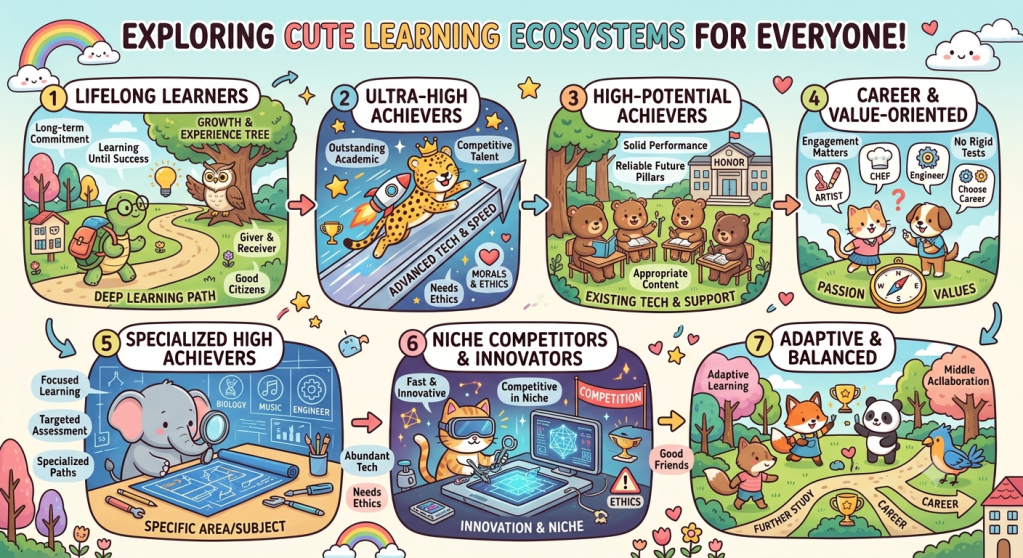
Building upon ecological forest architecture, the article further introduces a multi-layered learning ecosystem model in which learners occupy different developmental niches analogous to ecological strata. Each layer contributes unique functions to the overall resilience, diversity, and sustainability of the educational ecosystem. This ecological perspective challenges conventional assumptions that educational success should be measured primarily through standardized academic achievement. Instead, it argues that sustainable learning outcomes emerge from the balanced development of diverse learner capabilities, equitable participation, adaptive institutional structures, emotional maturity, ethical responsibility, ecological consciousness, and lifelong learning capacities.
The proposed framework contributes to contemporary educational philosophy in three principal ways. First, it bridges evolutionary philosophy and institutional governance by demonstrating that sustainable educational systems require both adaptive self-organization and carefully designed institutional structures. Second, it extends ecological civilization beyond environmental discourse into a comprehensive philosophy of learning that emphasizes the interdependence of human development, social institutions, and ecological systems. Third, it provides a conceptual foundation for designing learning ecosystems capable of supporting the transformative competencies advocated by UNESCO Education for Sustainable Development 2030 and the Inner Development Goals (IDGs), including systems thinking, collaboration, self-awareness, anticipatory competence, and responsible action.
Rather than treating education merely as preparation for employment or economic competitiveness, this framework redefines education as a process of cultivating ecological intelligence, adaptive citizenship, cultural resilience, and collective flourishing. Ultimately, sustainable learning ecosystems are presented not only as educational innovations but also as essential institutional infrastructures for facilitating the transition from prosperity-based civilization toward life-affirming ecological civilization.
Keywords: Ecological Civilization; Learning Ecosystem; Cultural Evolution System; Adaptive Cultural Governance; Sustainable Learning Outcomes; Education for Sustainable Development; Systems Thinking; Herbert Spencer; Han Feizi; Ecological Education.
Introduction
1. The Global Transition from Industrial Civilization to Ecological Civilization
The twenty-first century has become an era of profound systemic transformation. Climate change, biodiversity loss, accelerating technological disruption, demographic shifts, geopolitical uncertainty, and increasing social inequality collectively reveal that many contemporary crises are not isolated phenomena but interconnected manifestations of a deeper civilizational challenge. These global issues expose the limitations of development models that have historically prioritized economic expansion, industrial productivity, technological efficiency, and material prosperity over ecological integrity and human flourishing.
For more than two centuries, industrial civilization has generated remarkable advances in science, medicine, engineering, and economic development. However, the same civilization has also produced unprecedented ecological degradation, excessive resource extraction, environmental pollution, widening social disparities, and increasing psychological distress. These challenges suggest that contemporary societies are confronting not merely environmental problems but a fundamental crisis of civilization itself.
In response, the concept of ecological civilization has gradually emerged as an alternative paradigm for rethinking the relationship between humanity, society, and nature. Rather than perceiving nature as an external resource to be exploited, ecological civilization views humans as integral participants within interconnected ecological systems. Human prosperity therefore depends not upon maximizing production alone but upon sustaining the dynamic balance among ecological resilience, social justice, cultural diversity, and human well-being.
Ecological civilization consequently represents more than an environmental agenda. It proposes a comprehensive transformation of values, institutions, governance, economics, education, and cultural practices toward life-affirming systems capable of sustaining both present and future generations. Such transformation requires not only technological innovation but also profound changes in how individuals learn, think, collaborate, and construct meaning within increasingly complex socio-ecological environments.
2. Education as the Foundation of Civilizational Transformation
Education occupies a central position within every civilization because educational systems transmit knowledge, shape cultural values, cultivate social identities, and prepare future generations for participation in society. Throughout history, educational institutions have reflected the dominant worldview of their respective civilizations. Industrial civilization largely designed education to produce standardized knowledge, specialized labor, bureaucratic efficiency, and economic competitiveness.
Although these objectives contributed significantly to economic growth, they increasingly appear insufficient for addressing contemporary sustainability challenges characterized by uncertainty, complexity, interconnectedness, and rapid change. Modern societies require citizens who can navigate ambiguity, integrate diverse forms of knowledge, collaborate across disciplines and cultures, think systemically, and make ethically responsible decisions within complex adaptive systems.
Consequently, educational transformation cannot be limited to curriculum revision or technological innovation alone. Rather, it requires reconsidering the philosophical assumptions that define learning itself. Education must evolve from a system primarily preparing individuals for labor markets toward a living ecosystem that cultivates lifelong learning, ecological intelligence, adaptive capacity, emotional maturity, ethical responsibility, and collective resilience.
This perspective aligns closely with UNESCO’s Education for Sustainable Development (ESD 2030), which emphasizes transformative learning capable of empowering learners to address global sustainability challenges. Similarly, the Inner Development Goals (IDGs) highlight that sustainable societal transformation depends fundamentally upon the cultivation of inner capacities, including self-awareness, systems thinking, collaboration, critical reflection, empathy, and responsible action. Together, these initiatives indicate that sustainable development requires educational ecosystems capable of integrating cognitive, emotional, ethical, social, and ecological dimensions of human development.
3. Learning Ecosystems Beyond Conventional Educational Models
Recent scholarship has increasingly employed the concept of learning ecosystems to describe educational environments characterized by interconnected relationships among learners, educators, institutions, communities, digital technologies, workplaces, families, and natural environments. Unlike traditional educational models that conceptualize learning as a linear transmission of knowledge, learning ecosystems recognize learning as an emergent, distributed, and relational process embedded within dynamic networks.
Nevertheless, despite growing interest in learning ecosystems, significant theoretical fragmentation remains. Existing literature frequently examines educational ecology, institutional governance, learner-centered education, systems thinking, organizational learning, sustainability education, or ecological civilization independently. Few conceptual frameworks systematically integrate these perspectives into a coherent theory capable of explaining how educational systems themselves evolve, adapt, maintain resilience, and generate sustainable learning outcomes across multiple levels of society.
Furthermore, many existing educational models continue emphasizing measurable academic performance while paying comparatively limited attention to institutional adaptability, cultural evolution, ecological relationships, emotional development, ethical responsibility, and community resilience. Consequently, the concept of sustainable learning outcomes often remains narrowly interpreted through cognitive achievement rather than holistic human flourishing.
4. Knowledge Gap and Theoretical Motivation
This article argues that the principal limitation of current educational theory lies not in the absence of sustainability-oriented initiatives but in the lack of an integrated philosophical framework connecting ecological civilization, cultural evolution, institutional governance, and learning ecosystem design.
Although ecological civilization emphasizes harmonious relationships between humans and nature, it provides relatively limited guidance regarding the internal dynamics through which educational institutions evolve. Conversely, systems thinking and learning organization theories explain organizational adaptation but often devote less attention to philosophical questions concerning civilization, culture, and ecological ethics. Likewise, governance theories frequently emphasize institutional regulation without adequately explaining how learning environments remain adaptive, innovative, and culturally resilient over time.
To address these theoretical limitations, this paper synthesizes three complementary intellectual traditions.
First, Herbert Spencer’s Synthetic Philosophy provides an evolutionary perspective in which societies, institutions, and cultures continuously develop through increasing differentiation, integration, and adaptive complexity.
Second, Han Feizi’s philosophy of Legalism contributes an institutional perspective emphasizing that sustainable social order depends upon carefully designed governance structures, transparent rules, accountability, and adaptive administrative mechanisms rather than solely individual morality.
Third, ecological civilization offers a normative vision emphasizing the interdependence of ecological integrity, human flourishing, cultural diversity, and collective well-being.
Rather than viewing these traditions as mutually exclusive, this article argues that they complement one another in explaining both the evolutionary dynamics and institutional conditions necessary for sustainable educational transformation.
Purpose of the Study
Accordingly, this article develops an integrated conceptual framework that reconceptualizes learning ecosystems as the educational foundation of ecological civilization. Specifically, the study pursues four objectives:
- To synthesize evolutionary philosophy, ecological civilization, institutional governance, and systems thinking into an integrated theoretical framework for sustainable education.
- To propose the Cultural Evolution System (CES) as a conceptual model explaining how learning cultures continuously evolve through diversity, adaptation, institutional learning, and collective intelligence.
- To develop the Adaptive Cultural Governance (ACG) model as a governance framework that balances institutional stability with adaptive innovation across educational ecosystems.
- To demonstrate how ecological principles—particularly the multilayered architecture of forest ecosystems—can inform the design of learning ecosystems capable of producing sustainable learning outcomes for individuals, organizations, communities, and society.
Ultimately, this article proposes that sustainable education should no longer be understood merely as delivering sustainability-related knowledge. Instead, educational systems themselves must become living ecological systems capable of continuous learning, cultural adaptation, institutional resilience, and collective flourishing. Learning ecosystems therefore function not only as educational environments but also as civilizational infrastructures supporting humanity’s transition toward an ecological civilization.
Theoretical Foundations
1. Synthetic Philosophy and Evolutionary Learning
Among nineteenth-century philosophers, Herbert Spencer occupies a distinctive position for attempting to construct one of the earliest comprehensive theories integrating biology, psychology, sociology, ethics, and political philosophy into a unified evolutionary worldview. His Synthetic Philosophy was not intended merely as a biological theory of evolution but as a universal explanatory framework suggesting that all natural, social, and intellectual phenomena develop according to common evolutionary principles (Spencer, 1862, 1876). Although contemporary scholarship often associates Spencer primarily with Social Darwinism, this characterization oversimplifies his broader philosophical project. His central concern was the progressive organization of increasingly complex systems rather than the justification of social inequality.
Spencer proposed that evolution constitutes a universal process through which systems transform from relatively homogeneous, incoherent, and weakly differentiated states toward greater heterogeneity, integration, coherence, and functional specialization. Evolution therefore involves not only increasing complexity but also increasing coordination among differentiated components. As systems become more specialized, they simultaneously require stronger mechanisms of integration to maintain overall coherence and resilience (Spencer, 1862).
This dynamic relationship between differentiation and integration provides an important philosophical foundation for understanding contemporary learning ecosystems. Educational systems are neither static institutions nor simple mechanisms for transmitting knowledge. Instead, they represent complex adaptive systems composed of multiple interacting agents—including learners, educators, families, communities, technologies, policy makers, and natural environments—that continuously influence one another through reciprocal learning processes.
From Spencer’s perspective, meaningful educational development should therefore not be interpreted as linear accumulation of information but as the progressive organization of increasingly sophisticated relationships among knowledge, skills, values, identities, institutions, and social practices. Learning becomes an evolutionary process in which individuals and institutions simultaneously adapt to changing environmental conditions while contributing to the evolution of the broader cultural system.
This evolutionary interpretation resonates strongly with contemporary complexity science, which views educational systems as emergent networks characterized by nonlinearity, self-organization, distributed intelligence, and adaptive feedback (Davis & Sumara, 2006). Rather than assuming predetermined educational outcomes, complexity theory suggests that sustainable learning emerges through continuous interactions among diverse participants operating across multiple organizational levels. Spencer’s evolutionary philosophy anticipated many of these principles by emphasizing that adaptation arises not through isolated components but through the coordinated evolution of entire systems.
One of Spencer’s most significant contributions to educational philosophy lies in his conception of progressive differentiation. As societies evolve, educational systems likewise become increasingly differentiated, creating diverse learning pathways, specialized expertise, institutional functions, and forms of knowledge production. However, differentiation alone cannot guarantee sustainable development. Excessive specialization without integration may produce fragmentation, institutional silos, and social polarization. Consequently, Spencer argued that higher stages of evolution simultaneously require stronger forms of systemic integration capable of coordinating diverse components toward shared purposes.
This balance between diversity and integration is particularly relevant within contemporary sustainability education. Modern educational institutions increasingly promote interdisciplinary learning, collaborative problem-solving, and stakeholder engagement because complex sustainability challenges cannot be addressed within isolated disciplinary boundaries. Climate change, public health, artificial intelligence, biodiversity conservation, and social equity all require integrated knowledge systems that connect scientific understanding with ethical reasoning, cultural values, institutional governance, and community participation.
From this perspective, learning ecosystems should not seek uniformity among learners. Instead, diversity constitutes an essential source of adaptive capacity. Different learners contribute distinct perspectives, experiences, cultural backgrounds, cognitive strengths, emotional capacities, and creative potentials that collectively enhance the resilience of the educational ecosystem. Diversity therefore functions not as an obstacle to educational effectiveness but as a prerequisite for long-term systemic adaptation.
Spencer’s evolutionary framework also provides valuable insights into lifelong learning. Evolution is never completed; it represents an ongoing process of adaptation to continuously changing environmental conditions. Likewise, learning cannot be confined to formal schooling or early stages of life. Individuals, organizations, and societies must continually reconstruct their knowledge, values, and practices in response to emerging ecological, technological, economic, and cultural transformations. Lifelong learning therefore becomes an evolutionary necessity rather than merely an educational aspiration.
Nevertheless, Spencer’s framework also exhibits important limitations when considered from the perspective of contemporary sustainability. His optimism regarding spontaneous social evolution occasionally underestimates the role of institutional design, governance, and deliberate collective action in shaping developmental trajectories. Evolutionary processes do not inevitably produce socially desirable outcomes. Environmental degradation, institutional collapse, social inequality, and technological risks demonstrate that adaptive systems may evolve toward undesirable states when governance mechanisms fail to maintain balance between innovation and stability.
Furthermore, Spencer’s nineteenth-century emphasis on competition has often been interpreted in ways that obscure the equally important roles of cooperation, mutual dependence, and collective adaptation. Contemporary ecological science demonstrates that ecosystem resilience depends not solely upon competition but upon intricate networks of symbiosis, reciprocity, diversity, and cooperative interactions among multiple species. Similarly, sustainable learning ecosystems require collaborative knowledge creation, shared responsibility, distributed leadership, and inclusive participation rather than individual competition alone.
These limitations do not diminish Spencer’s theoretical significance. Rather, they indicate the necessity of extending his evolutionary philosophy through complementary theoretical perspectives capable of explaining institutional governance, ecological ethics, and collective learning. In the present study, this extension is achieved by integrating Spencer’s Synthetic Philosophy with ecological civilization, Han Feizi’s philosophy of adaptive governance, systems thinking, and sustainability education.
Accordingly, Spencer’s principal contribution to this article is not a deterministic theory of social evolution but an evolutionary ontology of learning. Educational systems are understood as living socio-cultural ecosystems that continuously evolve through increasing differentiation, adaptive integration, feedback, and collective learning. Sustainable learning outcomes therefore emerge not from standardized instructional processes alone but from the evolutionary capacities of educational ecosystems to balance diversity, resilience, innovation, institutional coherence, and lifelong adaptation.
This evolutionary interpretation provides the first theoretical pillar of the proposed Forest Learning Ecosystem Theory (FLET). It establishes that sustainable educational transformation depends fundamentally upon understanding learning as an emergent evolutionary process embedded within complex socio-ecological systems rather than as the linear transmission of predetermined knowledge. The subsequent sections expand this foundation by incorporating ecological civilization as the normative vision, adaptive governance as the institutional mechanism, and systems thinking as the operational architecture through which learning ecosystems become capable of supporting sustainable human development.
2. Forest Ecology as a Biomimetic Foundation for the Ecological Learning Ecosystem Theory
One of the central conceptual inspirations for the Ecological Learning Ecosystem Theory (ELET) originates from forest ecology. Rather than employing forests merely as a metaphor for educational environments, this study proposes that the structural and functional characteristics of mature forest ecosystems provide a valuable biomimetic heuristic for understanding how learning ecosystems may develop, adapt, and sustain themselves over time. Biomimicry, broadly understood as learning from nature’s design principles, has increasingly informed research in systems science, organizational studies, sustainability, and ecological design. Applying this perspective to education enables learning ecosystems to be interpreted as living adaptive systems rather than mechanistic organizations.
Natural forests are among the most resilient and self-sustaining ecosystems on Earth. Their long-term stability does not result from centralized control but from continuous interactions among diverse organisms operating across multiple ecological layers. Forest ecosystems exhibit distributed intelligence, functional diversity, adaptive succession, reciprocal relationships, resource circulation, and dynamic equilibrium. These characteristics closely resemble the properties of complex adaptive systems that contemporary educational researchers increasingly recognize within schools, universities, communities, and lifelong learning networks.
The present study therefore adopts the seven-layer ecological forest model proposed by Jintana Bubanban and colleagues (2021) as a conceptual heuristic for understanding the structural diversity of learning ecosystems. While the original model was developed for ecological forest restoration and sustainable land management, its ecological principles provide a useful framework for conceptualizing differentiated educational functions within interconnected learning communities.
2.1 Structural Correspondence between Forest Ecology and Learning Ecosystems
A mature forest is organized vertically into multiple ecological layers, each contributing unique functions while simultaneously supporting the resilience of the entire ecosystem. No single layer possesses complete autonomy; rather, ecosystem health emerges from reciprocal interactions among all layers.
Similarly, learning ecosystems consist of multiple educational actors whose diverse roles collectively generate adaptive educational capacity. Leadership, educators, learners, communities, technologies, policy environments, and cultural resources function as interconnected ecological niches rather than isolated institutional components.
The structural correspondence proposed in Forest Learning Ecosystem (FLE) is summarized conceptually as follows:
| Forest Ecology | Ecological Function | Educational Analogue |
| Emergent Layer | Long-term ecological stability and environmental protection | Visionary leadership, educational policy, institutional vision |
| Canopy Layer | Primary energy capture and ecosystem regulation | Universities, schools, major educational institutions |
| Understory Layer | Regeneration and ecological transition | Teachers, mentors, instructional designers |
| Shrub Layer | Rapid adaptation and biodiversity | Professional learning communities, local organizations, innovation teams |
| Forest Floor | Nutrient cycling and seed germination | Learners, families, community participation, lifelong learning |
| Climbers and Epiphytes | Connectivity across ecological layers | Digital technologies, interdisciplinary collaboration, knowledge networks |
| Aquatic Layer | Resource circulation and environmental balance | Local culture, well-being, ecological context, social support systems |
Importantly, this correspondence should not be interpreted as a literal one-to-one mapping. Rather, it serves as a systems heuristic illustrating how educational diversity contributes to ecosystem resilience.
2.2 Ecological Principles Underlying Educational Systems
Beyond structural similarity, forest ecosystems demonstrate several ecological principles that directly inform the conceptual architecture of FLE.
The first principle is functional diversity. Forest resilience depends upon the coexistence of organisms performing complementary ecological functions. Likewise, educational ecosystems flourish when learners, educators, administrators, families, policymakers, and community organizations contribute distinct yet interconnected capabilities. Diversity therefore represents an adaptive resource rather than an administrative challenge.
The second principle is ecological succession. Forest ecosystems continuously evolve through gradual processes of regeneration, disturbance, recovery, and maturation. Educational development similarly occurs through continuous cycles of innovation, evaluation, institutional learning, and cultural renewal rather than through isolated reform initiatives. This ecological principle directly informs the Cultural Evolution System (CES) proposed later in this article.
The third principle is mutualistic interdependence. Forest organisms rarely survive independently. Plants, fungi, microorganisms, insects, animals, and climatic conditions participate in reciprocal relationships that strengthen ecosystem resilience. Analogously, learning ecosystems depend upon collaborative intelligence, shared leadership, interdisciplinary cooperation, and reciprocal knowledge exchange. Educational quality therefore emerges from relationships rather than isolated individual performance.
The fourth principle is resource cycling. Natural forests produce remarkably little waste because nutrients continuously circulate throughout the ecosystem. In educational contexts, knowledge, experience, professional expertise, and cultural wisdom should likewise circulate continuously across generations, institutions, and communities. Learning thus becomes a regenerative process rather than a consumptive activity.
The fifth principle is adaptive resilience. Healthy forests absorb disturbances while preserving their fundamental ecological integrity. Similarly, educational ecosystems should develop capacities enabling adaptation to technological disruption, demographic change, environmental crises, economic uncertainty, and cultural transformation without losing their ethical commitments or educational purposes.
2.3 From Forest Ecology to Cultural Evolution
Perhaps the most significant contribution of forest ecology to FLE concerns the understanding of evolution itself. Forest ecosystems evolve neither through random change alone nor through rigid predetermined planning. Instead, adaptive evolution emerges from continuous interactions among diversity, environmental feedback, resource availability, and ecological selection.
This ecological understanding provides the conceptual foundation for the Cultural Evolution System (CES). Educational cultures evolve through analogous adaptive cycles in which pedagogical innovations emerge, communities evaluate their effectiveness, institutions stabilize successful practices, and subsequent environmental changes initiate further cycles of renewal. Evolution is therefore understood as an ongoing process of adaptive learning rather than linear progress toward a fixed endpoint.
Similarly, Adaptive Cultural Governance (ACG) reflects ecological regulation rather than bureaucratic control. Just as healthy ecosystems maintain coherence without centralized command, adaptive educational governance creates conditions that enable diverse educational actors to coordinate their activities through shared values, distributed leadership, evidence-informed decision-making, and collaborative responsibility.
2.4 Biomimicry and the Future of Educational Philosophy
Viewing educational systems through the lens of forest ecology represents a broader philosophical shift from industrial metaphors toward ecological worldviews. Industrial models conceptualize education as standardized production, efficiency optimization, and hierarchical control. By contrast, ecological models emphasize adaptation, diversity, emergence, reciprocity, resilience, and continuous renewal.
FLE therefore does not argue that schools should imitate forests literally. Rather, it proposes that the organizational intelligence embedded within mature ecological systems offers valuable design principles for reimagining educational institutions capable of addressing the uncertainties of the Anthropocene. Forest ecosystems demonstrate that long-term sustainability emerges not from maximizing uniformity or control but from cultivating relationships, diversity, adaptability, and mutual flourishing across the entire living system.
Accordingly, forest ecology functions within FLE as a biomimetic conceptual foundation that links educational philosophy with ecological science. This integration provides the theoretical bridge connecting Herbert Spencer’s evolutionary philosophy, complexity science, ecological civilization, and adaptive educational governance into a coherent framework capable of explaining how learning ecosystems evolve toward sustainable human development.
3. Ecological Civilization as a Civilizational Paradigm for Learning Ecosystems
The concept of ecological civilization has emerged as one of the most influential paradigms for reimagining sustainable human development in the twenty-first century. Unlike conventional environmentalism, which often focuses on mitigating ecological degradation within existing economic and political structures, ecological civilization advocates a comprehensive transformation of civilization itself. It calls for a fundamental reorientation of humanity’s relationships with nature, society, technology, economy, culture, and education. In this sense, ecological civilization represents not merely an environmental agenda but an ontological, ethical, and educational paradigm that redefines the meaning of human progress.
The emergence of ecological civilization reflects growing recognition that contemporary global crises cannot be adequately understood through reductionist or sector-specific approaches. Climate change, biodiversity loss, resource depletion, technological disruption, public health emergencies, social fragmentation, and declining institutional trust are deeply interconnected manifestations of systemic imbalance. These challenges reveal the limitations of the industrial worldview, which has historically emphasized economic growth, technological control, resource extraction, and human dominance over nature. While industrial civilization generated unprecedented scientific and economic achievements, it also produced unintended ecological and social consequences that increasingly threaten planetary resilience and human well-being.
Ecological civilization responds to these challenges by proposing an alternative civilizational logic grounded in interconnectedness, reciprocity, regeneration, and long-term sustainability. Human societies are understood not as entities existing outside natural systems but as integral components of larger socio-ecological networks. Consequently, sustainable development cannot be achieved solely through technological innovation or economic reform. It requires profound transformations in cultural values, institutional arrangements, governance systems, educational philosophies, and collective patterns of learning.
From this perspective, education assumes a foundational role in civilizational transformation. Educational systems are not merely mechanisms for transmitting knowledge; they function as institutions through which societies reproduce worldviews, construct cultural identities, shape ethical commitments, and cultivate future capacities for adaptation. Every civilization therefore embodies a characteristic educational philosophy reflecting its dominant assumptions regarding human nature, social organization, and the relationship between humanity and the natural world.
Industrial civilization largely organized education around the production of standardized knowledge, disciplinary specialization, labor force preparation, and economic competitiveness. Such educational models contributed substantially to national development throughout the twentieth century. However, they are increasingly challenged by contemporary sustainability problems characterized by uncertainty, complexity, interdependence, and rapid systemic change. Learners today require capacities extending far beyond technical competence, including systems thinking, ecological literacy, ethical reasoning, collaborative problem-solving, emotional intelligence, adaptive learning, and responsible global citizenship.
Ecological civilization therefore necessitates a corresponding transformation in educational philosophy. Rather than preparing learners exclusively for participation in industrial economies, education should cultivate the capacities required for sustaining resilient socio-ecological systems. Learning becomes a lifelong process through which individuals continuously deepen their understanding of interdependence among ecological processes, cultural diversity, technological innovation, institutional governance, and collective well-being.
This educational vision resonates strongly with many ancient philosophical traditions that have long emphasized relational understandings of existence. Buddhist philosophy, for example, interprets reality through the principle of dependent origination, emphasizing that all phenomena arise through conditions of mutual interdependence. Similarly, Taoist philosophy understands harmony as emerging from dynamic balance rather than domination or control. Numerous Indigenous knowledge systems likewise conceive humans as participants within living ecological communities rather than autonomous masters of nature. Although these traditions differ substantially in metaphysical assumptions, they converge in recognizing relationality, reciprocity, and interconnectedness as fundamental characteristics of reality.
Consequently, ecological civilization should not be interpreted as an entirely novel paradigm but rather as a contemporary synthesis integrating scientific knowledge with enduring philosophical insights concerning the interconnected nature of life. Its significance lies in translating these relational principles into institutional, educational, economic, and governance systems capable of supporting sustainable futures.
Within educational research, this shift implies moving beyond mechanistic models of teaching and learning toward ecological conceptions of learning ecosystems. Learning ecosystems recognize that educational development emerges through dynamic interactions among learners, educators, families, communities, technologies, policies, cultures, and natural environments. Learning is therefore not an isolated cognitive activity but a relational process distributed across multiple social and ecological contexts.
Here, Herbert Spencer’s Synthetic Philosophy provides an important evolutionary complement to ecological civilization. Spencer argued that increasingly complex systems evolve through simultaneous differentiation and integration. Ecological civilization extends this evolutionary perspective by emphasizing that such development must remain embedded within ecological limits and ethical responsibilities. Complexity alone does not constitute progress unless it enhances resilience, equity, ecological integrity, and collective flourishing. Evolutionary advancement must therefore be evaluated not only by increasing organizational complexity but also by the quality of relationships connecting individuals, institutions, communities, and ecosystems.
This reinterpretation also addresses one of the principal criticisms directed toward classical evolutionary philosophy. Spencer’s framework has frequently been associated with deterministic assumptions regarding inevitable social progress. Ecological civilization challenges this interpretation by emphasizing that future developmental trajectories remain contingent upon conscious institutional choices, ethical commitments, cultural learning, and collective governance. Evolution is neither automatic nor inherently beneficial; it requires deliberate cultivation of adaptive capacities capable of responding responsibly to ecological and social change.
Accordingly, sustainable learning ecosystems should be understood as evolutionary socio-ecological systems whose resilience depends upon maintaining dynamic equilibrium among diversity, cooperation, institutional adaptability, ecological awareness, and shared responsibility. Learning outcomes therefore extend beyond academic achievement to encompass the development of ecological intelligence, ethical judgment, emotional maturity, systems thinking, collaborative competence, and adaptive citizenship.
These broader educational outcomes closely correspond with UNESCO’s Education for Sustainable Development 2030 framework and the Inner Development Goals (IDGs), both of which recognize that addressing global sustainability challenges requires transformative learning rather than incremental curricular reform. Education must cultivate individuals capable not only of understanding complexity but also of participating responsibly in the continuous co-evolution of society and nature.
Within the conceptual framework proposed in this article, ecological civilization functions as the normative foundation of the Forest Learning Ecosystem Theory (FLET). Whereas Spencer explains why learning systems evolve, ecological civilization clarifies the direction toward which such evolution should aspire. Sustainable educational transformation is therefore defined not simply as increasing institutional efficiency or academic performance but as enhancing the capacity of learning ecosystems to support life-affirming relationships among individuals, communities, institutions, and the biosphere.
Viewed from this perspective, learning ecosystems become educational expressions of ecological civilization itself. They represent living cultural ecosystems in which diversity, mutual support, adaptive governance, ethical responsibility, and continuous learning collectively generate the conditions necessary for sustainable human development. The following section extends this theoretical foundation by examining how systems thinking and complexity science provide the operational architecture through which such ecological learning ecosystems can be designed, governed, and continuously renewed.
4. Learning Ecosystems through Systems Thinking and Complexity Science
While Spencer’s Synthetic Philosophy explains the evolutionary nature of social development and ecological civilization provides the normative direction for sustainable transformation, an important theoretical question remains unresolved: How do learning ecosystems actually evolve? Addressing this question requires moving beyond linear educational models toward systems thinking and complexity science, both of which conceptualize learning as an emergent property of dynamic interactions within complex adaptive systems.
For much of the twentieth century, educational institutions were designed according to mechanistic assumptions inherited from industrial civilization. Learning was frequently understood as a linear process in which knowledge was transmitted from teachers to learners through standardized curricula, predetermined objectives, and measurable instructional outcomes. Educational effectiveness was therefore evaluated primarily through efficiency, predictability, and standardized assessment. Although these approaches supported mass education during industrialization, they increasingly struggle to address contemporary challenges characterized by uncertainty, rapid technological change, ecological disruption, cultural diversity, and global interdependence.
Systems thinking offers an alternative epistemological perspective by viewing educational institutions as interconnected wholes rather than collections of isolated components (Senge, 2006). Within a systems perspective, learning outcomes emerge from patterns of interaction among learners, educators, families, communities, institutional policies, technologies, cultural traditions, and ecological environments. Individual components cannot be fully understood independently because their functions arise through relationships within the broader system.
Complexity science extends this systems perspective by emphasizing that educational systems exhibit the characteristics of Complex Adaptive Systems (CAS). Such systems consist of numerous autonomous agents interacting continuously through nonlinear relationships, distributed decision-making, adaptive feedback, and self-organization (Davis & Sumara, 2006). Learning therefore emerges not through centralized control but through ongoing interactions among multiple participants whose collective behaviors produce patterns that cannot be predicted solely from individual actions.
This understanding fundamentally transforms the educational paradigm. Rather than viewing learning as an output generated by instructional inputs, complexity science conceptualizes learning as an emergent phenomenon arising through continuous adaptation between individuals and their environments. Educational development therefore depends less upon rigid instructional design than upon creating conditions that enable meaningful interaction, experimentation, reflection, collaboration, and adaptive feedback.
Several characteristics distinguish learning ecosystems as complex adaptive systems.
First, nonlinearity implies that small interventions may generate disproportionately large educational consequences, while extensive reforms may produce unexpectedly limited effects. A single mentoring relationship, community project, technological innovation, or institutional policy may transform the developmental trajectory of entire learning communities. Conversely, large-scale curriculum reforms frequently fail when underlying cultural relationships remain unchanged.
Second, emergence suggests that sustainable learning outcomes cannot be fully prescribed in advance. Creativity, innovation, ethical judgment, collaborative intelligence, and ecological awareness develop through collective participation rather than direct instruction alone. Educational ecosystems therefore generate new knowledge, practices, and cultural norms that exceed the intentions of any individual participant.
Third, distributed intelligence recognizes that knowledge is embedded throughout the educational ecosystem rather than concentrated exclusively within teachers or institutions. Learners contribute diverse experiences, families provide cultural continuity, communities offer contextual knowledge, digital technologies expand access to information, while natural environments themselves become living classrooms that continuously shape human understanding. Intelligence therefore becomes a collective ecological property rather than merely an individual cognitive capacity.
Fourth, adaptive feedback enables continuous learning across multiple organizational levels. Learners adjust their strategies through reflection and experience; educators redesign pedagogical approaches in response to learner needs; institutions revise policies based on organizational learning; communities influence educational priorities according to changing social contexts. These interconnected feedback loops continuously reshape the learning ecosystem while maintaining its overall capacity for adaptation.
Finally, self-organization allows educational communities to generate new structures, practices, and collaborative networks without requiring centralized control over every aspect of learning. Innovation often emerges spontaneously when diverse participants share common purposes, open communication, mutual trust, and opportunities for experimentation.
These principles collectively suggest that educational resilience depends less upon maintaining institutional stability than upon preserving adaptive capacity. Resilience should therefore be understood not as resistance to change but as the ability of learning ecosystems to reorganize, learn, and continue functioning under conditions of uncertainty. Such resilience closely parallels ecological systems, where biodiversity, redundancy, modularity, and reciprocal relationships enable ecosystems to absorb disturbances while sustaining long-term functionality.
The ecological analogy becomes particularly valuable when considering forest ecosystems. Mature forests are not organized through centralized planning. Instead, they evolve through countless interactions among trees, microorganisms, fungi, insects, animals, water systems, climate, and soil nutrients. Diversity, cooperation, competition, succession, and mutual adaptation collectively generate ecosystem resilience over extended periods. No individual organism controls the forest, yet the forest continuously reorganizes itself through distributed ecological intelligence.
Learning ecosystems exhibit similar dynamics. Learners occupy diverse developmental niches, educational institutions perform complementary functions, communities contribute contextual knowledge, technologies facilitate new connections, and governance structures provide enabling conditions for collective adaptation. Sustainable learning therefore resembles ecological succession rather than mechanical production.
This ecological interpretation directly informs the Cultural Evolution System (CES) proposed in this article. CES conceptualizes cultural learning as an adaptive evolutionary cycle consisting of four interconnected processes:
- Variation — Educational ecosystems encourage diversity of learners, perspectives, experiences, pedagogical approaches, and innovations. Diversity constitutes the primary source of adaptive potential rather than a problem requiring standardization.
- Selection — Communities, institutions, and governance mechanisms collectively evaluate emerging practices according to educational effectiveness, ethical responsibility, ecological sustainability, and social relevance. Selection is therefore understood as collective learning rather than competitive elimination.
- Stabilization — Effective practices gradually become embedded within institutional cultures, professional standards, organizational routines, and shared values. Stabilization provides continuity while preserving opportunities for future adaptation.
- Evolution — Continuous feedback generates renewed variation, institutional learning, and cultural innovation, allowing learning ecosystems to respond adaptively to changing environmental conditions without sacrificing coherence.
Unlike traditional evolutionary models emphasizing competition, CES incorporates cooperation, mutual learning, and institutional memory as essential evolutionary mechanisms. Educational cultures evolve not because individuals compete for survival but because communities continuously reconstruct shared knowledge through collaborative inquiry and reflective practice.
The CES framework also extends Spencer’s evolutionary philosophy in two significant respects. First, it replaces deterministic assumptions regarding inevitable progress with adaptive learning processes responsive to ecological and social contexts. Evolution is understood as contingent rather than predetermined. Second, it integrates institutional governance into evolutionary dynamics, recognizing that adaptive educational cultures require supportive organizational structures capable of balancing innovation with stability.
This balance becomes particularly important within sustainability education. Excessive institutional rigidity suppresses creativity and adaptive learning, whereas unrestricted flexibility risks fragmentation, inconsistency, and declining educational quality. Learning ecosystems therefore require governance systems capable of maintaining dynamic equilibrium between continuity and transformation. Such governance mechanisms are examined in the following section through the philosophy of Han Feizi and the proposed framework of Adaptive Cultural Governance (ACG).
Accordingly, systems thinking and complexity science constitute the operational architecture of the Forest Learning Ecosystem Theory (FLET). Spencer explains the evolutionary nature of educational development, ecological civilization establishes its ethical direction, while complexity science clarifies the adaptive mechanisms through which learning ecosystems continuously evolve. Together, these perspectives provide the conceptual basis for understanding education not as a static institutional structure but as a living ecological system capable of generating sustainable learning outcomes through continuous cultural evolution, collaborative intelligence, and adaptive resilience.
5. Legalism and Adaptive Institutional Governance
Although evolutionary learning emphasizes adaptation, diversity, and self-organization, sustainable educational transformation cannot rely exclusively upon spontaneous evolutionary processes. Complex adaptive systems require institutional arrangements that maintain coherence while preserving the flexibility necessary for continuous learning. This tension between adaptive freedom and institutional stability represents one of the central challenges in contemporary educational governance.
Classical systems theory frequently assumes that adaptive systems naturally evolve toward higher levels of organization through distributed interactions and feedback. However, empirical experience demonstrates that educational systems may also evolve toward fragmentation, institutional inertia, inequality, or declining public trust when governance mechanisms fail to coordinate collective action. Evolution, therefore, is neither inherently progressive nor normatively desirable. Its direction depends upon the quality of institutional design, cultural norms, and governance processes that shape adaptive capacities over time.
Within this context, the political philosophy of Han Feizi provides an important but often overlooked contribution to educational theory. As the principal philosopher of the Legalist tradition during China’s Warring States period, Han Feizi sought to understand how large and increasingly complex societies could maintain social order despite the limitations of individual morality, personal virtue, and subjective judgment. Rather than assuming that ethical intentions alone would produce stable governance, Han Feizi argued that durable institutions require carefully designed systems capable of coordinating diverse human behaviors under changing social conditions.
Although Legalism has frequently been interpreted primarily as an authoritarian philosophy emphasizing strict legal control, such interpretations overlook its deeper institutional insights. Contemporary institutional theory suggests that effective governance depends not merely upon formal authority but upon transparent rules, organizational accountability, clearly defined responsibilities, adaptive monitoring, and continuous institutional learning (North, 1990). When interpreted through this contemporary perspective, Han Feizi’s philosophy can be understood less as a doctrine of coercion and more as an early theory of adaptive institutional governance.
Three interconnected concepts constitute the institutional architecture of Han Feizi’s political philosophy: Fa (法), Shi (勢), and Shu (術). Together, these concepts provide complementary mechanisms through which complex organizations maintain stability while adapting to environmental change.
Fa (法) refers to transparent rules, shared standards, institutional procedures, and predictable systems of evaluation. Within educational ecosystems, Fa should not be interpreted narrowly as rigid regulation. Instead, it represents collectively understood principles that establish fairness, accountability, and consistency across diverse learning environments. Clear governance structures reduce uncertainty, strengthen institutional trust, and create stable conditions within which innovation can occur responsibly.
Importantly, Fa establishes institutional reliability rather than bureaucratic rigidity. Adaptive educational systems require rules sufficiently stable to coordinate collective action yet sufficiently flexible to accommodate emerging knowledge, technological innovation, and changing societal needs. Accordingly, governance should be viewed as enabling adaptive learning rather than restricting institutional creativity.
Shi (勢) refers to the structural capacity of institutions to influence collective behavior. Unlike authority derived solely from charismatic leadership or personal virtue, Shi emphasizes that sustainable governance emerges from organizational structures capable of aligning incentives, responsibilities, communication, and decision-making processes toward common purposes. Educational quality therefore depends not only upon talented educators but also upon institutional arrangements that support collaboration, knowledge sharing, professional development, and organizational learning.
This structural interpretation resonates with contemporary research on educational leadership, which increasingly emphasizes distributed leadership, network governance, and collaborative organizational cultures rather than hierarchical control. Institutions function effectively when authority is embedded within resilient organizational relationships rather than concentrated exclusively within individual leaders.
Shu (術), often translated as administrative technique or managerial method, concerns the practical capacities through which governance is continuously enacted. In contemporary educational systems, Shu includes mechanisms such as formative evaluation, organizational feedback, reflective practice, participatory decision-making, digital learning analytics, quality assurance, and evidence-informed policy development. Rather than functioning as instruments of surveillance, these mechanisms provide information enabling continuous organizational adaptation.
When interpreted collectively, Fa, Shi, and Shu describe governance as an adaptive learning process rather than a static administrative structure. Institutions continuously observe, interpret, evaluate, and revise their practices through iterative cycles of organizational learning. Governance therefore becomes an integral component of educational evolution rather than an external mechanism imposed upon learning communities.
This interpretation complements rather than contradicts Spencer’s evolutionary philosophy. Spencer demonstrated that increasingly differentiated systems require stronger forms of integration to maintain coherence. Han Feizi explains how such integration becomes institutionally possible. Adaptive educational ecosystems therefore require both evolutionary diversity and governance structures capable of coordinating that diversity toward shared educational purposes.
Nevertheless, important tensions exist between Spencer and Han Feizi. Spencer generally placed greater confidence in spontaneous social evolution and voluntary cooperation, whereas Han Feizi emphasized the necessity of explicit institutional regulation. Contemporary complexity science suggests that neither perspective alone adequately explains sustainable educational transformation. Excessive institutional control may suppress creativity, experimentation, and adaptive learning. Conversely, unrestricted self-organization may generate fragmentation, inequality, and declining organizational coherence. Sustainable governance therefore depends upon maintaining dynamic equilibrium between institutional order and evolutionary adaptation.
To address this challenge, the present study proposes the concept of Adaptive Cultural Governance (ACG) as the governance dimension of the Ecological Learning Ecosystem Theory (ELET). ACG extends Han Feizi’s institutional insights by integrating them with contemporary systems thinking, organizational learning, and ecological governance. Rather than emphasizing compliance alone, Adaptive Cultural Governance conceptualizes governance as a continuous process of cultivating institutional cultures capable of learning, adaptation, collaboration, and ethical responsibility.
The ACG framework consists of five mutually reinforcing governance principles.
- Rule-Based Governance establishes transparent institutional expectations that promote fairness, trust, and accountability while remaining responsive to contextual diversity.
- Learning-Based Governance positions every institutional process—including evaluation, policy development, leadership, and quality assurance—as opportunities for organizational learning rather than administrative control.
- Evolution-Based Governance encourages experimentation, innovation, reflective inquiry, and adaptive improvement, recognizing that educational excellence emerges through continuous cultural evolution rather than static standardization.
- Evidence-Based Governance supports decision-making through multiple forms of evidence, including quantitative data, qualitative experiences, community knowledge, ecological indicators, and professional judgment. This broader conception of evidence acknowledges the complexity of educational ecosystems while avoiding reductionist dependence upon standardized performance metrics alone.
- Purpose-Based Governance ensures that institutional adaptation remains guided by shared ethical commitments rather than short-term efficiency or organizational self-interest. Within ecological civilization, the ultimate purpose of governance is the flourishing of individuals, communities, ecosystems, and future generations.
Collectively, these principles redefine governance from an administrative function into an ecological capability. Governance becomes the mechanism through which educational ecosystems sustain adaptive resilience while preserving coherence, fairness, institutional trust, and long-term developmental capacity.
Within the proposed Forest Learning Ecosystem Theory, Adaptive Cultural Governance constitutes the institutional layer connecting evolutionary learning with sustainable educational outcomes. Spencer explains why learning systems evolve; ecological civilization clarifies the ethical direction of that evolution; systems thinking describes the adaptive dynamics through which learning emerges; Adaptive Cultural Governance explains how institutions intentionally cultivate conditions enabling sustainable cultural evolution.
Consequently, governance should not be viewed as an external constraint imposed upon educational systems but as an intrinsic ecological process through which learning communities continuously coordinate diversity, maintain resilience, negotiate shared values, and collectively construct sustainable futures. The following section extends this theoretical integration by examining how UNESCO Education for Sustainable Development 2030 and the Inner Development Goals define the human capabilities that adaptive learning ecosystems should ultimately cultivate.
6. UNESCO Education for Sustainable Development 2030, the Inner Development Goals, and Civilizational Learning Outcomes
The preceding sections have established the philosophical, ecological, systemic, and institutional foundations of the proposed Forest Learning Ecosystem Theory (FLET). However, a comprehensive educational theory requires not only an explanation of how learning systems evolve and how they should be governed, but also a clear articulation of their ultimate educational purpose. This teleological dimension addresses a fundamental philosophical question: What kinds of human capabilities should sustainable learning ecosystems cultivate in order to support the transition toward ecological civilization?
Historically, educational outcomes have reflected the dominant values of particular civilizations. During the industrial era, educational success was largely defined through standardized academic achievement, disciplinary specialization, workforce preparation, and economic productivity. Although these outcomes contributed significantly to national development, they increasingly appear inadequate for societies confronted with climate instability, technological disruption, demographic transitions, social polarization, ecological degradation, and global interdependence.
Contemporary sustainability challenges require educational systems capable of cultivating capacities that extend beyond cognitive performance alone. Learners must develop the ability to understand complex systems, navigate uncertainty, collaborate across cultural and disciplinary boundaries, exercise ethical judgment, regulate emotions, anticipate future consequences, and participate responsibly in democratic and ecological decision-making. Educational success therefore becomes inseparable from the development of the whole person rather than the accumulation of disciplinary knowledge alone.
This broader educational vision is reflected in UNESCO’s Education for Sustainable Development: Towards Achieving the SDGs (ESD for 2030), which conceptualizes education as a transformative process enabling individuals and communities to contribute actively to sustainable societies (UNESCO, 2020). Rather than treating sustainability as an additional curriculum topic, ESD emphasizes transformative learning that reshapes values, behaviors, institutions, and collective capacities.
UNESCO identifies several core competencies essential for sustainable development, including systems thinking, anticipatory competence, normative competence, strategic competence, collaboration, critical thinking, self-awareness, and integrated problem-solving. Collectively, these competencies recognize that sustainability depends upon learners’ capacity to interpret complex relationships, evaluate alternative futures, reconcile competing values, collaborate across differences, and act responsibly under conditions of uncertainty.
Complementing UNESCO’s external orientation toward societal transformation, the Inner Development Goals (IDGs) emphasize that sustainable change also depends upon the cultivation of inner human capacities. The IDG framework identifies five interconnected dimensions—Being, Thinking, Relating, Collaborating, and Acting—that together support the development of self-awareness, emotional maturity, openness, cognitive flexibility, empathy, trust, courage, and purposeful action.
Importantly, the IDGs challenge conventional educational assumptions by arguing that global sustainability cannot be achieved solely through technological innovation or institutional reform. Lasting societal transformation requires corresponding transformations in human consciousness, character, values, and patterns of relationship. Sustainable institutions ultimately depend upon sustainable persons capable of ethical reflection, emotional regulation, collaborative leadership, and responsible citizenship.
Despite their complementary strengths, UNESCO ESD and the IDGs have generally been developed as parallel rather than fully integrated frameworks. ESD primarily emphasizes the external competencies necessary for addressing sustainability challenges, whereas the IDGs focus upon the internal capacities enabling individuals to engage constructively with those challenges. This article argues that ecological learning ecosystems require both dimensions simultaneously. External transformation without inner development risks producing technically competent but ethically fragile societies; conversely, inner development without societal engagement may fail to generate meaningful institutional and ecological change.
Within the Ecological Learning Ecosystem Theory, these complementary perspectives are synthesized through the concept of Civilizational Learning Outcomes (CLOs).
Civilizational Learning Outcomes extend beyond conventional educational assessment by conceptualizing learning as the continuous cultivation of capabilities required for sustaining ecological civilization across individual, organizational, community, and societal levels. Rather than measuring educational success exclusively through academic performance, CLOs evaluate the extent to which learning ecosystems strengthen the adaptive capacities necessary for long-term socio-ecological flourishing.
The proposed framework identifies seven interconnected domains of Civilizational Learning Outcomes.
Ecological Intelligence refers to the capacity to understand the interconnected relationships among ecological systems, social institutions, technological development, economic activities, and human well-being. Learners recognize that human prosperity depends upon maintaining resilient ecological relationships rather than maximizing short-term resource extraction.
Systems Thinking enables individuals to perceive patterns, feedback loops, interdependencies, and emergent properties across complex adaptive systems. Rather than analyzing isolated problems, learners develop the capacity to interpret complexity holistically while anticipating unintended consequences.
Adaptive Learning Capacity describes the ability to continuously reconstruct knowledge, revise mental models, and respond constructively to changing environmental conditions. Learning therefore becomes an ongoing evolutionary process rather than the acquisition of fixed information.
Ethical Responsibility encompasses moral reflection, fairness, justice, ecological stewardship, and commitment to the common good. Sustainable learning ecosystems cultivate ethical reasoning capable of balancing individual aspirations with collective and intergenerational responsibilities.
Collaborative Intelligence reflects the capacity to generate knowledge collectively through dialogue, trust, reciprocity, cultural diversity, and distributed leadership. Innovation emerges not solely from individual excellence but from the quality of relationships connecting learners, educators, institutions, and communities.
Inner Maturity integrates self-awareness, emotional regulation, resilience, openness, humility, compassion, and reflective judgment. These qualities enable individuals to navigate uncertainty without becoming overwhelmed by complexity or social conflict.
Finally, Adaptive Citizenship represents the capacity to participate responsibly in the continuous co-evolution of democratic institutions, cultural communities, ecological systems, and global society. Citizens become active contributors to societal learning rather than passive recipients of institutional decisions.
Collectively, these seven domains redefine educational success as the cultivation of human capabilities necessary for sustaining ecological civilization. They move beyond traditional distinctions between cognitive and affective learning by recognizing that sustainable development requires the integration of intellectual, emotional, ethical, social, ecological, and civic dimensions of human growth.
The proposed Civilizational Learning Outcomes also reinforce the evolutionary foundations established throughout this article. Spencer’s Synthetic Philosophy explains the evolutionary dynamics through which educational systems develop increasing complexity; ecological civilization provides the ethical direction of that development; systems thinking clarifies the adaptive mechanisms of learning; Adaptive Cultural Governance creates institutional conditions supporting continuous cultural evolution; Civilizational Learning Outcomes define the developmental capacities that emerge through these interconnected processes.
Accordingly, learning outcomes should not be understood as static educational endpoints but as emergent properties of living learning ecosystems. Individuals do not simply acquire competencies; rather, they participate in the continuous co-evolution of knowledge, culture, institutions, communities, and ecological systems. Sustainable education therefore becomes a lifelong process through which human beings progressively strengthen their capacities to contribute responsibly to the flourishing of both society and the biosphere.
This integrated perspective completes the theoretical foundation of the present study. The following section synthesizes Spencer’s evolutionary ontology, ecological civilization, systems thinking, Adaptive Cultural Governance, and Civilizational Learning Outcomes into the Forest Learning Ecosystem Theory (FLET), a comprehensive philosophical framework explaining how learning ecosystems can be intentionally designed to support sustainable human development within an ecological civilization.
Forest Learning Ecosystem Theory (FLET): An Initial-Integrative Theory for Sustainable Learning Ecosystem
1. Defining the Forest Learning Ecosystem Theory (FLET)
The accelerating convergence of ecological degradation, technological transformation, geopolitical uncertainty, demographic transitions, and cultural fragmentation has revealed important limitations within prevailing educational paradigms. Educational systems developed during the industrial era have been remarkably successful in expanding access to schooling, increasing literacy, and supporting economic development. Nevertheless, they have been comparatively less successful in preparing individuals and societies to navigate the interconnected, nonlinear, and uncertain challenges that characterize the twenty-first century. Contemporary sustainability challenges increasingly require educational systems capable not only of transmitting knowledge but also of cultivating adaptive capacities for lifelong learning, collaborative problem solving, ethical responsibility, institutional resilience, and ecological stewardship.
The preceding sections have demonstrated that no single theoretical tradition adequately explains this broader educational transformation. Spencer’s Synthetic Philosophy provides an evolutionary ontology but offers only limited guidance concerning institutional governance and normative educational purposes. Ecological civilization articulates an ethical vision of sustainable human development but does not fully explain the adaptive mechanisms through which educational systems evolve. Systems thinking and complexity science illuminate the dynamics of emergence, self-organization, and adaptation, yet they frequently remain descriptively oriented and provide relatively limited normative guidance. Han Feizi’s institutional philosophy contributes valuable insights into governance but requires reinterpretation within contemporary democratic and educational contexts. Likewise, UNESCO’s Education for Sustainable Development (ESD 2030) and the Inner Development Goals (IDGs) identify essential sustainability competencies but do not constitute a unified explanatory theory of educational transformation.
The Forest Learning Ecosystem Theory (FLET) is proposed to address this conceptual fragmentation. Rather than replacing existing theories, FLET functions as an integrative theoretical framework that synthesizes complementary philosophical traditions into a coherent explanation of how learning ecosystems evolve, how they may be intentionally governed, and how they contribute to sustainable human development. The theory is therefore both explanatory and normative. It seeks to explain the adaptive processes through which educational ecosystems develop while simultaneously articulating the ethical direction toward which that development should aspire.
FLET defines a learning ecosystem as a living socio-ecological system in which learners, educators, families, communities, institutions, technologies, cultures, and natural environments continuously co-evolve through reciprocal learning relationships. Within this perspective, learning is no longer understood as an individual cognitive event occurring exclusively inside classrooms. Instead, learning becomes a distributed ecological process emerging through interactions among multiple agents operating across interconnected social, cultural, institutional, technological, and ecological contexts.
This ecological interpretation represents a significant departure from mechanistic educational paradigms. Traditional educational models often assume that learning outcomes can be predicted through linear relationships between instructional inputs and learner performance. FLET rejects this assumption by recognizing that educational development displays the defining characteristics of complex adaptive systems: nonlinearity, emergence, feedback, self-organization, contextual sensitivity, and continuous adaptation. Consequently, educational quality cannot be explained solely by curriculum design, technological infrastructure, teacher effectiveness, or institutional policy considered independently. Rather, it emerges from the quality of relationships that connect the components of the ecosystem.
A foundational assumption of FLET is that educational systems should be understood as evolutionary cultural systems. Cultures, institutions, and learning communities continually generate variation through innovation, dialogue, experimentation, and interaction with changing environments. These variations are selectively retained, modified, or abandoned through collective learning processes that gradually reshape institutional practices, professional identities, educational values, and social norms. Educational change therefore resembles ecological succession more closely than mechanical production. Sustainable transformation occurs through cumulative adaptation rather than isolated reform initiatives.
Within this framework, the Cultural Evolution System (CES) provides the primary developmental mechanism of educational change. CES explains how learning ecosystems continuously generate diversity, evaluate emerging practices, stabilize effective innovations, and renew themselves through ongoing cycles of adaptation. Evolution is therefore interpreted not as deterministic progress but as an open-ended process of collective learning responsive to changing ecological, technological, cultural, and societal conditions.
However, adaptive evolution alone cannot guarantee educational sustainability. Educational ecosystems require institutional capacities capable of coordinating diversity while preserving coherence, fairness, accountability, and public trust. FLET therefore introduces Adaptive Cultural Governance (ACG) as its institutional dimension. Governance is conceptualized not as bureaucratic control but as the adaptive capacity of organizations to cultivate conditions under which continuous learning, responsible innovation, ethical deliberation, and collaborative problem solving become possible. Governance itself becomes an evolutionary learning process operating across individual, organizational, and societal levels.
The normative orientation of FLET is provided by the concept of ecological civilization. Unlike educational paradigms primarily oriented toward economic productivity or labor market competitiveness, FLET proposes that the ultimate purpose of education is to strengthen the adaptive capacities necessary for sustaining life-affirming relationships among individuals, communities, institutions, and the biosphere. Educational success is therefore evaluated not exclusively through academic achievement or economic outcomes but through the extent to which learning ecosystems contribute to ecological integrity, social cohesion, democratic participation, ethical responsibility, cultural resilience, and intergenerational well-being.
This normative commitment culminates in the concept of Civilizational Learning Outcomes (CLOs), which redefine educational achievement as the cultivation of human capabilities required for the flourishing of ecological civilization. CLOs integrate cognitive, emotional, ethical, ecological, social, and civic dimensions of development into a unified conception of sustainable human capability. They extend existing competency-based educational frameworks by recognizing that sustainable societies require not only knowledgeable individuals but also mature, reflective, collaborative, and adaptive citizens capable of participating responsibly in the continuous co-evolution of human civilization and the natural world.
From a philosophical perspective, FLET is structured around five mutually reinforcing dimensions. Its ontological foundation understands educational systems as living socio-ecological ecosystems characterized by emergence, relationality, and continuous evolution. Its epistemological foundation conceptualizes knowledge as adaptive, contextual, participatory, and continuously reconstructed through interaction. Its axiological foundation locates the ethical orientation of education within the principles of ecological civilization, emphasizing respect for life, justice, reciprocity, and long-term sustainability. Its praxeological foundation explains how Cultural Evolution Systems and Adaptive Cultural Governance enable educational transformation through collaborative adaptation. Finally, its teleological foundation defines Civilizational Learning Outcomes as the long-term purpose of educational development.
An important contribution of FLET is its explicit integration of inner and outer dimensions of educational transformation. Sustainable learning is interpreted as involving simultaneous development of personal consciousness, interpersonal relationships, institutional cultures, societal systems, and ecological responsibility. This multidimensional understanding reflects the growing recognition that global sustainability challenges cannot be addressed exclusively through technological innovation or policy reform. Lasting transformation requires corresponding changes in values, identities, governance practices, and patterns of collective learning.
Accordingly, FLET should be understood as a normative-integrative theory of educational transformation rather than as a predictive model claiming universal explanatory certainty. Its primary contribution lies in providing a coherent philosophical architecture through which diverse educational traditions, governance approaches, and sustainability frameworks may be interpreted as complementary dimensions of a common learning ecosystem. The theory offers a conceptual foundation for future empirical investigation while simultaneously providing guidance for educational leadership, curriculum design, institutional development, teacher education, and public policy aimed at fostering sustainable human development.
The subsequent sections elaborate the internal architecture of FLET by identifying its core components, explaining the dynamic relationships among Cultural Evolution Systems, Adaptive Cultural Governance, and Civilizational Learning Outcomes, and presenting a series of theoretical propositions through which the framework may be examined, refined, and empirically investigated in future research.
2. Core Components of the Ecological Learning Ecosystem Theory
To function as a coherent explanatory and normative framework, the Forest Learning Ecosystem Theory (FLET) requires a clearly articulated internal architecture. The theory proposed in this study is organized around three interdependent levels: Foundational Principles, Core Adaptive Mechanisms, and Civilizational Learning Outcomes. These levels should not be interpreted as isolated domains but as mutually reinforcing dimensions operating simultaneously within educational ecosystems. Together, they explain why learning ecosystems evolve, how they adapt, and what forms of human flourishing they are ultimately intended to cultivate.
2.1 Foundational Principles
The first level establishes the philosophical and scientific assumptions that provide the conceptual foundation of FLET. Rather than functioning as operational variables, these principles define the worldview within which educational systems are interpreted.
The first foundational principle is Evolutionary Relationality, derived primarily from Herbert Spencer’s Synthetic Philosophy. Educational systems are understood as evolving relational structures rather than static institutions. Their development is characterized by increasing differentiation, integration, specialization, and adaptive complexity. Learning therefore represents a continuous evolutionary process rather than a finite educational event.
The second principle is Ecological Interdependence, inspired by the paradigm of ecological civilization and supported by contemporary ecological sciences. Educational institutions exist within broader ecological, cultural, political, technological, and economic systems. Consequently, educational quality cannot be evaluated independently from ecological sustainability, social justice, cultural resilience, and collective well-being. Every educational decision influences—and is influenced by—the larger socio-ecological environment.
The third principle is Complex Adaptive Emergence, derived from systems thinking and complexity science. Learning ecosystems are characterized by nonlinearity, distributed intelligence, emergence, feedback, and self-organization. Educational outcomes therefore arise from interactions among diverse agents rather than through linear instructional causality. Complexity becomes a productive source of innovation rather than merely a challenge to institutional management.
Together, these three principles establish the ontological and epistemological foundations of FLET. They define educational reality as evolutionary, relational, ecological, and adaptive.
2.2 Core Adaptive Mechanisms
Building upon these foundations, FLET proposes two complementary mechanisms through which educational ecosystems continuously evolve: the Cultural Evolution System (CES) and Adaptive Cultural Governance (ACG).
The Cultural Evolution System represents the developmental engine of educational ecosystems. CES explains how educational cultures generate adaptive capacity through recurring cycles of variation, collaborative selection, institutional stabilization, reflective evaluation, and continuous renewal. Innovation is not viewed as an isolated event but as a natural consequence of healthy cultural evolution.
Variation encourages pedagogical diversity, interdisciplinary experimentation, cultural inclusion, and multiple learning pathways. Rather than eliminating differences, learning ecosystems cultivate diversity as a source of resilience and creativity.
Collaborative selection evaluates emerging practices through evidence, ethical reflection, contextual relevance, and collective dialogue rather than competitive elimination alone. Educational communities become co-creators of institutional knowledge.
Institutional stabilization embeds successful innovations within organizational memory, professional standards, leadership practices, and educational culture. Stabilization ensures continuity without suppressing future adaptation.
Reflective evaluation continuously monitors institutional learning through evidence-informed inquiry, stakeholder participation, and organizational reflection. Feedback strengthens adaptive learning rather than punitive accountability.
Continuous renewal initiates new cycles of innovation as changing ecological, technological, and societal conditions generate fresh educational challenges. Evolution therefore remains ongoing rather than reaching a final equilibrium.
While CES explains cultural evolution, Adaptive Cultural Governance (ACG) provides the institutional conditions enabling that evolution to remain coherent and ethically oriented.
ACG consists of five mutually reinforcing governance capacities.
- Normative Governance establishes shared values, ethical commitments, institutional trust, and transparent principles that guide educational decision-making while respecting contextual diversity.
- Adaptive Leadership distributes responsibility across organizational networks, empowering educators, learners, communities, and institutional leaders to participate collaboratively in continuous improvement.
- Learning Governance transforms policy implementation, evaluation, quality assurance, and organizational management into opportunities for institutional learning rather than bureaucratic compliance.
- Evidence-Informed Adaptation integrates quantitative indicators, qualitative experience, Indigenous knowledge, professional expertise, learner voices, and ecological observations into continuous institutional decision-making.
Resilient Institutional Culture cultivates openness, psychological safety, innovation, reciprocity, accountability, and collective responsibility, enabling educational organizations to respond constructively to uncertainty and disruption.
Together, CES and ACG constitute the operational architecture of FLET. CES generates adaptive cultural evolution, whereas ACG sustains the institutional conditions that enable such evolution to flourish responsibly.
2.3 Civilizational Learning Outcomes
The third level defines the educational purpose toward which adaptive learning ecosystems continuously evolve.
Unlike conventional outcome frameworks emphasizing academic achievement, employability, or technical competence alone, FLET proposes Civilizational Learning Outcomes (CLOs) as multidimensional capabilities supporting sustainable human development.
Seven interconnected domains characterize these outcomes.
- Ecological Intelligence enables learners to understand interdependence across environmental, economic, technological, and social systems.
- Systems Thinking develops the capacity to recognize feedback loops, emergence, complexity, and long-term consequences.
- Adaptive Learning Capacity supports continuous reconstruction of knowledge, flexible thinking, and lifelong learning.
- Ethical Responsibility strengthens moral judgment, ecological stewardship, fairness, and commitment to future generations.
- Collaborative Intelligence enables collective knowledge creation through trust, dialogue, reciprocity, and distributed leadership.
- Inner Maturity integrates self-awareness, emotional regulation, humility, resilience, openness, compassion, and reflective wisdom.
- Adaptive Citizenship prepares individuals to participate responsibly in democratic governance, community resilience, ecological stewardship, and global cooperation.
These seven domains should not be interpreted as isolated competencies but as mutually reinforcing expressions of educational flourishing within ecological civilization.
2.4 Systemic Integration
The defining contribution of FLET lies not merely in identifying these components but in explaining their dynamic integration.
The Foundational Principles establish the worldview through which educational systems are interpreted. They explain why educational ecosystems exhibit evolutionary, ecological, and adaptive characteristics.
The Core Adaptive Mechanisms translate these philosophical principles into institutional processes. Cultural Evolution Systems continuously generate innovation and learning, while Adaptive Cultural Governance ensures that adaptive change remains coherent, equitable, and ethically grounded.
Civilizational Learning Outcomes emerge as the cumulative result of these interacting processes. They are not produced directly through curriculum or assessment alone but arise from sustained participation within healthy learning ecosystems characterized by adaptive governance, collaborative cultures, and ecological relationships.
This architecture reveals an important theoretical distinction between education as instruction and education as ecosystem evolution. Conventional educational paradigms frequently concentrate on improving individual instructional practices. FLET argues that sustainable educational transformation depends equally upon the evolution of institutional cultures, governance systems, community relationships, and ecological contexts within which learning occurs.
Accordingly, the three-level architecture transforms FLET into a multilevel theory capable of explaining educational development across individuals, organizations, communities, and societies. Sustainable learning outcomes emerge not from isolated educational interventions but from the continuous co-evolution of philosophical assumptions, adaptive institutional processes, and life-affirming educational purposes operating within interconnected socio-ecological systems.
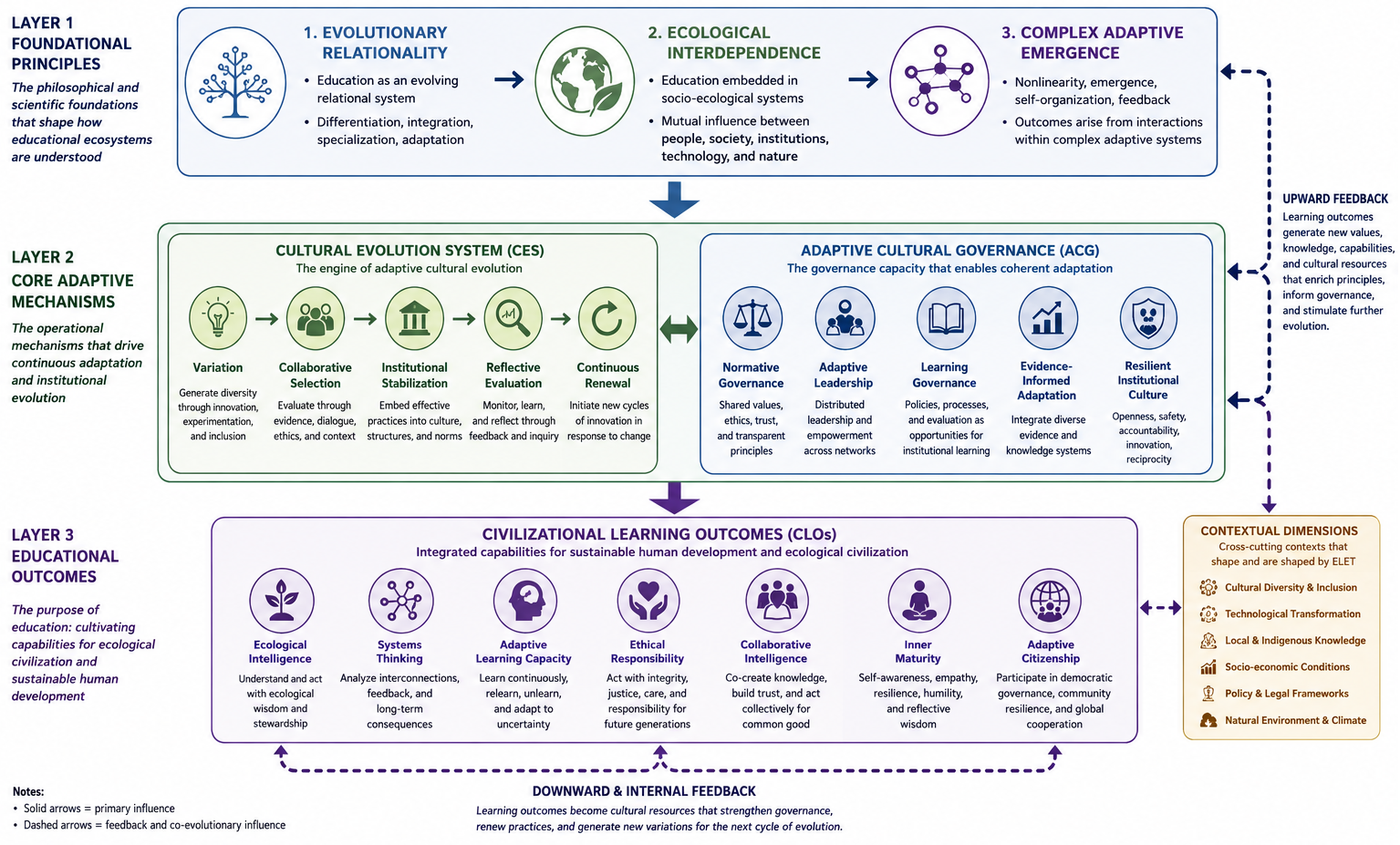
The Forest Learning Ecosystem Theory and Theoretical Propositions
The Forest Learning Ecosystem Theory (FLET) is proposed as a normative-integrative theory intended to explain how educational ecosystems contribute to sustainable human development through adaptive cultural evolution. As with other conceptual theories in educational philosophy and organizational science, the present framework should ultimately be evaluated through systematic empirical investigation. Accordingly, this section formulates a series of theoretical propositions that articulate the causal logic underlying FLET and provide a foundation for future qualitative, quantitative, and mixed-methods research.
Rather than representing statistical hypotheses applicable to a single empirical study, these propositions describe general explanatory relationships among the principal constructs of the theory. They clarify how ecological learning ecosystems generate adaptive capacities across individual, organizational, community, and societal levels.
Proposition 1: Educational ecosystems evolve through adaptive cultural interactions rather than linear instructional processes.
The first proposition establishes the ontological foundation of FLET. Learning ecosystems should be understood as complex adaptive socio-ecological systems whose development emerges from continuous interactions among learners, educators, institutions, technologies, communities, cultures, and ecological environments. Educational transformation therefore cannot be adequately explained through linear relationships between curriculum inputs and learning outputs. Instead, adaptive educational development arises through distributed interactions characterized by feedback, emergence, self-organization, and contextual adaptation.
Consequently, educational quality should be conceptualized as an emergent property of ecosystem relationships rather than the cumulative effect of isolated instructional interventions.
P1. The greater the ecological interconnectedness and adaptive interactions among components of a learning ecosystem, the greater its capacity for sustainable educational development.
Proposition 2: Cultural Evolution Systems strengthen institutional adaptability through continuous cycles of collaborative learning.
The Cultural Evolution System (CES) functions as the evolutionary engine of educational ecosystems. Adaptive educational cultures emerge through recurring cycles of variation, collaborative selection, institutional stabilization, reflective evaluation, and continuous renewal. Diversity of ideas generates innovation, collaborative evaluation identifies contextually appropriate practices, institutional learning preserves effective innovations, and reflective feedback initiates further adaptation.
Educational organizations exhibiting healthy cultural evolution should therefore demonstrate higher levels of organizational learning, innovation, resilience, and responsiveness to changing societal conditions.
P2. The effectiveness of Cultural Evolution Systems positively influences institutional adaptability, organizational learning, and long-term educational resilience.
Proposition 3: Adaptive Cultural Governance moderates the effectiveness of Cultural Evolution Systems.
Adaptive evolution alone cannot guarantee educational sustainability. Innovation without governance may generate fragmentation, whereas excessive bureaucratic control may suppress institutional learning. Adaptive Cultural Governance (ACG) provides the institutional capacities necessary to balance flexibility with coherence, innovation with accountability, and autonomy with shared ethical responsibility.
Governance therefore functions as an adaptive moderator rather than a controlling authority. Institutions characterized by participatory leadership, transparent decision-making, continuous evaluation, and evidence-informed learning are expected to transform cultural diversity into sustainable organizational development more effectively than institutions governed through rigid hierarchical control.
P3. Adaptive Cultural Governance positively moderates the relationship between Cultural Evolution Systems and sustainable institutional development.
Proposition 4: Healthy learning ecosystems generate Civilizational Learning Outcomes through multilevel adaptive interactions.
Civilizational Learning Outcomes (CLOs) represent the principal educational purpose of FLET. Unlike conventional competency frameworks that primarily evaluate individual academic performance, CLOs emerge through sustained participation within adaptive learning ecosystems. Ecological intelligence, systems thinking, adaptive learning capacity, ethical responsibility, collaborative intelligence, inner maturity, and adaptive citizenship develop simultaneously through interactions across multiple organizational levels.
Educational outcomes should therefore be interpreted as ecosystem properties rather than exclusively individual achievements.
P4. The quality of ecological learning ecosystems positively predicts the development of Civilizational Learning Outcomes among learners and educational communities.
Proposition 5: Inner development enhances the adaptive capacity of learning ecosystems.
Educational transformation depends not only upon institutional reform but also upon the continuous development of human consciousness, ethical judgment, emotional maturity, and relational competence. Drawing upon the Inner Development Goals (IDGs), FLET proposes that personal transformation contributes directly to institutional adaptability because emotionally mature individuals create healthier organizational cultures, stronger collaboration, and greater collective resilience.
Educational ecosystems investing in reflective learning, ethical dialogue, emotional intelligence, and contemplative practice should therefore demonstrate greater adaptive capacity than systems emphasizing cognitive performance alone.
P5. Higher levels of inner development among educational participants positively contribute to adaptive institutional cultures and collaborative intelligence.
Proposition 6: Collaborative intelligence mediates the relationship between governance and sustainable learning outcomes.
Knowledge creation increasingly depends upon distributed expertise rather than isolated individual performance. Adaptive Cultural Governance establishes institutional conditions supporting trust, reciprocity, dialogue, interdisciplinary collaboration, and shared leadership. These relational capacities generate collaborative intelligence that transforms individual expertise into collective problem-solving.
Collaborative intelligence therefore functions as a mediating mechanism linking governance structures with sustainable educational outcomes.
P6. Collaborative intelligence mediates the positive relationship between Adaptive Cultural Governance and Civilizational Learning Outcomes.
Proposition 7: Civilizational Learning Outcomes reinforce future cultural evolution through recursive feedback.
Unlike traditional educational models that conceptualize learning outcomes as terminal endpoints, FLET proposes that educational outcomes become resources for future ecosystem evolution. Learners who develop ecological intelligence, adaptive citizenship, ethical responsibility, and collaborative capacity subsequently influence institutional cultures, governance practices, community resilience, and public policy. These contributions generate new conditions supporting subsequent cycles of cultural evolution.
Educational systems therefore evolve recursively through positive feedback loops in which successful learning outcomes strengthen the adaptive capacities that originally produced them.
P7. Civilizational Learning Outcomes positively reinforce Cultural Evolution Systems through recursive institutional and societal feedback processes.
Proposition 8: Ecological learning ecosystems contribute to sustainable societal transformation through multilevel co-evolution.
The ultimate contribution of FLET extends beyond educational institutions themselves. Learning ecosystems influence organizations, communities, public governance, democratic participation, ecological stewardship, innovation systems, and cultural resilience. Simultaneously, these broader systems continuously reshape educational environments through reciprocal interactions.
Educational development and societal transformation therefore co-evolve rather than follow a unidirectional causal pathway.
P8. Educational ecosystems characterized by strong Cultural Evolution Systems, Adaptive Cultural Governance, and Civilizational Learning Outcomes contribute positively to sustainable societal transformation and the long-term development of ecological civilization.
An Integrated Explanatory Logic of FLET
Taken together, these propositions describe a recursive, multilevel, and evolutionary explanation of educational transformation. Educational ecosystems begin with adaptive interactions among diverse participants (P1), which generate institutional learning through Cultural Evolution Systems (P2). Adaptive Cultural Governance enables these evolutionary processes to remain coherent, ethical, and sustainable (P3). Healthy governance and adaptive learning cultures subsequently cultivate Civilizational Learning Outcomes (P4), while inner human development strengthens institutional adaptability (P5). Collaborative intelligence serves as a critical relational mechanism connecting governance with educational flourishing (P6). The resulting learning outcomes reinforce future cycles of cultural evolution through recursive feedback (P7), ultimately contributing to the long-term transition toward ecological civilization (P8).
This recursive architecture distinguishes FLET from linear models of educational effectiveness by conceptualizing learning ecosystems as continuously evolving socio-ecological systems. Rather than seeking equilibrium, adaptive educational ecosystems sustain resilience through ongoing cycles of learning, reflection, innovation, governance, and cultural renewal. The theoretical propositions presented here provide a coherent foundation for subsequent empirical investigation and establish FLET as a multilevel explanatory theory capable of informing educational research, institutional leadership, sustainability policy, and the philosophy of lifelong learning.
Forest Learning Ecosystems and Outcomes Across All Ages and All Kinds
To build a sustainable nation, education must be tailored to different learner profiles, ensuring that everyone—from lifelong scholars to specialized talents—has the right environment to thrive. Here is the structured framework for managing these diverse learning ecosystems with FLET that shifts education from a one-size-fits-all model to a dynamic Learning Ecosystem. By balancing academic drive, specialized technology, and strong moral grounding, we can cultivate high-potential citizens who contribute meaningfully to society at every stage of life (Suwanbundit & Takaew, 2023).
| No. | Learner Profile & Potential | Learning Approach & Content | Environment & Technology Support | Goals & Key Considerations |
| 1 | Lifelong Learners • Committed to long-term growth (spanning decades). • Act as both givers and receivers; pillars for peers. • Good, responsible citizens. | • Deep, comprehensive, and clear learning paths. • Focuses on long-term development rather than short-term wins. | • Continuous, multi-decade supportive ecosystem. • Provides ongoing opportunities to grow and mentor others. | • Goal: Achieved success, tangible masterpieces, and personal fulfillment. • Focus: Patience, continuous guidance, and social contribution. |
| 2 | Ultra-High Achievers • Fast learners with outstanding academic excellence. • High-potential citizens with competitive capabilities. | • Advanced, customized learning methods and specialized content. | • Highly enriched environments with cutting-edge technology to accelerate progress. | • Goal: Bringing honor to institutions/communities through high-level competitions. • Consideration: Strict guidance on discipline, morals, and ethics to prevent exploitation of others. |
| 3 | High-Potential Achievers • Fast learners with solid academic performance. • Reliable future pillars of the nation. | • Tailored learning methods and appropriate content matching their pace. | • Utilizes existing infrastructure and standard technology effectively (does not require excessive resources). | • Goal: Steady academic progress and reliable civic potential. • Consideration: Requires a baseline of supervision regarding discipline, morals, and ethics. |
| 4 | Career & Value-Oriented Learners • Fast learners with good academic performance. • High potential, but need active engagement. | • Personalized learning methods and content. • Shift away from strict grading or academic pressure. | • Adequate environment and technology to facilitate continuous, self-paced progress. | • Goal: Higher education or entering a career path aligned with personal values and passions. |
| 5 | Specialized High Achievers • Fast learners who excel brilliantly in specific areas or subjects. • High-potential citizens. | • Focused learning methods and specialized content tailored to their specific talents. | • Adequate environment and technology to support and accelerate their specific field of study. | • Goal: Seamless transition into specialized higher education. • Focus: Assessments and evaluations targeted only at their specific domains. |
| 6 | Niche Competitors & Innovators • Fast learners with outstanding talent in specific fields. • Highly competitive in their niche. | • Innovative, unconventional learning methods and ultra-modern, up-to-date content. | • Robust environment and abundant technology to fuel their intense, specialized interests. | • Goal: Winning niche competitions and developing highly specialized expertise. • Consideration: Requires essential guidance on discipline, morals, and ethics. |
| 7 | Adaptive & Balanced Learners • Average/mid-tier fast learners who engage in bursts. • Great peers and collaborative teammates. | • Flexible, adaptable learning methods and modulated content. | • On-demand access to learning environments and technology when requested or needed. | • Goal: Pursuing further education or entering the workforce to become self-reliant citizens. |
Discussion
The present study has developed the Forest Learning Ecosystem Theory (FLET) as a normative-integrative framework for understanding educational transformation within the context of ecological civilization. Rather than treating learning as an isolated instructional process or education as a mechanism for producing human capital, FLET conceptualizes educational systems as living socio-ecological ecosystems that continuously evolve through adaptive cultural interactions, collaborative governance, and lifelong learning. This reconceptualization responds to the growing recognition that twenty-first century educational challenges cannot be adequately addressed through traditional industrial models of schooling designed primarily for economic productivity and standardized knowledge transmission.
The central contribution of this study lies in its integration of several intellectual traditions that have historically developed in relative isolation. Herbert Spencer’s evolutionary philosophy provides the ontological foundation explaining why educational systems naturally evolve toward increasing complexity, differentiation, and integration. The paradigm of ecological civilization contributes the normative orientation by redefining educational success in terms of life-affirming relationships, ecological sustainability, and collective flourishing rather than economic growth alone. Complexity science and systems thinking explain the adaptive mechanisms through which educational ecosystems generate innovation, resilience, and emergent learning. Han Feizi’s philosophy, critically reinterpreted through the concept of Adaptive Cultural Governance, contributes institutional insights concerning how educational systems maintain coherence while remaining capable of continuous adaptation. UNESCO’s Education for Sustainable Development (ESD 2030) and the Inner Development Goals (IDGs) further provide internationally recognized competency frameworks that connect educational transformation with sustainable human development.
By synthesizing these diverse traditions, FLET contributes a comprehensive philosophical architecture that explains educational transformation across multiple analytical levels. Unlike conventional educational theories that primarily examine learners, teachers, or institutions independently, FLET conceptualizes learning as an emergent property arising from dynamic interactions among individuals, organizations, communities, technologies, cultures, governance systems, and ecological environments. This ecological perspective shifts attention from isolated educational variables toward the quality of relationships sustaining adaptive learning across the entire educational ecosystem.
A second theoretical contribution concerns the introduction of the Cultural Evolution System (CES) as the developmental mechanism of educational change. Existing educational research frequently conceptualizes institutional improvement through planned reform, policy implementation, or technological innovation. CES expands these perspectives by explaining educational development as an evolutionary process characterized by continuous cycles of variation, collaborative selection, institutional stabilization, reflective evaluation, and adaptive renewal. Educational quality therefore emerges through cumulative cultural learning rather than isolated reform initiatives.
The third contribution is the development of Adaptive Cultural Governance (ACG) as an institutional framework capable of coordinating adaptive educational evolution. Whereas conventional governance models frequently emphasize administrative control, accountability, and regulatory compliance, ACG redefines governance as an institutional learning capability that enables educational organizations to balance innovation with stability, autonomy with responsibility, and diversity with organizational coherence. Governance thus becomes an active participant in educational evolution rather than merely an external mechanism of supervision.
The fourth contribution involves the formulation of Civilizational Learning Outcomes (CLOs). Conventional educational outcome frameworks generally emphasize academic achievement, employability, technical competence, or measurable cognitive performance. FLET broadens this perspective by proposing that sustainable education should cultivate multidimensional human capabilities including ecological intelligence, systems thinking, adaptive learning capacity, ethical responsibility, collaborative intelligence, inner maturity, and adaptive citizenship. These outcomes reflect the adaptive capacities necessary for sustaining ecological civilization rather than merely succeeding within existing socioeconomic structures.
Collectively, these conceptual innovations establish FLET as a multilevel theory integrating ontology, epistemology, axiology, praxeology, and educational teleology. The theory therefore contributes not only to educational philosophy but also to systems science, sustainability education, organizational learning, leadership studies, and ecological governance.
From a practical perspective, FLET offers several important implications for educational policy and institutional leadership. Educational reform should increasingly focus upon cultivating healthy learning ecosystems rather than implementing isolated curriculum revisions. Policy development should encourage adaptive governance, interdisciplinary collaboration, lifelong learning infrastructures, community participation, ecological literacy, and institutional cultures capable of continuous reflection and innovation. Similarly, educational leadership should be understood less as hierarchical administration and more as the stewardship of adaptive relationships that sustain collective learning across diverse educational communities.
Curriculum development likewise requires reconsideration. Rather than organizing learning exclusively around disciplinary content, curricula informed by FLET would intentionally cultivate systems thinking, ecological understanding, ethical reasoning, collaborative problem-solving, emotional maturity, and adaptive citizenship across all educational levels. Such curricular transformation aligns naturally with UNESCO’s Education for Sustainable Development while extending its philosophical foundation through a broader ecological conception of educational evolution.
Teacher education also assumes renewed importance within this framework. Teachers are no longer viewed merely as transmitters of disciplinary knowledge but as ecological designers, adaptive leaders, cultural facilitators, and community builders. Their professional responsibilities increasingly involve nurturing relationships that enable learners, institutions, families, and communities to co-evolve through collaborative inquiry and shared responsibility.
Despite these contributions, the present study possesses several limitations. First, FLET is proposed as a conceptual and normative theory and has not yet undergone systematic empirical validation. Future research should examine the explanatory power of the proposed constructs across diverse educational contexts using qualitative, quantitative, mixed-methods, and longitudinal research designs. Comparative cross-cultural investigations would be particularly valuable in examining whether the proposed relationships remain consistent across different educational traditions and governance systems.
Second, while the theory integrates multiple philosophical traditions, further dialogue with additional perspectives—including Indigenous educational philosophies, Thai philosophy, Buddhist educational thought, and other non-Western traditions—would enrich the framework and enhance its intercultural applicability. Such expansion would strengthen the theory’s commitment to epistemic pluralism while remaining consistent with the ecological principle that diversity contributes to systemic resilience.
Third, future empirical research should operationalize the principal constructs proposed in FLET. Reliable measurement instruments for Cultural Evolution Systems, Adaptive Cultural Governance, Collaborative Intelligence, Learning Ecosystems, and Civilizational Learning Outcomes remain to be developed and validated through verification methods both qualitative and quantitative perspectives and may all contribute valuable evidence regarding the explanatory validity of the theory.
Future research may also investigate how emerging technologies—including artificial intelligence, learning analytics, digital ecosystems, and immersive educational environments—reshape adaptive cultural evolution within learning ecosystems. Rather than viewing technological innovation as an external variable, FLET encourages researchers to examine technology as one participant within broader socio-ecological systems whose influence depends upon governance, ethical values, cultural contexts, and human relationships.
Ultimately, the significance of FLET extends beyond educational institutions themselves. The ecological crises confronting contemporary civilization require educational philosophies capable of preparing humanity not only to solve increasingly complex problems but also to rethink the fundamental relationships through which societies understand learning, governance, technology, nature, and human flourishing. Education therefore becomes one of civilization’s primary adaptive capacities—a living process through which humanity continuously reconstructs itself in response to changing ecological and cultural conditions.
In conclusion, this article argues that the future of education lies not in producing more efficient instructional systems but in cultivating more adaptive learning ecosystems. Sustainable human development depends upon educational communities capable of learning continuously, governing wisely, collaborating ethically, and evolving collectively within the ecological boundaries of the living Earth. The Forest Learning Ecosystem Theory represents one possible philosophical pathway toward that future, inviting continued theoretical refinement, empirical investigation, and practical experimentation as educational systems around the world seek to contribute meaningfully to the emergence of an ecological civilization.
References
- Argyris, C., & Schön, D. A. (1996). Organizational learning II: Theory, method, and practice. Addison-Wesley.
- Bateson, G. (1972). Steps to an ecology of mind. Chandler Publishing.
- Capra, F. (1996). The web of life: A new scientific understanding of living systems. Anchor Books.
- Capra, F., & Luisi, P. L. (2014). The systems view of life: A unifying vision. Cambridge University Press.
- Checkland, P. (1981). Systems thinking, systems practice. John Wiley & Sons.
- Davis, B., & Sumara, D. (2006). Complexity and education: Inquiries into learning, teaching, and research. Lawrence Erlbaum Associates.
- Dewey, J. (1916). Democracy and education. Macmillan.
- Han, F. (1964). The complete works of Han Fei Tzu (W. K. Liao, Trans.). Arthur Probsthain. (Original work published ca. third century BCE)
- Hargreaves, A., & Fullan, M. (2012). Professional capital: Transforming teaching in every school. Teachers College Press.
- Inner Development Goals. (2023). Inner Development Goals framework 2023. https://innerdevelopmentgoals.org
- IPBES. (2019). Global assessment report on biodiversity and ecosystem services. IPBES Secretariat.
- Jackson, M. C. (2003). Systems thinking: Creative holism for managers. John Wiley & Sons.
- Meadows, D. H. (2008). Thinking in systems: A primer. Chelsea Green Publishing.
- Morin, E. (2008). On complexity. Hampton Press.
- OECD. (2019). OECD learning compass 2030: A series of concept notes. OECD Publishing.
- Piaget, J. (1970). Genetic epistemology. Columbia University Press.
- Senge, P. M. (1990). The fifth discipline: The art and practice of the learning organization. Doubleday.
- Spencer, H. (1862). First principles. Williams and Norgate.
- Spencer, H. (1896). The principles of sociology (Vols. 1–3). D. Appleton and Company.
- Sterling, S. (2001). Sustainable education: Re-visioning learning and change. Green Books.
- Sterling, S. (2010). Transformative learning and sustainability: Sketching the conceptual ground. Learning and Teaching in Higher Education, 5, 17–33.
- Suwanbundit, A., & Takaew, R. (2023). Study Report on the Monitoring and Evaluation of the Pilot Testing of Learning Ecosystem Models Conducive to the Potential Development of Thais 4.0 under the National Education Standards B.E. 2561. Office of of the Education Council.
- UNESCO. (2017). Education for Sustainable Development Goals: Learning objectives. UNESCO.
- UNESCO. (2020). Education for Sustainable Development: A roadmap. UNESCO.
- UNESCO. (2021). Reimagining our futures together: A new social contract for education. UNESCO.
- United Nations. (2015). Transforming our world: The 2030 Agenda for Sustainable Development. United Nations.
- Varela, F. J., Thompson, E., & Rosch, E. (1991). The embodied mind: Cognitive science and human experience. MIT Press.
- von Bertalanffy, L. (1968). General system theory: Foundations, development, applications. George Braziller.
- Walker, B., & Salt, D. (2012). Resilience practice: Building capacity to absorb disturbance and maintain function. Island Press.
- Wals, A. E. J., & Corcoran, P. B. (Eds.). (2012). Learning for sustainability in times of accelerating change. Wageningen Academic Publishers.
- Wheatley, M. J. (2006). Leadership and the new science: Discovering order in a chaotic world (3rd ed.). Berrett-Koehler.
- Whitehead, A. N. (1929). The aims of education and other essays. Macmillan.
- World Commission on Environment and Development. (1987). Our common future. Oxford University Press.
- Zhang, W. (2014). The ecological civilization debate in China: The role of ecological Marxism and constructive postmodernism. Monthly Review Press.


Leave a comment