Assist.Prof.Dr.Anek Suwanbundit, Ph.D.
Ph.D. Program of Philosophy and Ethics, Graduate School, Suan Sunandha Rajabhat University
Abstract
A contemplative-dialogical approach to religious learning in which participants first reflect inwardly, articulate their insights, engage in dialogue, and then synthesize a shared understanding for practice. The process is considered in relation to the accounts of wisdom, reflective inquiry, hermeneutics, and dialogical learning. It is argued that personal experience can initiate inquiry but should not be treated as unquestionable authority; likewise, collective agreement can clarify understanding but does not by itself establish truth. Through the lens of moderate postmodernism, the process is understood as an open yet responsible practice: learners loosen their attachment to interpretations, reread teachings in changing contexts, and seek common ground while preserving meaningful differences. The aim is not final consensus, but deeper understanding that remains open to ethical examination and lived verification.
Keywords: Religious Learning, Contemplative Inquiry, Dialogue, Shared Understanding, Wisdom, Moderate Postmodernism
Introduction
Religious learning is often understood as a passive process of listening to teachings, studying texts, or practicing meditation. Yet another possibility is to bring these activities into a shared process: learners contemplate a teaching individually, describe what they have understood, explore their interpretations through dialogue, and collaboratively formulate insights that can guide practice. This approach may be called contemplative-dialogical learning; a process in which inward reflection and interpersonal inquiry continually inform one another.
The process is more than a discussion about the concept of doctrine. In discussion, participants may defend positions or exchange information; in dialogue, they investigate how their assumptions, experiences, and interpretations shape what they understand. Bohm, Factor, and Garrett (1991) describe dialogue as a way to explore the assumptions and beliefs that influence collective thinking. Such inquiry is particularly relevant to religious learning, where the purpose is not simply to produce an intellectually satisfying explanation, but to deepen understanding and transform how one lives.
The central argument of this article is that religious learning becomes more complete when personal contemplation is opened to dialogue, dialogue leads to a provisional synthesis, and that synthesis returns to practice for further examination. The resulting knowledge is shared, but not imposed; open to reinterpretation, but not arbitrary; and grounded in experience, while remaining accountable to teachings, reason, and ethical consequences.
A Process of Contemplation, Dialogue, and Shared Inquiry
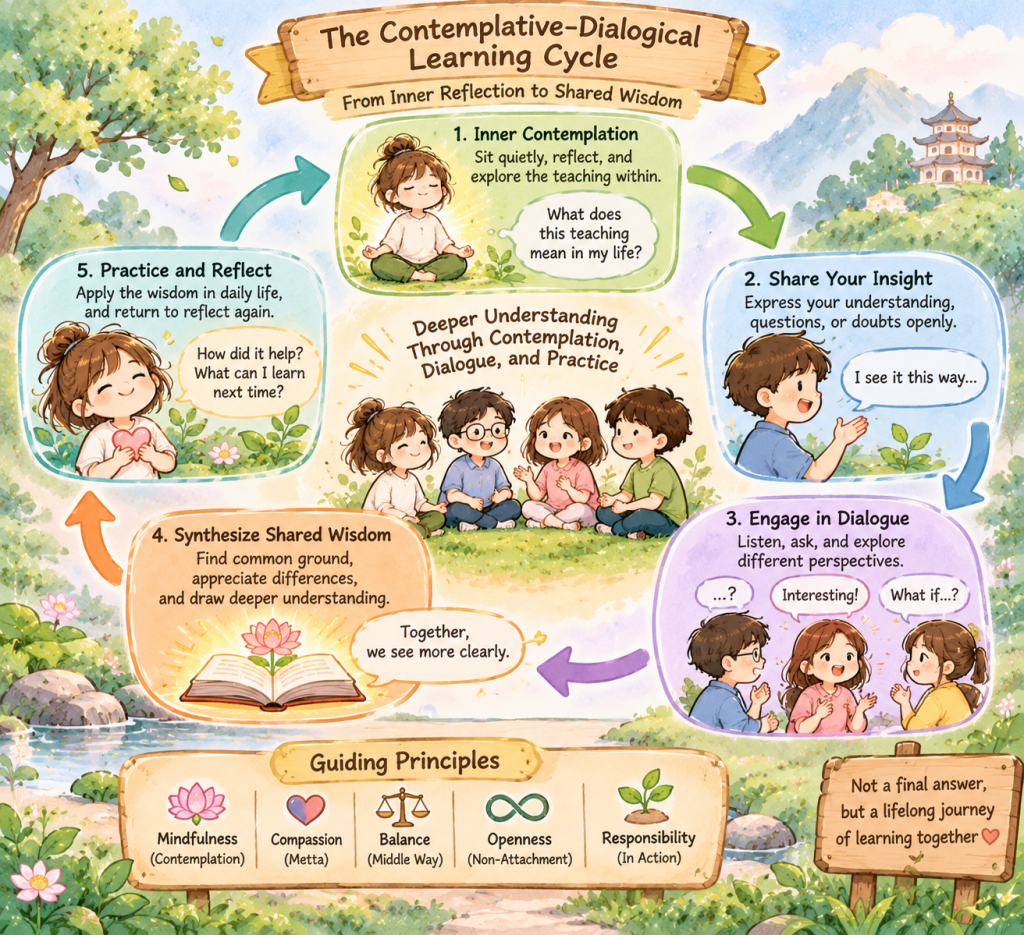
The process can be described as a recursive cycle of five movements.
Inner contemplation
Participants begin by listening to or reading a religous teaching, then reflect on its meaning and relationship to their own experience. They may ask: What does this teaching reveal about the way I respond to suffering, attachment, conflict, or change? This stage creates space between receiving a teaching and immediately asserting an opinion about it. This process resonates with the development of wisdom through learning, reflection, and cultivation. Anālayo (2021) explains that these modes of wisdom are interrelated rather than necessarily isolated stages; learning, reflection, and contemplative cultivation can support one another throughout practice.
Articulation of personal understanding
Participants then express what they have noticed, understood, or found difficult. They distinguish, as far as possible, between the teaching itself, their own experience, and their interpretation of that experience. For example, a participant studying non-attachment might say, “I understand letting go as not depending on a particular outcome.” Another might describe how this teaching has helped them respond less reactively to disappointment. A third might remain uncertain about whether letting go could be confused with avoiding responsibility. The purpose of articulation is not to present a finished answer. It is to make one’s current understanding available for inquiry.
Dialogical inquiry
Participants listen, ask clarifying questions, and examine the assumptions behind one another’s interpretations. A useful dialogue does not ask only, “Who is right?” It also asks, “What does this interpretation illuminate? What does it leave out? What might we be assuming without noticing?” This is consistent with Bohm’s account of dialogue as an inquiry into the assumptions and patterns that shape collective thought (Bohm et al., 1991). It also resembles Dewey’s (1933) account of reflective thinking, in which ideas are examined rather than accepted merely because they first appear plausible.
Synthesis of shared understanding
After dialogue, participants identify what has become clearer, what they can reasonably affirm together, and what remains unresolved. A synthesis should not erase differences merely to create the appearance of agreement. For instance, the group might formulate a shared understanding that non-attachment involves loosening one’s dependence on a desired outcome while continuing to act responsibly. Participants may still differ on how this principle applies to a particular relationship or professional obligation. That difference can be recorded as an open question rather than forced into a single conclusion.
Practice and renewed reflection
Finally, participants choose a practical implication to test in daily life. At a later meeting, they return to the question: What happened when we tried to live according to this understanding? What did the experience confirm, complicate, or correct? The process therefore moves from teaching to contemplation, from contemplation to dialogue, from dialogue to synthesis, and from synthesis back to practice. Its circular structure prevents a shared interpretation from becoming a fixed doctrine that no longer needs examination.
Table 1 Cycles of movement
| cycle | activities | lead question |
| inner contemplation (meditation) | Read, listen, observe the experience, and contemplate the Dharma calmly. | What does this point to in our lives and minds? |
| Articulation of personal understanding | Share your understanding, doubts, or uncertainties without rushing to claim you are correct. | What did I see or experience, and how did I interpret it? |
| Dialogical inquiry | Listen, question, verify assumptions, and listen to different perspectives. | What aspects of my understanding might be missing? |
| Synthesis of shared understanding | Separate what has common evidence, what remains controversial, and what is still unknown. | How far can we generally agree on? |
| Practice and renewed reflection | Put that understanding into practice and then reflect on it again. | When applied in real life, does this understanding reduce suffering or increase wisdom? |
Philosophical Foundations
Buddhist wisdom
The process has a clear affinity with the Buddhist distinction among wisdom arising from learning, reflection, and cultivation. These dimensions are often described as sutamayā paññā, cintāmayā paññā, and bhāvanāmayā paññā. Anālayo (2021) cautions against treating them as a rigid division between theory and practice: learning, reflection, and cultivation can be interrelated activities that support the development of wisdom.
Contemplation and dialogue can therefore be understood as complementary rather than competing modes of learning. Inner reflection allows a teaching to become personally meaningful; dialogue exposes the limits of individual understanding; practice tests whether the resulting insight supports discernment and a less harmful way of living. This does not mean that every personal experience is an instance of wisdom. Experience can be shaped by confusion, fear, desire, or prior assumptions. Nor does a group’s agreement automatically become Dharma. The process requires discernment: experience is taken seriously, but its interpretation remains open to examination.
Reflective inquiry
Dewey (1933) treats reflective thinking as a disciplined process rather than the passive reception of ideas. In contemplative-dialogical learning, this means that a participant does not stop at “I feel this teaching is true.” They ask what supports that understanding, what assumptions it contains, and what consequences follow if it is applied. Dialogue contributes by making private assumptions available for shared examination. A question from another participant may reveal that a seemingly obvious interpretation depends on a narrow experience or an unexamined definition. Reflection then becomes more than introspection: it becomes a willingness to revise one’s understanding in response to reasons and experience.
Hermeneutics
Hermeneutics emphasizes that understanding involves interpretation. We approach a teaching from within a particular history, language, and set of expectations; we do not encounter it from a completely neutral position. Gadamer’s (2004) philosophical hermeneutics helps explain why understanding can develop through an encounter between the learner’s horizon and the meaning of a text or tradition. In religious learning, this does not mean that a teaching can mean anything a reader wishes. Rather, it means that understanding deepens as learners become aware of their assumptions, attend carefully to the teaching, and allow the encounter to reshape their initial interpretation. Dialogue can make this process visible by bringing different interpretive horizons into conversation.
Philosophical Tensions and Limits
The approach is supported by several philosophical traditions, but it also faces important challenges.
First, consensus is not identical to truth. A group may agree because it has examined an issue carefully, but it may also agree because of social pressure, deference to authority, or fear of disagreement. A shared conclusion must therefore remain answerable to the teaching under consideration, relevant reasons, and the consequences of practice.
Second, personal experience is significant but fallible. A learner’s experience may disclose something important, yet the meaning assigned to it can be mistaken. The group should respect the person’s report without automatically treating the person’s interpretation as universally valid.
Third, dialogue can reproduce unequal power. Participants may have different levels of confidence, knowledge, or social authority. A teacher’s presence can be valuable in clarifying concepts and protecting the integrity of a tradition, but authority should not make sincere questioning impossible. Conversely, a facilitator should not treat every interpretation as equally well-grounded merely to preserve harmony.
Fourth, open interpretation must not become relativism. The fact that teachings can be interpreted in different contexts does not imply that every interpretation is equally coherent, faithful, or ethically sound. A responsible dialogue distinguishes openness from arbitrariness and respect from uncritical acceptance.
These tensions do not invalidate the method. They indicate the conditions under which it can become a serious form of learning rather than an informal exchange of opinions.
A Moderate Postmodern Interpretation
Within the framework of moderate postmodernism, contemplative-dialogical learning can be interpreted through three practices: non-attachment, rereading, and seeking common ground while reserving differences. These practices are used here as an interpretive framework, not as a claim that all postmodern philosophies share one unified doctrine.
Detachment
Detachment (Non-attachment) in dialogue means that participants do not make their current understanding into an extension of their identity. A person may speak sincerely and confidently while remaining willing to revise an interpretation. This does not require abandoning standards or treating all claims as equivalent. It means recognizing that a provisional understanding is not the whole of Dharma. The learner can remain committed to inquiry without becoming defensive about being right.
Rereading all
Rereading invites participants to ask how a teaching illuminates contemporary life. What might non-attachment mean in a culture that measures self-worth through achievement? How might compassion guide disagreement in a polarized community? How can equanimity be distinguished from indifference when a person witnesses injustice? Rereading should work in two directions. It brings the teaching into a new context, while allowing the teaching to challenge the assumptions of that context. It is not simply adapting Dharma to whatever is convenient; it is a reciprocal process of interpretation.
Seeking common ground while reserving differences
Dialogue can reveal shared concerns even among participants who interpret a teaching differently. They may agree that a response should reduce suffering, for example, while disagreeing about the best way to act in a particular situation. The aim is not to dissolve every difference into a single statement. It is to clarify what can be shared, what remains distinct, and how participants can continue learning together without coercion. In this sense, unresolved disagreement can be a productive result when it is more precise, informed, and compassionate than the disagreement with which the group began.
Conditions for a Responsible Dharma Dialogue
A contemplative-dialogical process is more likely to support learning when it follows several practical principles:
- Begin with contemplation. Allow time for silence, reading, or meditation before discussion begins.
- Distinguish teaching, experience, and interpretation. This helps prevent personal conclusions from being presented as the teaching itself.
- Listen to understand before responding. Participants can briefly restate another person’s point to check whether they have understood it accurately.
- Question ideas without diminishing people. Critical inquiry and psychological safety should support one another.
- Record both shared insights and unresolved questions. A synthesis should not manufacture consensus.
- Return to practice. Ask whether the understanding supports greater awareness, compassion, discernment, and responsibility in everyday life.
These principles are not a substitute for the guidance of qualified teachers or careful study of source texts. They are a way to make study and practice more reflective, dialogical, and accountable.
Conclusion
Contemplative-dialogical religious learning is a process in which inward reflection becomes more discerning through encounter with others, while dialogue becomes more meaningful through personal contemplation and practice. Buddhist accounts of wisdom provide a foundation for relating learning, reflection, and cultivation; reflective inquiry and hermeneutics help explain how assumptions can be examined and interpretations revised. From the perspective of moderate postmodernism, the process is best understood as a disciplined openness: learners do not cling to their own interpretations, reread teachings in changing contexts, and seek shared understanding without erasing difference. Its success should not be measured only by the production of a unified conclusion. It should also be measured by whether participants become more capable of seeing the limits of their understanding, responding to others with care, and translating insight into responsible action. The purpose of dialogue is not to make everyone think alike, but to help each person see more clearly—and to make that clearer seeing available for shared practice.
References
Anālayo, B. (2021). Hearing, reflection, and cultivation: Relating the three types of wisdom to mindfulness. Religions, 12(6), Article 441. https://doi.org/10.3390/rel12060441
Bohm, D. (1996). On dialogue. Routledge.
Bohm, D., Factor, D., & Garrett, P. (1991). Dialogue—A proposal. https://www.aofpd.org/libraryresources/dialogue-%E2%80%93-a-proposal/
Dewey, J. (1933). How we think: A restatement of the relation of reflective thinking to the educative process. D. C. Heath and Company.
Gadamer, H.-G. (2004). Truth and method (2nd rev. ed.; J. Weinsheimer & D. G. Marshall, Trans.). Continuum. (Original work published 1960)
Suwanbundit, A. (2026). Contemplative practices as theroria and askesis. https://philosophysuansunandha.com/2026/05/29/contemplative-practices-as-theoria-and-askesis/
Suwanbundit, A. (2024). Philosophical Contemplation. https://philosophysuansunandha.com/2024/04/25/philosophical-contemplation/


Leave a Reply