Bunchua, K., Wannapok, S., Takaew, R., Suwanbundit, A., & Harimtepathip, M. (2016). His Majesty King Bhumiphol’s Philosophy of Good Governance. In Proceeding of the 7th National and International Academic Conference and Research Presentation, Suan Sunandha Rajabhat University 2016 (pp. 132-145). Bangkok: Suan Sunandha Rajabhat University.
Abstract
The objectives of this research aimed to investigate how the Character of philosophy of self-sufficiency could be understood. The study found out that it could be understood in all dimensions of philosophy: metaphysics, epistemology and ethical philosophy. The findings showed that the metaphysical dimension found out that the theory of self-sufficiency aims are consistent with the metaphysical concept of spirit and body, which can clarify the concept of quality of life that is the sufficiency of living well without suffering for the survival in all situations of each individual and so developing to be a perfect man according to the postmodern ideal. The epistemological finding is that the theory of self-sufficiency aims at corresponding to the truth criterium of searching and progressively developing according to each situation, continuously without attachment complying with the key principle
of the Post-modernism too. In the line of applied philosophy, the self-sufficiency is the ethical philosophy in the concept of living to control and verify the good conduct of altruism and sharing as the key principles for the living with each other in happiness. That is the major purpose of the Post-modernism. The application of the self-sufficiency can be applied in the family, community and state levels with the key concept of the development of quality of life. In summary, the understanding of the self-sufficiency could go side by side with the philosophy of sufficiency economy with full character of post-modernity.
Keywords: Postmodern / Theory of Self- sufficiency / King Bhumiphol
Preamble
During the long Reign of His Majesty King Bhumiphol Adulyadej, the researcher has had a good luck to teach Philosophy in Chulalongkorn University, Assumption University, St. John’s University, and lastly in the Rajabhat SuanSunandha University. Collocating and developing knowledge of philosophy along His Reigning the researcher came to the consciousness as it is His Majesty’s longing to conscientize the people to understanding the Sufficiency Economy’ not only as a technique of a temporary earning a living of the grass-root population to abolish poverty and after a time, everything would be buried in the forgotten history. On the contrary, if some research could scrutinize His inauguration and application by way of philosophical analysis, appreciation and application, until His up-to-date Paradigm shows up, as not only effective solution for the prima ficie situation of the contemporary Thai population, but as an Ethical Theory in the globalization trend of thought from Thailand’s contribution, having the potentiality to develop side by side with the World’s progress to the future. If this research could find its way to be presented in the World congress, or to inspire an organization of an International Seminar in Thailand, offering a forum for the international scholars to discuss and promote His Philosophy among the today’s Philosophies, Thailand might have a Royal Philosopher in the list of the well-known philosophers of the World.
Objectives
- To find out, among the contemporary trends of the World philosophy, the one that may serve best the King’s Inauguration Pronouncement.
- To find out how to implement it to the needs of our country.
Research Methodology
The method used is of philosophy standard, that is discursive and dialectic
Result
The research found out that the Postmodern Philosophy of the moderate trend, fits best both objectives.
His Majesty’s Inauguration
His Majesty King Bhumiphol Adulyadej, in the ceremony of Ascending on the Throne of His Reign in Thailand, delivered an august inauguration “We will reign with Dharma, for the profit of Happiness of the august population of Siam” The researchers take this inauguration as the starting point and foundation of His Majesty’s philosophy that He has developed through His life on the throne up to date. This presentation can highlight only 2 main points: “with Dharma” and “Happiness.”
With Dharma
The word “Dharma” as used in Thai language of good governance, has at least 4 Connotations
A “Good Governance” has duty to take care of promoting 4 aspects of administration for the welfare of the Thai people, so as to be able to pass the 6 standards of evaluation of World Bank checking points:
- The Rule of Law
- Morality
- Accountability
- Participation
- Responsibility
- Cost Effectiveness of Economy
To satisfy all these checking points of World Bank, a Good Governance must take care of administering or managing to have the following aspects of the Thai people.
- Conscientizing Good Law. To promulgate only good laws, to observe good laws, to investigate according to good laws and to punish for the good laws.
- Conscientizing Good Ethic. An ethic is a system of virtues that makes a person or a society virtuous or qualified as “integrity”. Ethic is collected from the reasons of philosophy to encourage to be prefect above the requirement of laws and religious morality
- Conscientizing Good Morality. A Morality is a system of virtues deduced from the teaching of a religion that makes a person or a society virtuous as qualified as “integrity” The policy of Thai Good Governance is to offer freedom of belief to all citizens even freedom not to profess any religion. However it is desirable to promote morality of all religions recognized by the Thai tradition, so that the religious people may be willing to do good above the obligation of law and above the philosophical reason, “for the
profit of Happiness of the august population of Siam” - Conscientizing Good Traditions of the people of Siam. Traditions of Siam mean all traditions that were originated in Thailand, regardless of races and good customs. Thailand or “Siam” is the land of multiple races and customs: all are the composite Tradition of the people of Siam.
- Conscientizing Good Codes of Conduct. Any organization in the Kingdom should have its own Code of Conduct that comes from the unanimity of the responsible members of that organization, with the aim of the prosperity of the organization and the pride of its members. However, it is the responsibility of the Good Governance of the country to take care that all organizations of the country have a good Code of Conduct.
The Meaning of Dharma
In Thai language of the Good Governance context, “Dharma” has the following connotations:
- Juttidharm (ยุติธรรม) means justice in the context of laws.
- Cariyadharm (จริยธรรม) means ethic in the context of philosophical conduct.
- Siladharm (ศีลธรรม) means morality which is the application of the belief of each religion.
- Watanadharm (วัฒนธรรม) means culture which should includes all the cultures that are observed by all races and all groups of the people in the Kingdom. By all considerations, it is the happy word that was pronounced by His Majesty in His Inauguration: “We will reign with Dharma”. It is really a providential foundation for the philosophy that can by developed well for the Good Governance of Thailand or “Siam”.
Meaning of Happiness
In the Buddhist context, “Happiness” may have 2 levels: the Transcendental Happiness (Lokuttara Sukha โลกุตรสุข) and the immanent Happiness (Lokiya Sukha โลกียสุข). The Good Governance in the Thai Kingdom should not promote the Transcendental Happiness directly, but should do it by proxy by
promoting the religious organizations to have the facility to do it.
Happiness to be concerned directly by the Good Governance is the Immanent Happiness—the Happiness in this World as intended by the Royal Inauguration. But Happiness in this World is acquired by satisfying the instinct (called “Drive” by Friedrich Nietzsche) which can be divided into 4 levels by
Aristotle:
- Material Instinct which is satisfied by keeping stable, still, quiet, resting, etc. The Material Instinct in our human body finds happiness in keeping itself lazy, inactive, resting and to be served by others without limit of sufficiency.
- Vegetative Instinct which is satisfied by eating, consuming, keeping, for the future security. This instinct in human life finds happiness in acquiring, collecting accumulating and keeping without limit nor sufficiency.
- Procreating Instinct which is satisfied by the act of procreating for procreating without reason, discipline nor sufficiency. It is the authentic happiness for animal life.
- Intellective Instinct which, according to Aristotle and Nietzsche, is satisfied by the act of creativity, adaptively, collaboration and requisivity.
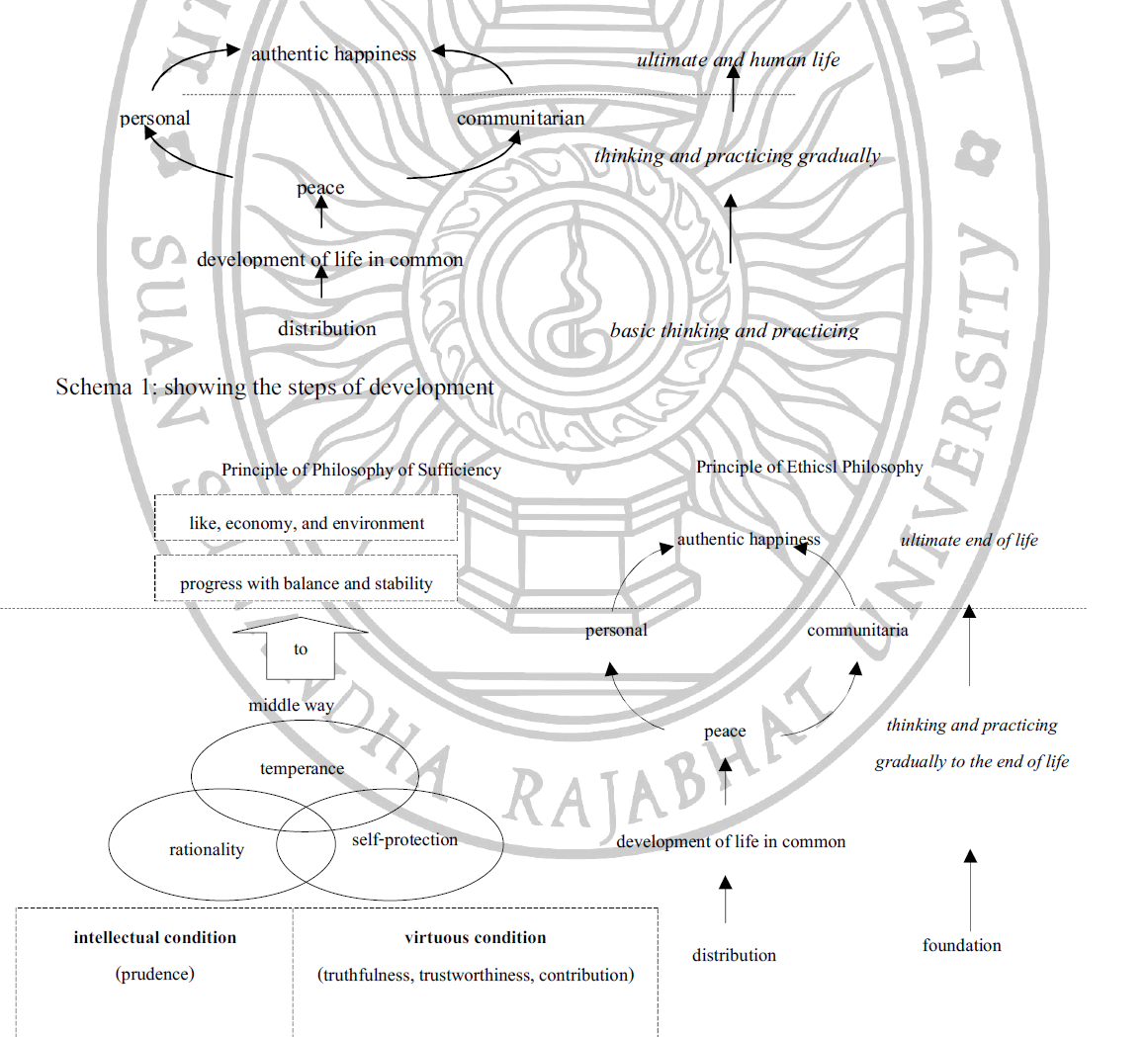
Humans are disposed to have all the 4 kinds of happiness in hierarchy from the low up thus: material, vegetative, procreative and intellective. Only the intellective instinct is authentic happiness by itself for humans. All the lower instincts are authentic happiness for humans only under the sufficiency control of the intellective instinct, and this is the meaning required for the understanding of His Majesty’s Theory of Sufficiency for the “Profit of Happiness of the august population of Siam”.
This concept is explained fully in the research text and schematically by the 2 diagrams
Perspectives of Human Happiness
According to the postmodernists, there are 5 possible perspectives of human happiness and the knowledge is very feasible to understand and to implement His Majesty’s Inauguration as a contemporary Philosophy of Sufficiency. They are:
- The primitive perspective (The 1st paradigm)
The primitive perspective on religion refers to the way in which the primitive people fashioned their religion as well as the way more advanced religions are viewed by people of this perspective today. It sees religion as entirely a matter of conforming to the will of supernatural Powers. Primitive peoples do not think in terms of Laws to be discovered but think only of the will of the
supernatural beings that they express or symbolize as mysterious forces beyond the understanding of the human mind like the On-Highs, gods, devas, devils, phis (ผี) and so forth. The most the primitives can do is to submit to the fact that such a will is operating. They have no right to inquire into its why or whence. When the will of the On-Highs becomes manifest, there is no choice but to follow it blindly and without question. Only in so doing would one’s actions work to one’s own welfare; to resist or to contradict it spells danger.
In this sense, the primary aim of primitive religious people is their own prosperity in this life. Whatever ideas they might have entertained about the next life, questions are of secondary concern. One pleases supernatural beings by doing their will precisely because one hopes for benefits here and now. The next life would, they believed, take care of itself. The primitive philosophy behind this way of thinking rests on the belief that the World or the whole Cosmos is without a law of its own. And that everything that takes place in this lawless cosmos or Chaos happens by the will of the higher powers, be they personal or impersonal, mysterious or revealed.
This primitive may of life and thought, the first that humanity knew, has survived through history along with other ways. Even in our own day not a few intellectuals continue to deal with their beliefs in this manner. They expect religion to provide them with worldly benefits, and are prepared to alter their beliefs and practices if such change would redound to their profit. In short, the primitive may remains as popular as ever today. But it hardly provides the right model for mutual understanding. Let us consider another option as our foundation for Peace.
- The ancient perspective (The 2nd paradigm)
The ancient way refers to the characteristic belief of the ancients and those who think like them that the world is regulated by laws and follows those laws with invariable fidelity. The universe is an ordered Cosmos, not a Chaos, or lawless world, as the primitive way believes. But like the primitive way, the ancient way is not much preoccupied with the next life. It believes that following the laws of the universe represents the best way to regulate life and control other creatures. They struggle to discover the hidden principles that would accord automatic power to those who know how to manipulate them. If this life is regulated, they seem to reason, then all would be right with the life to come as well. For the ancient way, the most important function of religious masters is to reveal laws to be followed. The beliefs and practices that render most to their advantage are accepted; those that work against them are avoided. This means that they are prone to Polytheism and even Polyreligionism: they pray to one god for rain and to another for children, and they would even ask the devil’s protection if that serves their purposes. The
alteration of beliefs is not difficult among such people, provided that there be something to be gained therewith.
This attitude that we have been calling the way of the ancients did not pass into oblivion but has survived to the present. It is not hard to find those among the contemporary religionists who still think in this way. But as they have been taught exclusivistic religions, they lend to restrict themselves to the laws and range of beliefs encompassed of their own tradition, which they consider sufficient to secure all the profit they seek. They like to think that relations with other religions would only weaken the effectiveness of their own. Christians of this stamp hold that God created the world and fitted it up with laws. Those of the laws that God chose to reveal to the world are sacred and all sufficient. To have recourse to what lies outside of divine revelation is to risk displeasing God and incurring divine wrath. In like manner, Buddhists of this type consider the Buddha to be the discoverer of the eternal laws. Though the Buddha did not teach everything as he had discovered, what he did teach and what has been transmitted through history is sufficient for those seeking release from suffering and the accumulation of as much benefit as possible.
All things considered, it is clear that there is little to hope for mutual understanding and respect among those who live and think in the way of the ancients.
- The medieval perspective (The 3rd paradigm)
The third way I would like to single out for attention is the way of the belief of the medieval people and those who keep their way of thinking up-to-date. Of course, not all the medieval followed the same way; some persisted in the primitive and some in the ancient ways. Only the most “up-to-date” people of the time led what I am calling the medieval way of life, according to which, the world has its own laws, but reliance on these laws alone has no guarantee of happiness in this life–not even for the most powerful caliph or the greatest conqueror. There are numerous spiritual masters of this way who teach that
at most one can expect only imperfect happiness this life. For, as all the great founders of the World Religions had taught, true and eternal happiness can only be attained in the life to come. To this end, these spiritual masters teach only ways of spiritual practice, each fitted out with its own rationale that
distinguishes it from all other ways. Hence, a variety of different traditions developed out of the same Scriptures, centered on different spiritual masters. Faced with this variety of competing religious ways, the medieval come to realize that what insures the survival of a religious tradition is strong cohesion among its adherents. And this, in turn, requires that one’s own tradition be exalted as highes: as possible above all others. This is the form in which medieval religions have come down from the past to our days, and a
form with which large numbers of people continue to be comfortable.
Insofar as such attachment to one’s own tradition begets competitions, as competition begets distrust, and distrust begets enmity, there is little hope for encounter among the people of this type.
- The modern perspective (The 4th paradigm)
The modern perspective (The 4th paradigm) The distinguishing trait of the modern way is the scientific approach to thought and action. The story of the modern age is that of the success of science with its discoveries and practical
technologies. It has engendered in the people the hope that science may one day succeed in resolving all the problems of human life. The way of science becomes the paradigmatic logic for all thought. Reason becomes identified with scientific method. Once the scientific mind-set has taken hold, all other attitudes are dismissed as ancient, obsolete, anti-intelleclual, and an obstruction to progress.
In the realm of religion, the modern way has sought to submit all claims of religious truth to the norms of scientific proof. As a result, those who follow this way put great stock in trying to demonstrate the logical reasonableness of what they believe. Not only is there a variety of religious teachings grounded in the religious experiences of different spiritual masters, but now we find an equally wide variety of ways to systematize these teachings. Just as there are many paths to the summit of mountain, so religious truth admits of many modes of rational axiomatization. This attitude promotes still greater rifts within tradition and raises inter-sectarian apologetics to a place of new prominence, Af present, most intellectuals belong to this modern way of thinking and acting. Each is sure of his or her own reasoning and its assumptions, tacit or articulated. Many give what they consider cogent reasons for not professing any religion at all, while those who profess a particular religious way, be it Buddhist or Christian or what not, cling proudly to their own system and find security in the companionship of those who think in the same terms, or in the attempt to convert others to their way of thinking. And so the process goes on:
Division begets Competition.
Competition begets Distrust.
Distrust begets Annihilation.
The modern way, no less than the other ways, does not hold out much hope as a way to true Mutual Understanding and Peace. Another way must be sought out.
- The contemporary perspective (The 5th paradigm)
Not all people living today subscribe to the contemporary way of life and thought; those who hold to one of the previous four attitudes cut themselves off from it. But it is becoming more and more widespread among the more searching minds and spirits of our time who think in terms of the future of the
human race. The contemporary way follows the following process:
To seek a clear status of the question at hand. This requires discipline, in particular of the sort that the philosophy method can provide.
To see as many possible answers as possible. One aims at exposing the question in all its aspects and hence to invite different perspectives on its resolution as many as possible.
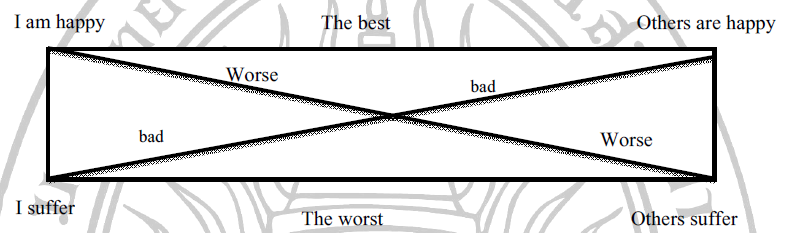
To select what is useful for oneself in enhancing the quality of life. Enhancing the quality of life means rising above competition to rejoice not only in one’s own happiness but also in that of others, and to suppress not only one’s own suffering but also that of others, Hence the quality of life rises roughly
in the following order:
1) To suffer for the suffering of others,
2) To rejoice by the suffering of others,
3) To suffer for the happiness of others,
4) To rejoice by and for the happiness of others
The first shows foolish selfishness; the second clever selfishness; the third limited good will; and the last, perfect and unbounded freedom.
Quality of Human Happiness
Human Happiness can be put in schematic hierarchy as follows:
The mind that follows the contemporary way sees, by critical analysis, that the four previous ways or paradigms do not lead to the final stage but get stuck in their own attachments. The first way clings to the will of mysterious powers and leaves little room for human improvement. The second may clings to the laws that govern human improvement, but lacks the necessary flexibility to cope with all human aspirations. The third way clings to the life-to-come to the detriment of the quality of this life; it lacks sufficient interest in this world to make it the arena for improving the quality of life. At best the third way can reach the third stage of the quality of life, but because of its attachment to the teaching of one master, it tends to produce fanatics prepared to suffer in order to impart the suffering on others. The forth way tends to destroy all religious beliefs in the name of rationality. Those who reflect until they are able to believe reasonably tend to be defensive in their beliefs. While engaging in one’s own apologetics, one fears defeat at the hands of another system of apologetics, and thus schools of thought multiply
themselves without end, even within the same religious denomination. The followers of the fourth way exhibit an attachment to their systems of thought, more so than is the case in any other way.
The modes of attachment may be briefly set out as follows:
Attachment begets Division
Division begets Competition
Competition begets Distrust
Distrust begets Annihilation
Mutual Annihilation begets Fight-for-Survival
The new way that is called the contemporary way, must be one of Detachment. Detachment may lead to division, but a kind of division that will not beget competition but rather a harmonious division of responsibilities.
Applying the contemporary way, the way of critical analysis and evaluation, education opens up the possibility of a policy of “unity in diversity” in which we can affirm that all ideals are good, but good in a different way from each other. There is no need to claim that all ideals are equal or even that they are
all equally good. Nor have we to say in the realm of religion that all religions are the same, which we know not to be the case. We do not judge one religion better than another, but we say that one religion is best for those who select it, while others are best for those who select them. By “selection” I mean consent with conviction. Had we not considered our religion to be the best, we should not have selected it. But at the same time we respect the selection of others. Each one selects what one sees best for oneself and respects the choice of others. Only among the religionists of this stamp can proper and unbiased interchange take place. There is no attachment to breed distrust in their hearts. Rather, in a spirit of detachment and trust, they can work together to search out the best, to share the experience of their searching, and to dialogue for the sake of improving the common quality of life. They do not mix all religious matters up confusedly, but use critical analysis to attain clarity of understanding about the foundations of their beliefs and about what can be learned from others. Finally, by evaluation they know how to be grateful, both to their own tradition in nurturing their qualities of life and for what other traditions can add to what they aspire to.
Only the Contemporary Perspective or the 5th Paradigm is fit to implement the Royal Philosophy.
Conclusion
The Philosophy of Sufficiency was originated in the Kingdom, by the King and for the King’s people of the so-called Siam. It is appropriate for the use of education and put to practice as a Good Governance of the Kingdom. It need a team of good scholars to research and develop for better and better understanding, another team of good instructors to educate the present and the future population accordingly. This research gives only a a pilot project to be moved and promoted to a better and better body of knowledge, with the hope that Thailand may go out from the Labyrinth and one day the World may recognize that, there is a philosophy good for the globalization al implement too. This paper presents only 1 aspect, the most prominent one as accomplished by the researcher group of SuanSunandha’s Philosophy and Ethics Ph.D. Program entitled: ลักษณะหลังนวยุคในทฤษฎี ความพอเพียงของพระบาทสมเด็จพระเจ้าอยู่หัวภูมิพลอดุลยเดชฯ. The presenter would like to invite those who have interest to read the whole report of this research in Thai language, available at the office of the Graduate School, SuanSunandha Rajabhat University.
Suggestion
The application needs to be more defined for the better understanding of the 5 philosophical paradigms which is strongly recommended for the following researches.
Reference
- Aristotle. (1988). Politics. translated by E. Barker. Oxford University Press.
- Audi, Robert. (1999). The Cambridge Dictionary of philosophy. New York: Cambridge University.
- Bauman, Z. (1996). Postmodern ethics. Cambridge: Blackwell.
- Best, S. & Kellner, D. (1999). Postmodern Theory. New York: The Guilford Press.
- Bunchua, K. (2005). “Dynamic heritage of Thais through five paradigms”. In McLean, G. F. (Ed.), Cultural heritage and contemporary change series IIID (pp. 267-73), Council for research in values and philosophy retrieved April 20, 2013, from http://www.crvp.org/book/Series03/IIID-3/front.htm.
- Glück, Robert. (2004). “Long Note on New Narrative”. Biting the Error: Writers Explore Narrative. Ed. Mary Burger et al. Toronto: Coach House Books.
- Jones, W.T. (1969). A History of Western Philosophy. New York: Harcourt Brace.
- Lacan, J. (1956 – 1957). The Seminar of Jacques Lacan Book IV. Object Relations. (Unpublished).
- Lévi-Strauss, C. (1966). The Savage Mind. Chicago: The University of Chicago Press.
- Mill, J.S. (1967). Utilitarianism” in Ethical theories. A Book of Readings. ed. A. I. Melden. New Jersey: Prentice – Hall.
- Nietzsche F. (1886). On the Genealogy of Morality. translated by Carol Diethe and edited by Keith Ansell-Pearson. (1994). Cambridge: Cambridge University Press.
- Sartre, Jean-Paul. (1976). Being and Nothingness. translated by Hazel E. Barnes. London: Methuen & Co. Ltd.
- Terence, I. (2007). The Development of Ethics 1, Oxford: Oxford University Press.
- UN Secretary-General office. (2006). Thai king’s development agenda, visionary thinking inspiration to people everywhere, Say Secretary-General to Bangkok Panel. retrieved April 20, 2013, from http://www.un.org/press/en/2006/sgsm10478.doc.htm.
- UNDP. (2007). Thailand Human Development Report 2007 : Sufficiency Economy and Human Development. United Nations Development Programme.
 ปรัชญาสวนสุนันทา
Leave a comment