Anek Suwanbundit, Ph.D.
Ravich Takaew, Ph.D. (Fellow of the Royal Society of Thailand)
Nasirat Aditharinbhirom, Ph.D.
Program of Doctor of Philosophy (Philosophy and Ethics), Graduate School,
Suan Sunandha Rajabhat University
Abstract
Education in the twenty-first century faces a fundamental challenge: the accumulation of information no longer guarantees the development of wisdom. Contemporary learners have unprecedented access to knowledge, yet access alone does not necessarily produce understanding, judgment, ethical responsibility, or the capacity to apply knowledge appropriately in complex situations. This article develops a philosophical framework for understanding education as a movement from knowledge transmission toward the cultivation of wisdom. It synthesizes three pedagogical metaphors associated with philosophical education; filling the sack with rice grains, growing orchids, and growing roses; with theories of experiential and lifelong learning. The article also reinterprets the popular notion of the Learning Pyramid not as an empirically verified hierarchy of retention percentages, but as a heuristic representation of increasing learner participation and intellectual agency. The article argues that philosophical education should not reject knowledge transmission but should integrate memory, understanding, critical reflection, value judgment, and practical application. This progression is expressed through the philosophical model of analysis, appreciation, and application, a movement from examining knowledge, to evaluating its value, and finally to transforming it into responsible action. Education for lifelong learning, therefore, should be understood as the cultivation of persons capable not merely of knowing more, but of thinking better, judging wisely, learning continuously, and acting responsibly toward others.
Keywords: philosophical pedagogy, lifelong learning, wisdom, critical thinking, Learning Pyramid, double-loop learning, deuterolearning, practical wisdom
Introduction
One of the central questions of education is deceptively simple: What is the purpose of teaching? The conventional answer often emphasizes the transmission of knowledge. Teachers possess knowledge, students lack it, and education is therefore organized around the transfer of information from one generation to another. Students listen, read, memorize, reproduce information, and eventually demonstrate that they have acquired sufficient knowledge through examinations. This model remains necessary. No human being can independently rediscover the accumulated knowledge of civilization. Language, mathematics, science, philosophy, history, ethics, and professional knowledge must, to some extent, be transmitted. A learner cannot critically examine a concept that he or she has never encountered. Knowledge therefore remains the indispensable material of thought. However, knowledge alone is not wisdom. A person may remember a large amount of information while lacking the capacity to determine when, where, and how that information should be used. A person may possess professional expertise while being unable to consider its ethical consequences. Likewise, an individual may receive moral instruction without developing the capacity to make moral judgments independently. The contemporary crisis of education is therefore not simply a crisis of insufficient information. In an age of digital technology and artificial intelligence, it is increasingly a crisis of judgment.
The educational problem may consequently be formulated as a philosophical question: How can education move from transmitting what people know toward cultivating the capacity to think, judge, learn, and act wisely? This question requires a re-examination of the relationship between teaching and learning. Teaching should not be understood as a single method but as a developmental process. Different forms of learning are appropriate at different stages of intellectual development. A beginner may require direct instruction and memorization. A developing learner may require structured practice and feedback. A mature learner may require opportunities for inquiry, interpretation, dialogue, criticism, and practical application. A philosophical approach to education therefore recognizes that the learner is neither an empty container nor an entirely autonomous creator of knowledge. Human learning develops through a dynamic relationship between receiving knowledge and transforming it. The learner first encounters a tradition, then understands and examines it, evaluates its meaning, and eventually applies or transforms it within new circumstances.
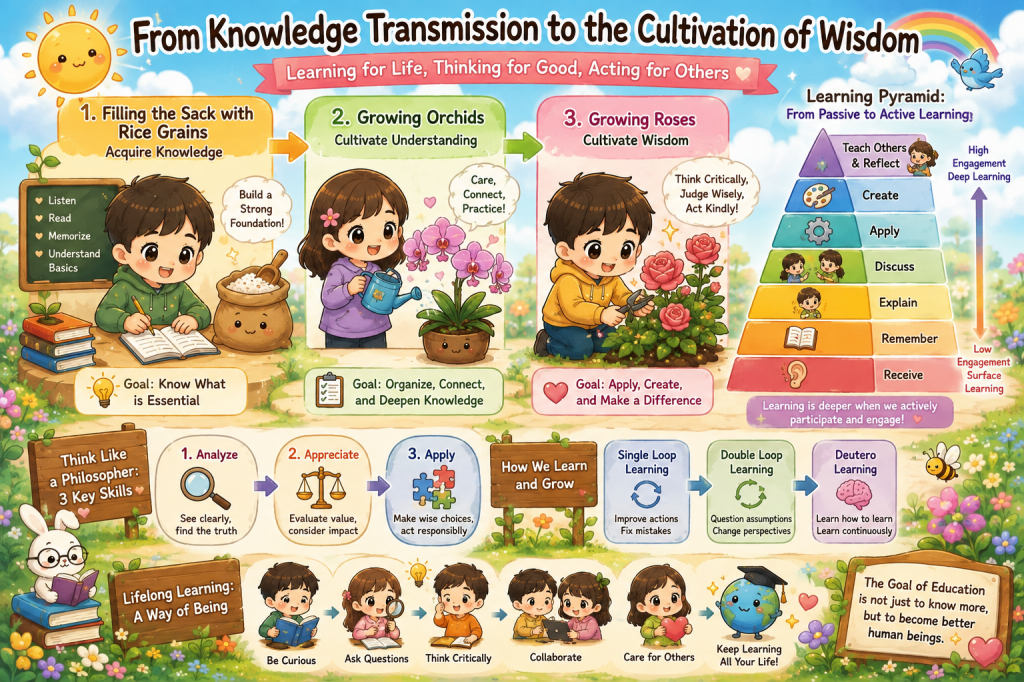
This article develops such a framework through three pedagogical metaphors: filling the sack with rice grains, growing orchids, and growing roses. (Bunchua, 1992) These metaphors are subsequently integrated with the idea of progressive learner participation commonly associated with the Learning Pyramid, theories of organizational and reflective learning, and the philosophical development of critical and practical wisdom. The central argument is that education should move through the following developmental sequence:
Receive → Remember → Understand → Connect → Analyze → Appreciate → Apply → Create → Reflect → Become
This movement does not imply that earlier stages become unnecessary. Wisdom does not eliminate knowledge, and critical thinking does not eliminate memory. Rather, each level incorporates and transforms the previous one.
Knowledge as the Material of Thought
The first stage of education concerns the acquisition of knowledge. The metaphor of filling the sack with rice grains represents this foundational stage. A learner who encounters a new field of knowledge requires concepts, vocabulary, facts, principles, examples, and frameworks. The mind must first acquire intellectual resources before it can employ them. In this stage, teaching methods such as listening, reading, note-taking, memorization, demonstration, and guided explanation remain important. Contemporary education sometimes reacts against traditional instruction by assuming that memorization is inherently inferior to critical thinking. Such an opposition is misleading. Critical thinking requires something upon which thought can operate. A learner cannot compare theories without knowing them, criticize arguments without understanding them, or creatively apply principles without possessing them. Knowledge is therefore not the enemy of independent thinking. It is the condition that makes independent thinking possible.
This first level may be described as the development of cognitive resources. The learner acquires a vocabulary for interpreting reality. For example, before students can engage in philosophical reflection about justice, they may need to encounter concepts such as equality, liberty, responsibility, rights, virtue, power, and dignity. Before they can critically examine scientific evidence, they must understand fundamental principles of reasoning and observation. Whereas, the weakness of this stage emerges only when education stops here. When knowledge is treated merely as information to be stored and reproduced, learners may become intellectually dependent upon authority. They may know what previous thinkers have said but remain unable to formulate questions of their own. They may pass examinations while lacking the capacity to address unfamiliar problems.
The metaphor of the sack is therefore useful because it represents both necessity and limitation. An empty sack has little practical value, but a sack filled with rice must eventually be used. Knowledge that remains permanently stored but never examined, evaluated, or applied has not yet become wisdom.
From Possessing Knowledge to Developing Understanding
The second pedagogical metaphor is growing orchids. If filling the sack represents the acquisition of knowledge, growing orchids represents the careful cultivation, organization, reinforcement, and assessment of knowledge. An orchid cannot flourish merely because it has been planted. It requires appropriate conditions, nourishment, care, time, and attention. Similarly, knowledge acquired during an initial encounter must be reinforced and connected with other knowledge. Learners need opportunities to recall what they have learned, practice using concepts, receive feedback, correct misunderstandings, and gradually develop intellectual confidence.
At this stage, assessment becomes meaningful not merely as a mechanism for assigning grades but as a means of revealing the structure of understanding. Questions, exercises, examinations, and demonstrations can help learners recognize what they know and what they do not yet understand. The educational movement is therefore:
Exposure → Memory → Practice → Feedback → Consolidation
The purpose of assessment at this level should not be limited to determining whether students can reproduce information. A more meaningful assessment asks whether learners can organize knowledge coherently. For example, students studying educational philosophy should not merely memorize the names of philosophical theories. They should be able to explain the differences between essentialism, perennialism, progressivism, reconstructionism, and relational approaches to education. They should recognize the assumptions underlying each approach and identify the circumstances in which different theories may generate different perspectives.
The learner begins to move from isolated information toward a network of understanding. This stage also corresponds to the development of intellectual discipline. Learners discover that understanding requires repetition, patience, correction, and attention. Knowledge does not become stable simply because it has been encountered once. However, even highly developed understanding does not necessarily produce wisdom. A person may be capable of explaining a theory accurately while remaining unable to apply it meaningfully in life. The transition from growing orchids to growing roses therefore represents a more profound transformation in the philosophy of education.
Education as the Cultivation of Practical Wisdom
The metaphor of growing roses represents the highest pedagogical aspiration of the framework. Whereas the sack emphasizes acquisition and the orchid emphasizes cultivation, the rose represents the flourishing of the learner’s own intellectual and moral capacities. A rose cannot be forced to bloom simply by command. It requires preparation, care, an appropriate environment, and time. Similarly, wisdom cannot simply be transferred from teacher to student. Teachers can provide knowledge, questions, examples, criticism, and guidance, but the learner must eventually perform the work of understanding and judgment. At this level, the central purpose of education changes. The question is no longer merely: What does the learner know? It becomes: How does the learner think with what he or she knows? The learner is encouraged to analyze situations, identify assumptions, compare alternatives, recognize complexity, evaluate values, and develop practical responses. Knowledge becomes an instrument of reflection rather than an object of possession.
This stage resembles Aristotle’s concept of phronesis, or practical wisdom. Practical wisdom differs from theoretical knowledge because it concerns judgment within concrete and changing circumstances. A person may know general principles while still lacking the wisdom to determine how those principles should be applied in a particular situation. For this reason, education for wisdom must expose learners to uncertainty. A purely mechanical educational system rewards learners for finding predetermined answers. Wisdom-oriented education, however, sometimes requires students to encounter questions for which no simple answer exists. Learners must distinguish between problems that can be solved through technical expertise and problems that require interpretation, dialogue, ethical judgment, or collective deliberation.
Growing roses therefore involves:
- asking meaningful questions
- examining presuppositions
- considering multiple perspectives
- evaluating consequences
- recognizing values and conflicts
- developing arguments
- applying knowledge creatively
- reflecting upon experience
- assuming responsibility for action.
The movement from knowledge to wisdom may therefore be represented as follows:
Information → Knowledge → Understanding → Judgment → Action → Reflection → Wisdom
At this stage, education becomes closely connected with character formation. The learner is no longer merely an individual receiving knowledge but an emerging participant in society.
The Learning Pyramid: From Passive Reception to Participatory Learning
The popular concept of the Learning Pyramid has often been used to illustrate the proposition that learners tend to become more deeply engaged when they move from passive reception toward active participation. The familiar representation places activities such as listening and reading near the base of active engagement, while discussion, practice, and teaching others are represented as more participatory forms of learning. However, the specific numerical retention percentages frequently associated with the Learning Pyramid should be treated cautiously. Scholars have questioned the historical and empirical basis of these precise percentages, and there is insufficient evidence to treat them as universal measurements of human memory (Letrud & Hernes, 2018). The crucial distinction is not between good and bad methods. Listening to a lecture can be effective when learners are encountering unfamiliar knowledge. Reading can be essential for conceptual depth. Demonstration can be indispensable for professional training. Nevertheless, when interpreted carefully as a pedagogical heuristic, the Learning Pyramid remains useful for philosophical reflection. Its greatest value does not lie in numerical claims about retention but in its suggestion that learning may deepen when learners increasingly participate in the production, discussion, application, and communication of knowledge.
This interpretation corresponds closely with Bunchua’s three pedagogical metaphors. The stage of filling the bag with rice grains corresponds primarily to foundational learning. Learners receive concepts and information through listening, reading, observation, and structured instruction. The stage of growing orchids corresponds to the organization and reinforcement of knowledge. Learners review, connect, discuss, and demonstrate what they have learned. The stage of growing roses corresponds to active and transformative learning. Learners apply knowledge, solve problems, participate in dialogue, teach others, and reflect upon the consequences of action. The relationship may be represented conceptually as follows:
| Pedagogical Metaphor | Primary Educational Purpose | Dominant Learner Activity | Developmental Outcome |
| Filling the bag with rice grains | Knowledge acquisition | Listening, reading, memorizing | Foundational knowledge |
| Growing orchids | Knowledge cultivation | Organizing, reviewing, demonstrating | Intellectual competence |
| Growing roses | Wisdom cultivation | Analyzing, applying, reflecting, teaching | Practical wisdom |
The important implication is that no single teaching method is sufficient for all purposes. Lecturing is not inherently inferior to discussion. Memorization is not inherently opposed to understanding. Assessment is not inherently incompatible with creativity. The philosophical question is whether the teaching method corresponds appropriately to the developmental needs and learning objectives of the learner.
Lifelong Learning and the Transformation of Assumptions
The cultivation of wisdom requires education to extend beyond formal schooling. Lifelong learning involves the continuing capacity to encounter new experiences, revise assumptions, and develop new ways of understanding. Argyris and Schön (1978) provide a particularly important framework through their distinction between single-loop learning and double-loop learning.
Single-loop learning occurs when individuals identify errors and modify their actions while leaving their fundamental assumptions relatively unchanged. For example, an organization may discover that a particular process is inefficient and modify the procedure without questioning the broader values or assumptions that produced the process. Double-loop learning occurs when individuals question the assumptions, values, and governing variables that structure their actions. This form of learning therefore has the potential to transform paradigms rather than merely improve existing practices (Argyris & Schön, 1978). The distinction is important for wisdom cultivation. A person who learns from mistakes at the level of technique may become more efficient. A person who learns to question the assumptions that produced the mistake may become more reflective. Beyond these forms of learning lies the concept of deutero-learning, or learning how to learn. At this level, learners become increasingly aware of their own learning processes. They begin to ask questions such as:
How do I learn?
How do I learn most effectively in certain situations?
What assumptions influence my interpretation?
Why do I accept certain sources as trustworthy?
How does my experience influence my judgment?
When should I preserve an existing belief, and when should I revise it?
Such questions are profoundly philosophical because they move learning from the acquisition of external knowledge toward reflection upon the conditions of knowing itself. The lifelong learner therefore becomes not merely a consumer of knowledge but an investigator of his or her own processes of understanding as them know how to continue learning when encounter what they do not know.
the Threefold Movement of Analysis, Appreciation, and Application
A particularly useful philosophical framework for wisdom cultivation may be expressed through three movements:
Analysis → Appreciation → Application
Analysis: Understanding the Structure of a Problem.
Analysis involves separating, examining, comparing, and clarifying. Learners ask:
What is this idea?
What are its components?
What is happening?
What are the relevant concepts?
What assumptions are being made?
What evidence supports the claim?
What are the possible causes and consequences?
How does it differ from alternative perspectives?
Analysis prevents learners from intellectual confusion and uncritical acceptance.
Appreciation: Evaluating meaning and value
Evaluation goes beyond the description of facts. It asks about value. A learner may successfully analyze a policy without determining whether it is desirable. Evaluation therefore asks:
Is this good or harmful?
For whom is it beneficial?
What values are involved?
What consequences should be considered?
What should be preserved, changed, or rejected?
This stage transforms critical thinking into value judgment and ethical reflection.
Application: Transforming Judgment into Action
The final movement concerns the translation of thought into life. Application is not just the mechanical use of knowledge. It involves adapting knowledge to particular contexts. application asks:
What should I do?
How can this knowledge improve practice?
What action is appropriate in this context?
What are the possible consequences of intervention?
How can action remain responsible toward others?
Application therefore represents the movement toward practical wisdom.
The three movements correspond closely with the developmental progression from filling the sack, to growing orchids, to growing roses. Wisdom is not a final answer but an increasingly mature relationship with the ongoing complexity of reality as a continuous cycle:
Analyze reality → Evaluate its meaning and value → Apply judgment → Reflect upon consequences → Analyze again
From Knowledgeable Persons to Wise Persons
The ultimate objective of education should not simply be the production of knowledgeable individuals. A knowledgeable person may possess information. An intelligent person may solve problems. A critical thinker may identify weaknesses in arguments. A wise person, however, must integrate knowledge, judgment, experience, ethical responsibility, and action.
Wisdom therefore requires a relationship between the self and others. A person cannot be considered fully wise if intellectual ability is continually used to exploit others. Knowledge without ethical responsibility may become an instrument of domination. For this reason, education must also cultivate awareness of what it means to exist in relation to others. The philosophical idea of being-for-the-other emphasizes that human existence cannot be understood solely through individual interests. Human beings exist within relationships of responsibility and interdependence. Education therefore has a social and ethical dimension that extends beyond personal achievement (Bauman, 1996). The cultivation of wisdom must consequently ask not only “What can I achieve?” but also “How should I live with others?” and “How should my knowledge be used?” These questions transform education from a process of individual advancement into a practice of human and social cultivation.
This ethical transformation requires more than teaching rules. Moral rules can be memorized, yet ethical responsibility depends upon judgment. Learners must develop the capacity to recognize situations in which rules conflict, values compete, and consequences are uncertain. The highest form of education therefore combines:
Knowledge + Critical Reflection + Practical Wisdom + Ethical Responsibility
Such an approach does not create individuals who simply obey instructions. It cultivates persons capable of responsible freedom. They can think independently without becoming isolated from others. They can question tradition without assuming that everything inherited from the past is meaningless. They can participate in society without surrendering their critical capacities.
Conclusion
The movement from knowledge transmission to wisdom cultivation represents a fundamental transformation in educational philosophy. Knowledge remains essential. Learners require concepts, facts, languages, and intellectual traditions. The stage of filling the bag with rice grains therefore remains necessary because no learner can think critically about what he or she does not know. Yet knowledge must be cultivated and organized. The metaphor of growing orchids represents the development of intellectual competence through reinforcement, connection, assessment, and disciplined study. Ultimately, however, education must enable learners to become capable of independent growth. The metaphor of growing roses represents the emergence of intellectual autonomy, practical wisdom, creativity, and responsible action. The development of the learner may therefore be understood as a wisdom journey:
wisdom = {receive → understand → question → appreciate → apply → reflect → learn again}
This cyclical movement constitutes the essence of lifelong learning. Education should not aim to produce individuals who merely possess answers. It should cultivate individuals who know how to ask better questions, examine their own assumptions, listen to others, learn from experience, and act responsibly under conditions of uncertainty. The deepest purpose of education is therefore not simply to fill the human mind. It is to cultivate the human capacity to continue growing.
A truly educated person is not one who believes that learning has been completed. Rather, it is one who has developed the intellectual humility and practical courage to continue learning throughout life. From this perspective, the movement from knowledge transmission to wisdom cultivation is also a movement from dependence toward autonomy, from memorization toward understanding, from isolated knowledge toward connected meaning, and from intellectual ability toward responsible action. The ultimate flower of education is not information. It is wisdom.
References
Argyris, C., & Schön, D. A. (1978). Organizational learning: A theory of action perspective. Addison-Wesley.
Bauman, Z. (1996). Postmodern ethics. Blackwell.
Bunchua, K. (1992). Contextual philosophy. Assumption University Press.
Letrud, K., & Hernes, S. (2018). The diffusion of the learning pyramid myths in academia: An exploratory study. Journal of Curriculum Studies, 50(3), 291–302. https://doi.org/10.1080/00220272.2017.1329164


Leave a Reply