Nasirat Aditharinbhirom, Ph.D.
Program of Doctor of Philosophy (Philosophy and Ethics), Graduate School,
Suan Sunandha Rajabhat University
There is a quiet question hidden behind the modern desire to have more: How much is enough? We are often encouraged to move forward, to earn more, own more, achieve more, travel more, learn more, and become more successful than we were yesterday. Growth has become almost synonymous with a good life. Yet, somewhere between aspiration and accumulation, we may forget to ask a more fundamental question: What kind of life are we trying to build?
Sufficiency, in this sense, is not an invitation to stop growing. Nor does it mean having little, suppressing ambition, or accepting limitations without question. Rather, sufficiency asks us to develop the wisdom to distinguish between what we need, what we want, what we merely desire because others possess it, and what genuinely gives life meaning. This distinction opens a deeper understanding of a Philosophy of Sufficiency Economy (PSE), Thai-oriented philosophy of well-being in which happiness is not merely pleasure, wealth, or positive emotion, but the ability to live with balance, adaptability, meaningful relationships, appreciation, and inner freedom. The question is therefore not simply, “How little can I live with?” but rather: “How much is enough for me to live fully, wisely, and generously?”
Sufficiency Is Not the Opposite of Ambition
One of the most common misunderstandings of sufficiency is to equate it with limitation. If I practice sufficiency, must I stop dreaming? If I am content with what I have, must I stop pursuing excellence? If I do not compete aggressively, will I fall behind? These questions arise because contemporary society often places more and better on the same scale. More income is assumed to mean greater success; a larger house, a newer device, a higher position, or greater social recognition can easily become symbols of a better life. Yet, having more does not necessarily mean living more deeply.
Aristotle’s conception of happiness, or eudaimonia, provides an illuminating philosophical contrast. Happiness is not simply a pleasant emotional state but a form of living well through virtuous activity. Moreover, Aristotle’s notion of self-sufficiency does not describe isolated self-reliance; it includes the relationships through which human beings live and flourish together (Aristotle, trans. 1999; Kraut, 2026). Thus, sufficiency should not be understood as the rejection of aspiration. It is better understood as the ability to prevent aspiration from becoming enslavement. A person may dream of becoming a farmer, fisherman, gardener, teacher, even more as, scientist, artist, entrepreneur, physician, or leader, and still live sufficiently.
A useful principle for PSE might therefore be: Be sufficient in the way you live, without being insufficient in the dreams you dare to pursue. Sufficiency limits neither imagination nor excellence. It asks only that our achievements remain subordinate to life rather than becoming the master of life.
Enough” Is a Form of Wisdom
The word “enough” appears deceptively simple such as enough food, enough money, enough possessions, enough work, enough recognition, enough entertainment, enough information. But where is the boundary? The difficulty is that enough cannot be determined entirely by quantity. What is enough for one person may be insufficient for another. A young working-man beginning a career may need to accumulate skills and experiences; a parent may need financial security for a family; an entrepreneur may need to take calculated risks; a community may need reserves to survive a crisis.
Therefore, sufficiency cannot simply be a fixed number. It is a capacity for discernment. The PSE has traditionally been articulated through moderation, reasonableness, and self-immunity, supported by knowledge and ethical integrity (Amalitwarin, 2022). This is important because moderation without reason can become passivity, while reason without ethics can become manipulation. Likewise, self-immunity is not isolation; it is the capacity to remain resilient amid internal and external change. Consequently, enough does not mean: “I should want less because wanting more is wrong.” It means: “I should understand why I want something before allowing that desire to govern my life.” This is a very different philosophy. It transforms sufficiency from a rule about consumption into a discipline of consciousness.
Enough with Wisdom
The idea can therefore be expressed simply equation as; Sufficiency = Enough + Wisdom. This equation is rooted from the philosophy of moderated postmodern that persuade us to ask more and more question for the better answers.
Enough: What do I really need? What genuinely contributes to my well-being? What is already sufficient? What can I live without?
Wisdom: What are the consequences of my choices? Am I consuming because I need something or because I am comparing myself with others? Does what I gain improve my life or merely increase my anxiety? Does my success create value for others? Will today’s convenience become tomorrow’s burden?
This combination is essential. Without enough, wisdom may become endlessly instrumental: we continually calculate how to acquire more. Without wisdom, enough may become an excuse for stagnation. But when they meet, something different emerges: a life that can grow without becoming consumed by growth. I continues to interpret the PSE as an ethical framework involving with cardinal virtue such as prudence, courage, temperance, and just, rather than merely an economic prescription (Amalitwarin, 2022)
Sufficiency in the Age of Comparison
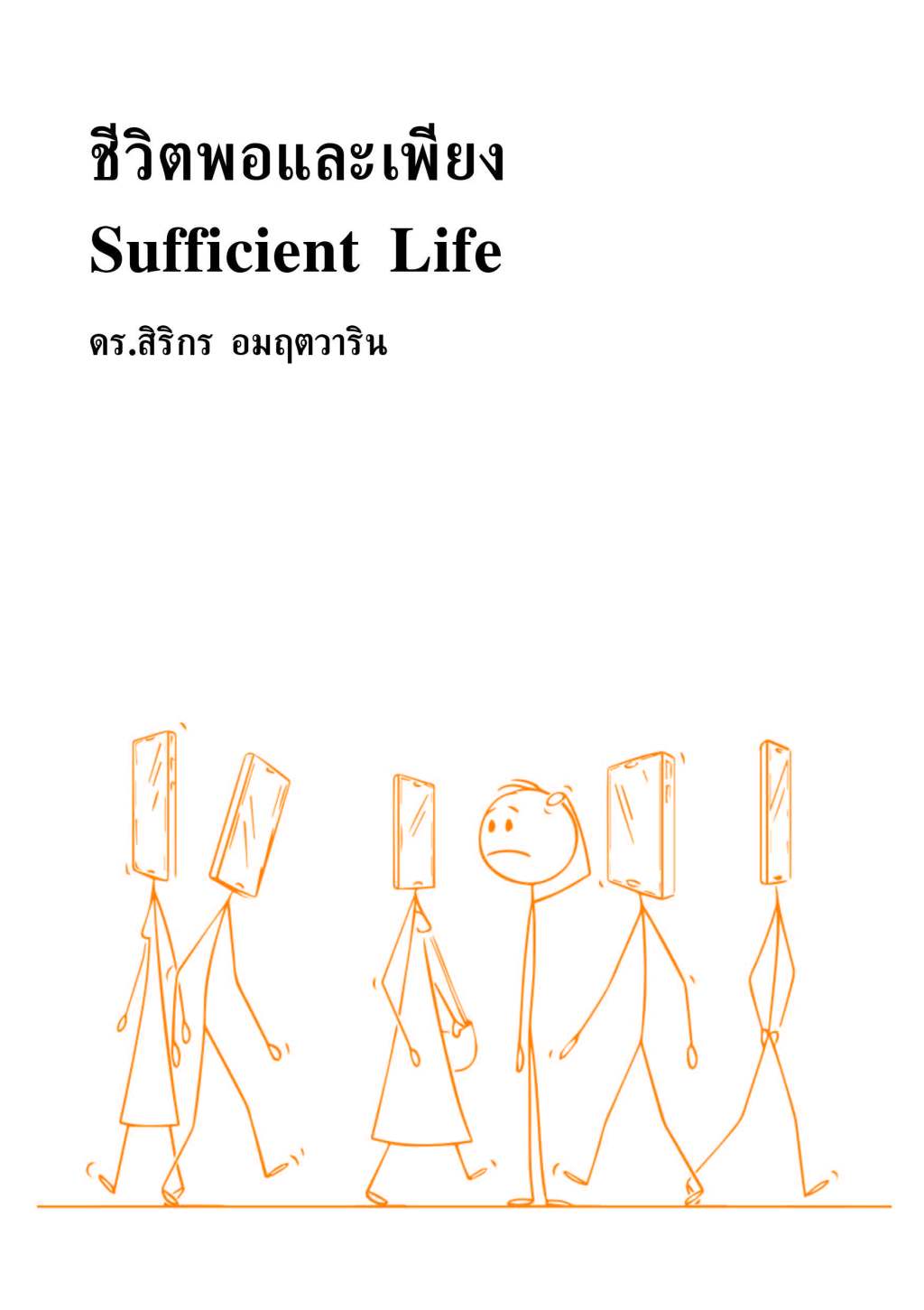
Nowadays, the greatest challenge to sufficiency is not poverty but comparison. A person may have enough until they see someone else who has more. A mobile phone that was perfectly satisfactory yesterday can suddenly feel inadequate after seeing a newer model. A comfortable life can suddenly appear unsuccessful when measured against carefully curated images on social media. Comparison quietly changes the meaning of enough. The question becomes: “Is this enough for my life?” and gradually changes into: “Is this enough compared with everyone else’s life?”
Once this happens, the boundary of enough becomes infinite. There will always be someone richer, younger, more beautiful, more successful, more influential, or more accomplished. Sufficiency therefore requires not only economic discipline but psychological independence from comparison. This does not mean ignoring others or refusing to learn from them. Instead, it means learning to distinguish inspiration from self-rejection. Another person’s success can become a source of learning rather than evidence of our inadequacy. Their Spot-light does not necessarily make ours darker.
Do What Matters
A sufficiency-oriented life is not necessarily a slow life. It can be extraordinarily active. A young person may study intensely, build a company, create art, develop technology, or work toward social change. What changes is not necessarily the amount of action, but the relationship with action.
Instead of asking: “How much can I accomplish?” we might ask: “What is worth accomplishing?”
Instead of: “How can I become more successful?” we might ask: “What kind of success allows me to remain human?”
And instead of: “How can I maximize my productivity?” we might ask: “What deserves my limited time, attention, energy, and life?”
This is where sufficiency becomes closely connected with well-being. The World Health Organization’s contemporary understanding of health literacy emphasizes not merely obtaining information but being able to access, understand, appraise, and use information in ways that promote health and well-being (World Health Organization [WHO], 2025). We can extend this insight philosophically: Perhaps life literacy also requires knowing when enough is enough.
The transformation of sufficiency to life is a movement from having toward being. Modern consumer culture often asks: What do you have? Sufficiency asks: Who are you becoming?
The first question measures accumulation, the second measures development. The first looks outward, whereas, the second turns inward, and then returns outward through relationships and contribution. This is why sufficiency can be understood as a philosophy of human development. The United Nations Development Programme’s recent work on Thailand’s Sufficiency Economy Philosophy explicitly connects it with human development, empowerment, resilience, inclusion, and the Sustainable Development Goals (UNDP, 2025). The United Nations’ Sustainable Development Goal 12 likewise calls for responsible consumption and production, linking resource efficiency with quality of life and the well-being of present and future generations (United Nations, 2026). Sufficiency, therefore, can become a bridge between personal well-being and planetary well-being.
Six Practices of PSE as Thai Life
Sufficiency can become meaningful when it moves from an abstract principle into daily practice. I recommended as follows:
1. Live with Nature: Nature reminds us that growth has their rhythms. A tree does not produce fruit every day. A field cannot be harvested continuously. Rest is not the opposite of growth; it is part of growth. To live with nature is to recognize the limits of the body, mind, resources, and environment. It is to recover the ability to pause.
2. Learn Continuously: Sufficiency does not mean saying, “I know enough.” On the contrary, wisdom requires continuous learning. The question is not how much information we can accumulate but whether learning enables us to understand ourselves, others, and the changing world more deeply.
3. Invest in Relationships: Possessions can increase convenience, but relationships often create meaning. Aristotle’s conception of self-sufficiency itself remains fundamentally social: a flourishing human life is not the life of an isolated individual but one situated among family, friends, and fellow citizens (Aristotle, trans. 1999). For Thai , therefore, having enough people to share life with may be more important than having enough things to display.
4. Eat and Live Well: Thai put significant on food, food is not merely fuel. Eating well can become a small daily practice of gratitude, moderation, health, culture, and connection. A sufficiency-oriented lifestyle asks not only: “What can I consume?” but: “What kind of life does my consumption support?”
5. Share and Care: Sufficiency becomes richer when it is shared to person you care. Knowledge can be shared without being depleted, kindness can be given without making the giver poorer, time can become meaningful through companionship, and resources can create greater social value when circulated wisely. This resonates with contemporary interpretations of sufficiency that emphasize resilience, empowerment, inclusion, and collective human development rather than individual self-reliance alone (UNDP, 2025).
6. Create Meaningful Value: The question of our life is: “What am I creating that is worth my life?” A person can create wealth, but one can also create knowledge, beauty, trust, friendship, health, opportunity, community, or hope. Sufficiency does not ask us to create less. It asks us to create what matters.
A Question for the New Generation
Young people today do not need another lecture or instruction to order them to be content. They need a more interesting question such as; What kind of success would allow you to remain yourself? Can you grow without constantly comparing yourself? Can you become ambitious without becoming anxious? Can you become wealthy without becoming greedy? Can you compete without losing compassion? Can you use technology without becoming controlled by it? Can you rest without feeling guilty? Can you enjoy ordinary life while still pursuing extraordinary dreams?
If the answer is yes, then sufficiency is no longer a philosophy of limitation. It becomes a philosophy of freedom. Achievement is meaningful, ambition can be beautiful, money is useful, technology is useful, and comfort is valuable. The problem begins when these things cease to be means for living and become the measure of whether life is worth living. A person may own many things but possess little freedom. Another may possess fewer things yet have time, friendship, health, curiosity, gratitude, and peace. Which person is richer?
There is no simple economic answer. But philosophically, the question reveals something important: wealth is not identical to well-being. Sufficiency does not reject prosperity. It asks prosperity to serve human flourishing.
Conclusion
Sufficiency is sometimes misunderstood as the principle of stopping, but enough is not the end of the journey of life. We should understood it as the knowing why we growth and continue. To live sufficiently is to know what deserves our attention, what deserves our effort, what deserves our money, what deserves our love, and what can simply be left behind.
It is to understand that not every desire deserves fulfillment, not every opportunity deserves pursuit, not every comparison deserves an emotional response, and not every achievement is worth the price of losing ourselves. In the spirit of Thai, sufficiency can therefore be expressed as a quiet but powerful proposition: Enough is not having less. Enough is knowing what matters. And the mature form of happiness is not the moment when we finally possess everything we want. It is the moment when we become wise enough to recognize: “I have enough to live, enough to grow, enough to love, enough to share, and enough freedom to continue becoming who I am meant to be.”
This is not the abandonment of ambition. It is ambition liberated from greed. It is not the rejection of prosperity. It is prosperity guided by wisdom. And it is not merely an economic principle. It is a way of being. “Enough + Wisdom → Balance → Meaning → Shared Well-being”. That may be one of the foundations of Thai and world to live fully without needing to consume the whole world in order to feel that one’s life is full.
References
Amalitwarin, S. (2022). Sufficient Life. Pispes Ltd.
Aristotle. (1999). Nicomachean ethics (W. D. Ross, Trans.). Batoche Books. (Original work published ca. 4th century BCE).
United Nations Development Programme. (2007). Thailand human development report 2007: Sufficiency economy and human development. UNDP.
United Nations Development Programme. (2025). Empowerment of people and communities to achieve the SDGs and human development 2024: The 6th Thailand Human Development Report—Sufficiency Economy Philosophy. UNDP.
United Nations. (2026). Goal 12: Responsible consumption and production. United Nations Sustainable Development.
World Health Organization. (2025). Health literacy. World Health Organization.


Leave a Reply